
Watering & care · Aug 29, 2026 · By Nell Harding
The Cheapest Soil Test You Own Is Blooming Right Now
A mophead hydrangea reads the chemistry of the ground it grows in and prints the answer in color. Blue means acid, pink means sweet, purple means in between. Here is how to read yours, and how to change its mind.
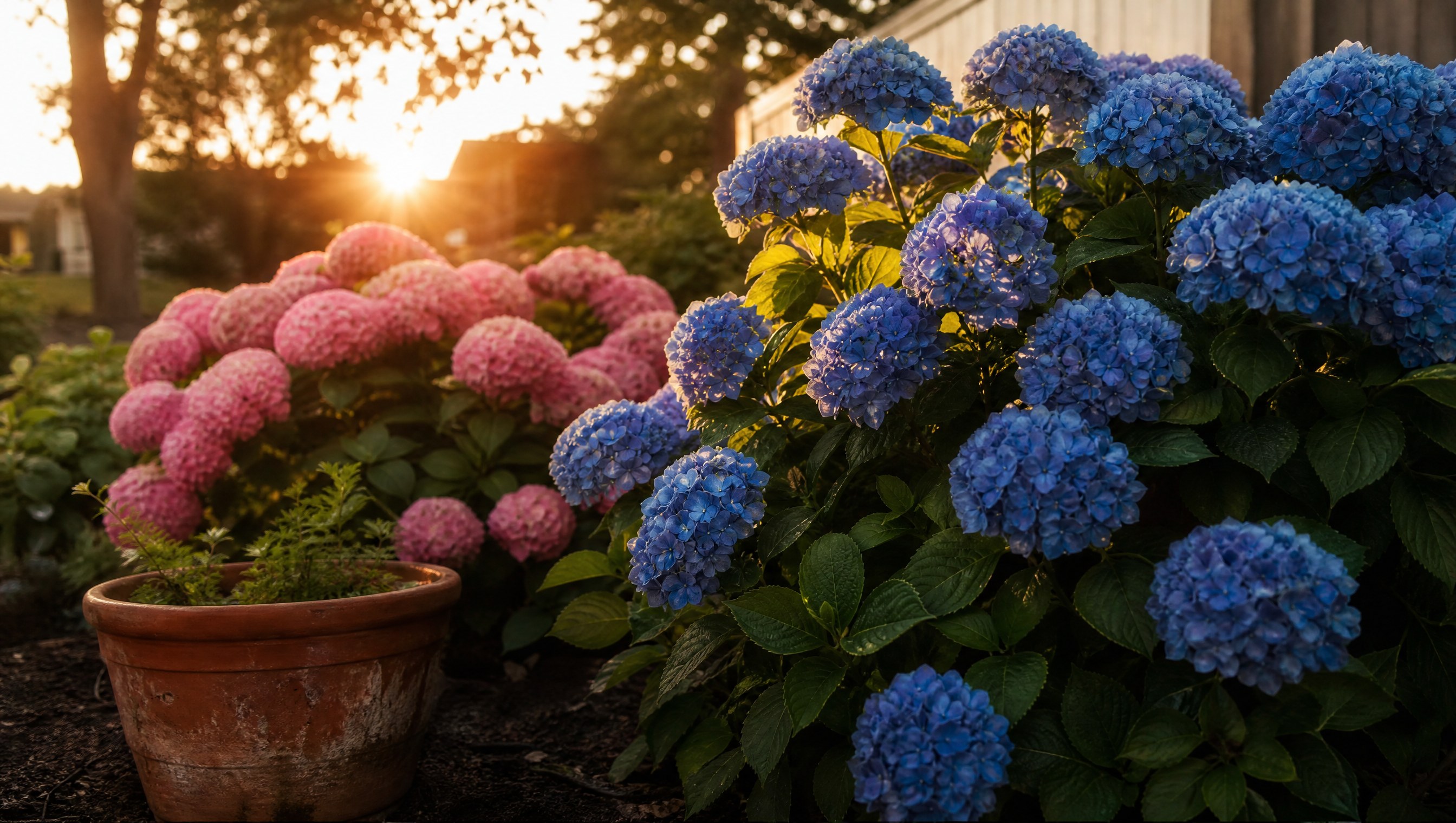

Somewhere on your street right now, two hydrangeas planted the same spring are blooming in two different colors, and neither owner knows why. The answer is not the nursery, not the fertilizer, and not luck. It is the dirt. A mophead hydrangea runs a continuous chemistry test on the ground it grows in and publishes the result all summer, in color, for free.
We have paid for plenty of soil test kits over the years, and we keep recommending them for anyone starting a vegetable bed. But the kits answer a question once. The shrub by the front walk answers it every day from June to September, and you can read the result from the driveway.
How the trick works
The color of a bigleaf hydrangea bloom is controlled by aluminum. There is aluminum in nearly every garden soil in North America, but the plant can only drink it when the soil is acidic. In acid ground, roughly below a pH of 5.5, aluminum dissolves into the soil water, the roots pull it up, and the pigment in the petals binds to it and turns blue.
In sweeter ground, up around 6.5 and higher, the aluminum locks up into compounds the roots cannot touch. No aluminum reaches the petals, and the same pigment that would have gone blue settles into pink. The plant did not change. The menu did.
Purple, or a shrub wearing blue on one side and pink on the other, means the soil is sitting in the middle, or that the pH varies across the root zone. A hydrangea straddling a concrete walk will often blush pink on the walk side, because lime leaches out of concrete and sweetens the soil beside it for years.
Reading yours
Walk out and look. Solid rich blue means your soil is genuinely acidic, which is worth knowing well beyond the flower bed. Blueberries, azaleas, and rhododendrons will thrive in that ground without any help. Clear pink means neutral to alkaline soil, the kind most vegetables prefer and most lawns tolerate happily.
One honest caveat before you plan a garden around a bloom. White hydrangeas, including the roadside panicle types and the native oakleafs and Annabelles, do not play this game at all. Their flowers carry none of the pigment and stay white in any soil on earth. Only the pink-blue mopheads and lacecaps, the bigleaf family, work as instruments.
Changing the answer
If you want blue and the shrub insists on pink, you are arguing with your dirt, and the dirt can be persuaded. Garden sulfur or aluminum sulfate worked into the soil around the drip line, applied in spring and again in fall, will walk the pH down. The old-timers buried rusty nails and coffee grounds by the roots. The nails never did a thing. The coffee grounds helped a little, for the same reason the sulfur helps a lot.
Going the other way is easier. A few handfuls of garden lime each season sweetens the soil, locks up the aluminum, and turns the blooms pink. Southern gardeners on naturally acid soil have been liming their way to pink hydrangeas for generations.
Either direction, be patient. The bloom answers this season for what the soil was last season. A color change is a project measured in months, not weeks, and a full transformation usually takes a year. A hydrangea in a container is the fast exception, since a pot holds so little soil that it can be steered in a single spring.
And if the shrub sits near a foundation, a sidewalk, or a downspout, expect drift. Concrete sheds lime, and in some towns the tap water runs alkaline enough to sweeten a pot all by itself. A blue hydrangea slowly going lavender under the hose bib is telling you about your water, not your fertilizer.
Why it is worth reading
Soil pH quietly decides more in a garden than almost anything we do on top of it. It sets which nutrients dissolve and which stay locked away, which is why a yellowing shrub in alkaline ground often needs no fertilizer at all, just acidity. If your hydrangea reads strongly one way or the other, you have learned which plants will fight you and which will feel at home, and you learned it without opening your wallet.
The kits are still worth it the day you dig a vegetable bed. But for the broad answer, the one that explains the moss in the lawn and the sulking blueberry bush, the test has been blooming by the front steps all along.
