
Planting & timing · Aug 29, 2026 · By Nell Harding
The Bedroom in Your Lawn: How to Read Deer Beds at Sunrise
For about an hour after sunrise, the dew turns your lawn into a guest register. Flattened ovals in the grass tell you who slept over, how many they were, and even which way the wind blew at midnight. Here is how to read them before they fade.
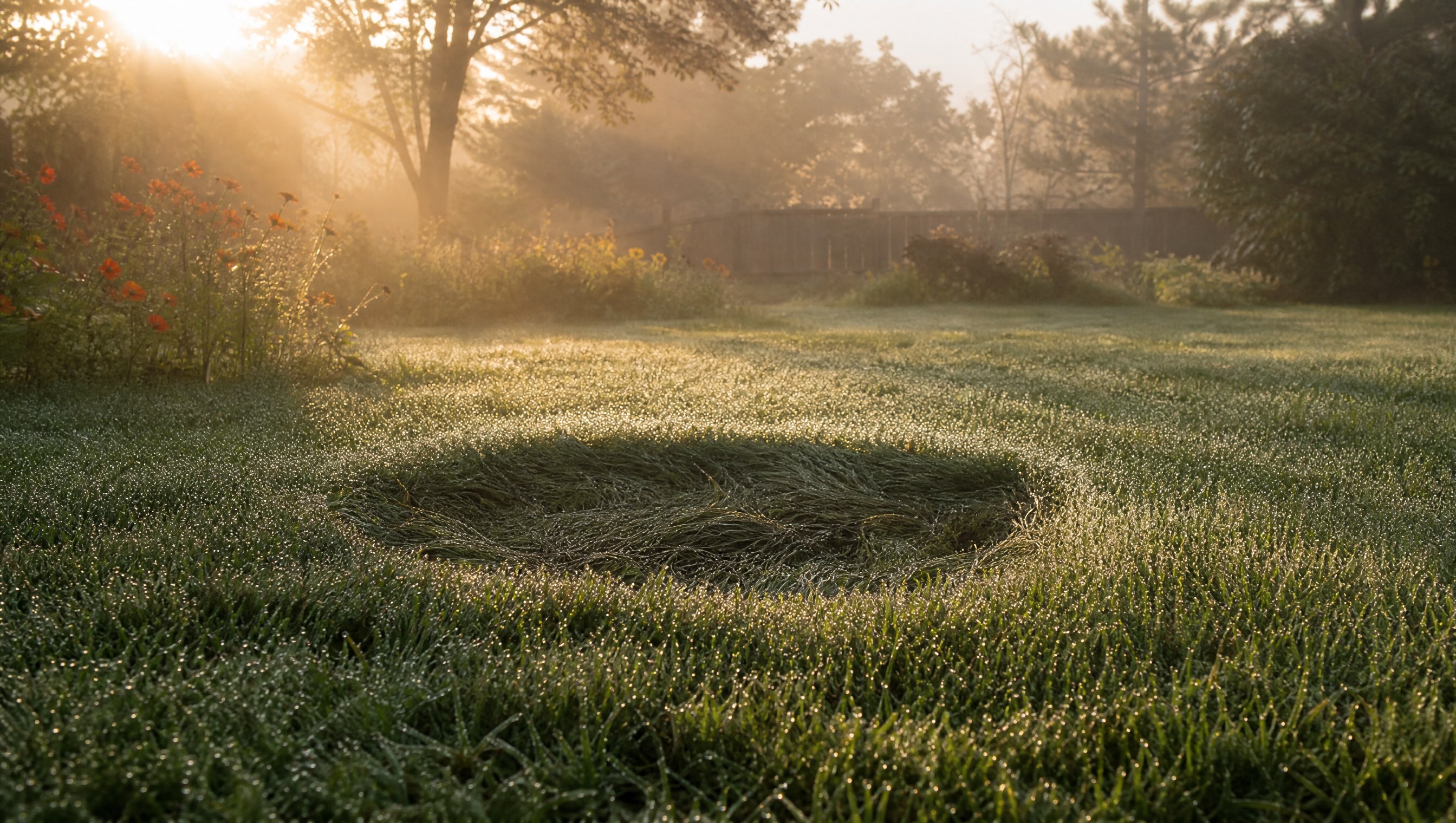

Most of what happens in a garden happens while nobody is watching. The proof is written in the grass for about an hour every morning, and then the grass stands up and erases it. If you walk out right after sunrise, before the dew burns off, you can read the whole night like a register at a country inn.
The easiest entry to read is the deer bed. A white-tailed deer does not sleep the way we do, flat out and oblivious for eight hours. It folds its legs beneath itself, settles its chest into the grass, and dozes in short stretches, chewing its cud, ears still working the dark. When it leaves, it leaves behind a flattened oval about the size of a bathtub, pressed down in one smooth swirl.
Dew is what makes the bed visible. Overnight the grass collects a coat of fine droplets, and wherever a warm body lay, that coat is missing and the blades are pressed flat. In low morning light the dry oval reads darker and smoother than the silvered grass around it, the way a hand print shows on a frosted window. By mid morning the sun has dried the whole lawn even and the page is blank again.
So the first rule is simply timing. This is a sunrise errand. Coffee in hand is fine, but the window closes fast, an hour on a still morning, less with any breeze. The same walk at nine will show you nothing and you will wonder if you imagined the whole thing.
What the ovals tell you
One large oval, roughly five feet by three, is a single adult. The grass inside is usually swirled in the direction the animal curled, and if the night was dry you may find a few coarse, hollow hairs pressed into it.
Two or three ovals close together are the good find. A doe beds down with her fawns of the year, and the family sleeps nearly touching. The small ovals give it away. A fawn bed can be scarcely bigger than a laundry basket. If you find that cluster at the garden edge, you now know exactly who has been sampling your hostas, and that it is a family operation.
The placement is a lesson in caution. Deer rarely bed in the open middle of a lawn. They like something solid at their backs, a fence line, a hedge, the skirt of a spruce, with a clear view downhill or downwind in front. A bed tells you where the animal felt safe, and that spot will be reused. Deer are habitual, and a good bedroom gets slept in for weeks.
There is even a compass in it. Deer tend to bed facing downwind. Their eyes cover what is in front, their nose covers what is behind. If several beds all open toward the same direction, that was roughly the downwind side at midnight. You are reading yesterday's weather off the lawn along with the guest list.
Not every flat patch is a deer
A word of honest calibration. Matted grass has other causes. A dog that suns itself leaves a circle, but usually in the open, in daylight spots, and without the dew shadow of a fresh overnight bed. Heavy rain lays grass over in streaks, all leaning one way, not swirled ovals. And a ring of dark, lush, flattened-looking grass that persists for days is likely a fairy ring fungus, not an animal at all. The overnight deer bed is the one that appears crisp at dawn and is gone by nine.
None of this requires a wildlife camera or a single dollar. It asks only that you get out there once, early, and look at your own grass sideways against the light. Gardeners spend a great deal of attention on what we plant and surprisingly little on who visits it. The lawn keeps the record for us. It just does not keep it for long.
If deer pressure is a real problem in your garden, the beds are intelligence as well as charm. Repellents and fencing work best on the actual routes, not where we guess the routes are. A week of morning reads will map the bedroom, the entry gap in the fence and the favorite exit, and that map is worth more than any amount of spray on the wrong hedge.
Tomorrow at sunrise, walk the edges first, along the fence, under the big trees, beside the hedge. Count the ovals, note which way they face, and put your hand flat in the middle of one. Some mornings, if you are very early, it is still warm.
