
Garden myths · Sep 19, 2026 · By Nell Harding
Why Yellowjackets Are Worse in September, and What to Do About a Ground Nest
The same colony that was easy to ignore in June is now short-tempered, sugar-hungry, and defending a nest with thousands of workers in it. Here is why the timing works out this way, and what actually helps versus what makes a September nest worse.
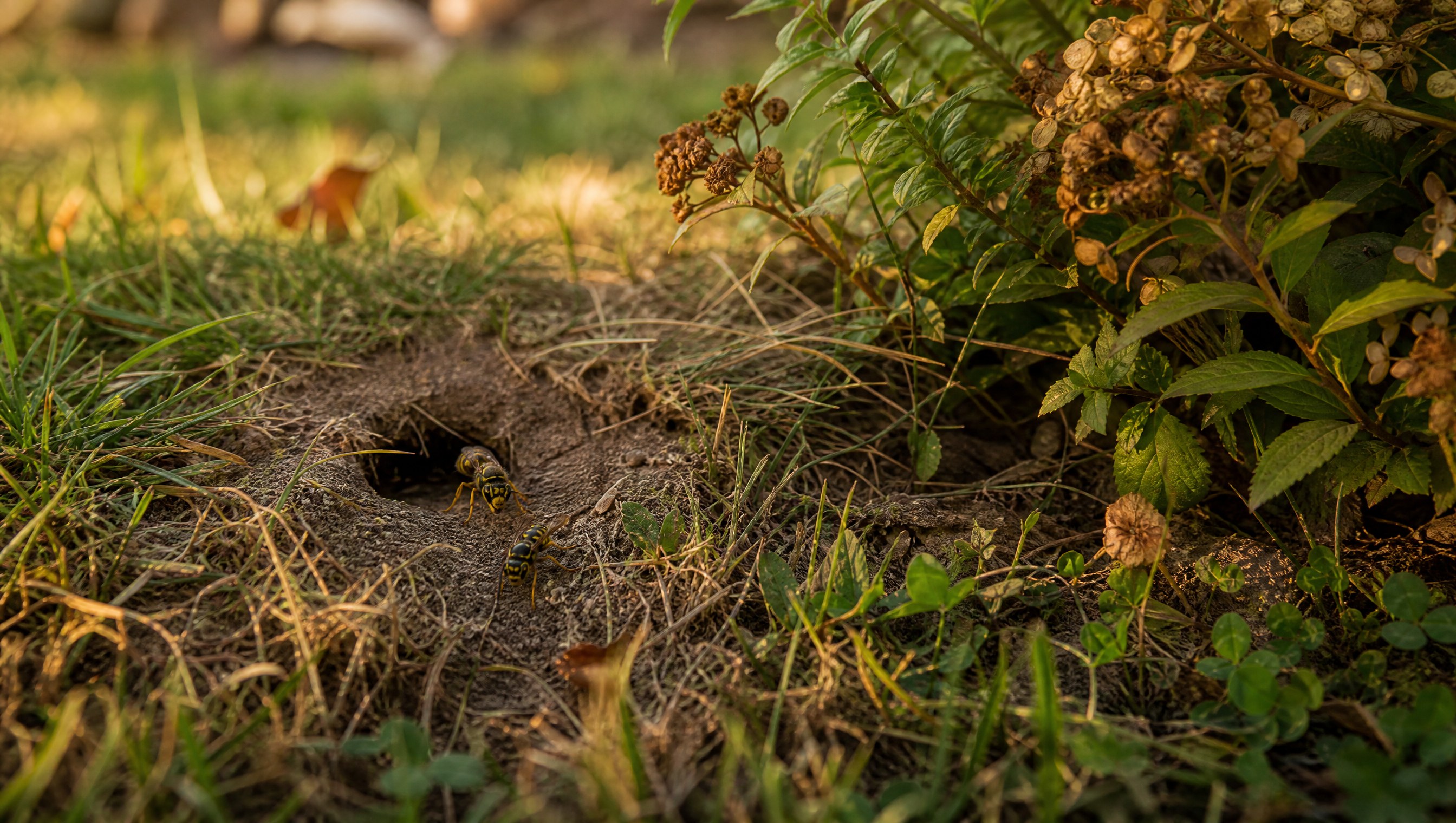

A single mated queen starts a yellowjacket colony alone each spring, building a small paper nest and raising the first handful of workers by herself before handing off all the foraging to them. By late summer that same colony can hold several thousand workers, and by September it has reached its yearly peak size right as it is starting to fall apart, which is the paradox behind why the picnic table gets so much worse this month even though nothing about the weather has changed yet.
For most of the season the workers are hunting protein: caterpillars, flies, other insects, chewed up and fed to the growing larvae back in the nest, which is genuinely useful pest control most of the summer. Ohio State University Extension's Ohioline factsheet puts a number on how large that workforce gets: colonies commonly reach four thousand to five thousand workers with ten to fifteen thousand cells by August and late September. In September the queen slows and then stops laying, the number of larvae in the nest drops, and there is suddenly a large workforce of foragers with far less larval feeding to do and far less protein reward to bring home for it. Ohioline is specific about the timing of the shift too, noting that in the late summer, roughly August through October, food preferences change from proteins to sweets, because sugar is now feeding the workers themselves rather than the brood.
That shift, combined with sheer colony size, is why September stings spike. The workers are also, at this point in the year, defending a large, established nest with a full season invested in it, and a colony under threat responds with more stings from more individuals than the same nest would have mustered in June.
The Whole Colony Dies at the First Hard Freeze
Unlike a honeybee hive, a yellowjacket colony is entirely annual. Ohio State University Extension's factsheet states it plainly: the workers, drones, and old queen die at the onset of cold temperatures, while only fertilized new queens seek protected places to overwinter, and abandoned nests typically decompose and disintegrate over winter. The founding queen, all the workers, and the whole nest structure die at the first hard freeze; nothing overwinters in it. The only survivors are newly mated queens produced late in the season, which leave the nest, mate, and find an individual sheltered spot such as under bark or leaf litter to overwinter alone, each one a potential new colony the following spring. The nest itself is never reused. A hole that had an active nest in it this September will not have the same colony back next year, though a different queen may start a new one nearby.
The Ground Nest Question
Many yellowjacket species nest underground in an old rodent burrow or a similar cavity, with just a modest hole marking the entrance in a lawn, garden bed edge, or under a shrub, hiding a nest that can be considerably larger below ground than the opening suggests. If a September ground nest is off the beaten path, away from a doorway, walkway, or a spot where mowing or kids regularly pass close by, the straightforward answer is to leave it alone. The colony is weeks from dying on its own at the first hard freeze, and disturbing a large, defensive nest for no functional reason is how most late-season stings happen.
If the nest is somewhere it genuinely has to go, in a doorway, along a regularly used path, or near where people sit, the guidance from extension sources is consistent: treat it near dusk, when most of the wasps have returned to the nest, and for anything beyond a small, easily reached opening, bring in a licensed pest control operator rather than improvising. NC State Extension's yellowjacket-in-turf guidance is explicit on two points: never use a light near the nest, because emerging wasps are attracted toward it, and do not pour gasoline or petroleum down a nest hole, calling it extremely hazardous and environmentally unsound. Flooding a nest with a hose is a similarly unreliable, sting-heavy idea that usually just displaces angry wasps rather than eliminating them.
The Wall Void Case Is Different
A yellowjacket nest inside a wall void, soffit, or other structural cavity is a separate problem from a ground nest, and it comes with its own trap: sealing the visible entry point from the outside without eliminating the colony first can drive thousands of disoriented wasps to look for another way out, which is sometimes into the living space through a gap around an outlet or light fixture. A wall-void nest is a licensed-operator job for that reason; the treatment and the sealing need to happen in the right order, not just the entry hole plugged shut. It is also worth checking whether the noise and traffic that first gave the nest away is coming from inside the wall itself before assuming it is a simple exterior job; a faint, steady hum audible from indoors near a suspect wall section is a fairly reliable sign the colony is on the house side of the siding, not merely nesting in the mulch below it.
What Helps at the Table, and What Backfires
Covering food and sweet drinks, using cups with lids for anything sugary outdoors, and clearing plates promptly genuinely reduces the odds of an encounter, because it removes the specific late-season attractant yellowjackets are keying in on. Commercial sugar-water traps set well away from the seating area, not on the table itself, can pull some foragers off, though they will not empty a large nest on their own. What reliably makes things worse is swatting at an individual wasp near food; a crushed or threatened yellowjacket releases an alarm pheromone that recruits nearby nestmates to the same spot, turning one annoyed wasp into several.
Stings and the Allergy Line
An ordinary sting calls for washing the site, ice to reduce swelling, and an oral antihistamine if itching is significant; unlike a honeybee, a yellowjacket does not leave its stinger behind and can sting repeatedly. The line to take seriously is any sign of a systemic reaction, hives spreading away from the sting site, swelling of the lips, tongue, or throat, difficulty breathing, dizziness, or nausea, which calls for emergency care immediately rather than home treatment, and anyone with a known sting allergy should carry their prescribed epinephrine through the rest of the season while colonies are at their largest and most active.
Sources
This article draws on The Ohio State University's Ohioline factsheet on yellowjacket biology and behavior, and NC State Extension's yellowjacket-in-turf guidance on ground-nest identification and safe treatment.
