
Planting & timing · Sep 19, 2026 · By Nell Harding
The Flower Is Already Inside the Bulb
A daffodil or tulip bulb bought this month is not a seed and not a promise. Cut one in half and you can see next spring's flower already built, folded up and waiting on the food it packed for itself last summer.
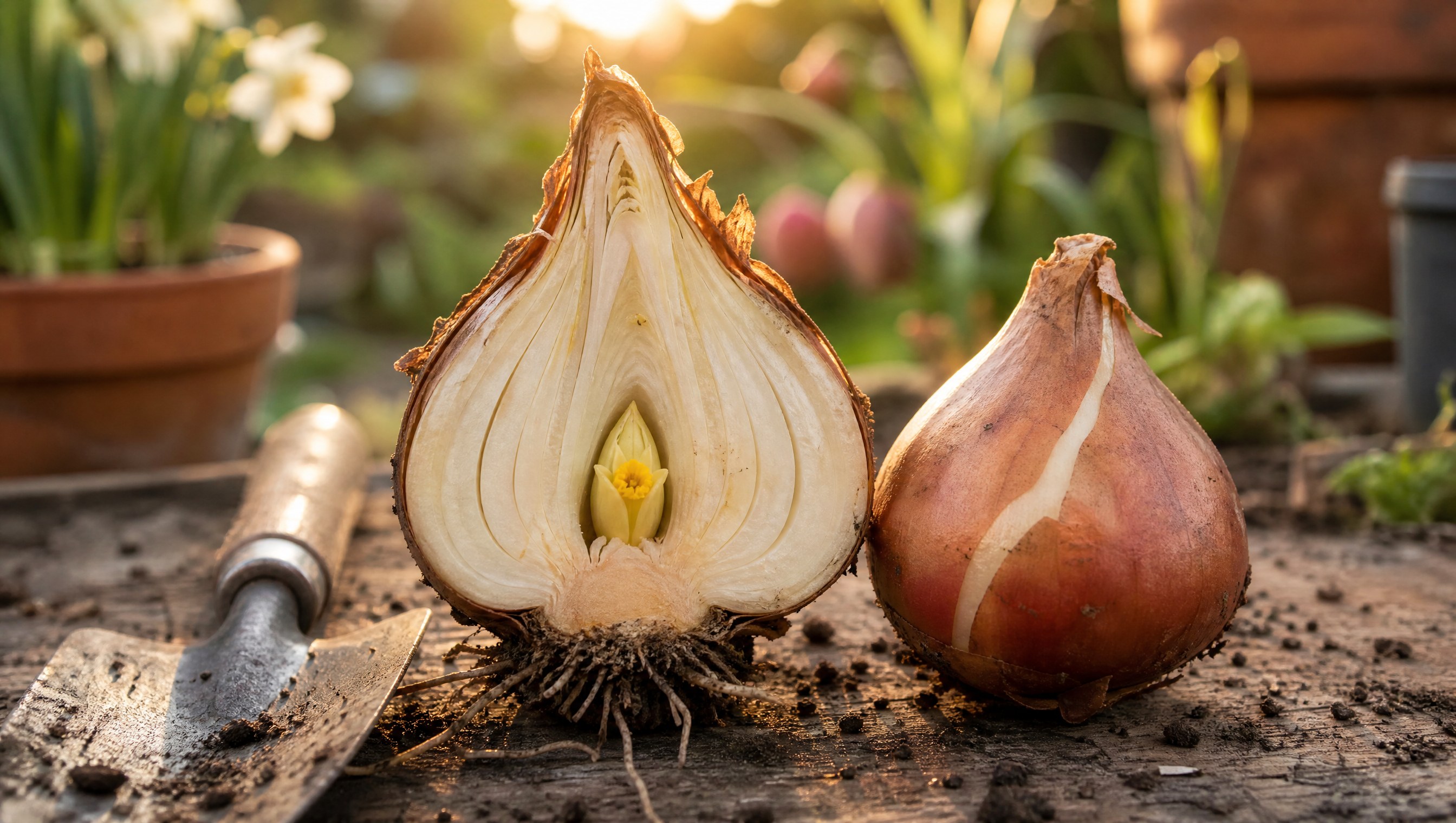

Every fall the same thing happens at the garden center: a bin of dry brown bulbs gets treated like a packet of seeds, something that has to be coaxed into becoming a flower. It already is one. Slice a daffodil or tulip bulb in half lengthwise right now, in September, and you will find next spring's bloom sitting inside it, fully formed in miniature, months before the ground even thinks about frost.
What a Slice Actually Shows
Take a bulb you are not planning to plant and run a sharp knife straight down through the center, root end to tip. The outside layer is dry and papery, almost like an onion skin, and under it are thicker, fleshier scales stacked one inside the next. Push through those scales and you reach the middle, and there it is: a pale, tightly closed shape with the outline of petals, a stem, and sometimes even the beginnings of leaves, all built at a scale you could hold between two fingers.
That is not a metaphor for potential. It is the actual flower, assembled last growing season while the leaves were still green and photosynthesizing, then folded down and sealed inside the bulb before the plant went dormant. The bulb you buy in September already decided what its flower will look like. Nothing you do between now and April adds the bloom. Your job is only to keep it alive and give it the cold it needs to finish the job.
The Layers, Named
Cornell Cooperative Extension's bulb guidance breaks a true bulb, the daffodil and tulip type, into a short list of parts, and each one earns its keep. The outer scales are stored food, mostly starch, packed away the previous spring to fuel next year's growth without any help from roots or leaves. The basal plate is the flattened disk at the bottom, a compressed stem that roots grow from and that holds the whole structure together. Above the basal plate, at the core, sits the embryonic shoot: the already formed flower bud and the leaf tissue that will unfurl around it.
University of Minnesota Extension's flower bulb material adds the timing detail that matters most for what you do with a September bulb: roots begin growing from the basal plate within a few weeks of planting in warm soil, well before any top growth shows above ground. That root system is what the bulb spends autumn building. The flower is not being built in fall. It is being anchored.
Bulb, Corm, or Tuber
Not everything sold as a bulb is built this way, and the distinction is worth thirty seconds. A true bulb, daffodil, tulip, hyacinth, lily, is layered scales around a central bud, the structure just described. A corm, like a crocus or gladiolus, is solid tissue all the way through, more like a swollen stem base than a stack of scales, and it is used up and replaced by a new corm each season rather than persisting. A tuber, like a dahlia, has no scales and no basal plate at all; it grows eyes similar to a potato, and the new shoot comes from those eyes rather than from a preformed center. Slicing any of the three open shows you exactly which one you are holding.
This matters at planting time because only the true bulbs, the ones with the embryonic flower already sealed inside, guarantee the shape of next year's bloom the way a daffodil does. Corms and tubers still build viable flowers, but the mechanism is different enough that treating all three the same at planting depth or spacing shortchanges at least one of them.
Why a Bad Bulb Gives You a Blind Bud
This is also the explanation for the most common bulb disappointment: a healthy-looking plant that comes up, leafs out, and never flowers, called a blind or blasted bud. If the flower is already built inside the bulb before you ever plant it, then a bulb that never blooms was almost always already damaged or incomplete at the point of sale, not failed by anything that happened in your garden.
A bulb that sat too long in a warm store, or one that was lifted and dried out too aggressively after the previous season, can have its embryonic bud desiccate or abort before it ever reaches your hands. Squeezing a bulb gently to check for firmness, and choosing the heaviest bulb of a given size rather than the lightest, is a decent proxy for whether that internal structure survived storage intact. A light, papery bulb has often lost moisture from exactly the tissue that matters most.
It is also why forcing bulbs indoors for winter bloom works reliably on a schedule: the flower does not need to be grown from nothing, only kept cold long enough to break dormancy and then warmed to let a structure that already exists finish expanding. Nurseries selling pre-chilled bulbs for indoor forcing are selling you time, not flowers, because the flowers were already there.
So when you are standing at the bin this month deciding between daffodils, none of the growing is still ahead of the plant in the way it feels like it is. The bulb has already done the hard, slow work of building a flower and storing the food to unfold it. What is ahead of you is soil, depth, and cold, in that order, and then standing back in April to watch something that was finished last summer simply open.
Plant true bulbs at roughly three times their own height, point up, in well-drained soil, and water them in once. After that the bulb is largely running on the plan it already made. The waiting is not the plant catching up to spring. It is spring, already assembled, waiting on the calendar.
