
Planting & timing · Sep 28, 2026 · By Nell Harding
Witch Hazel Blooms When the Rest of the Garden Is Done
Common witch hazel waits until the leaves are falling to open its spidery yellow flowers, usually peaking in early November. Here is when to look for it, who pollinates it that late, how its seed pods fire, and where the odd name comes from.
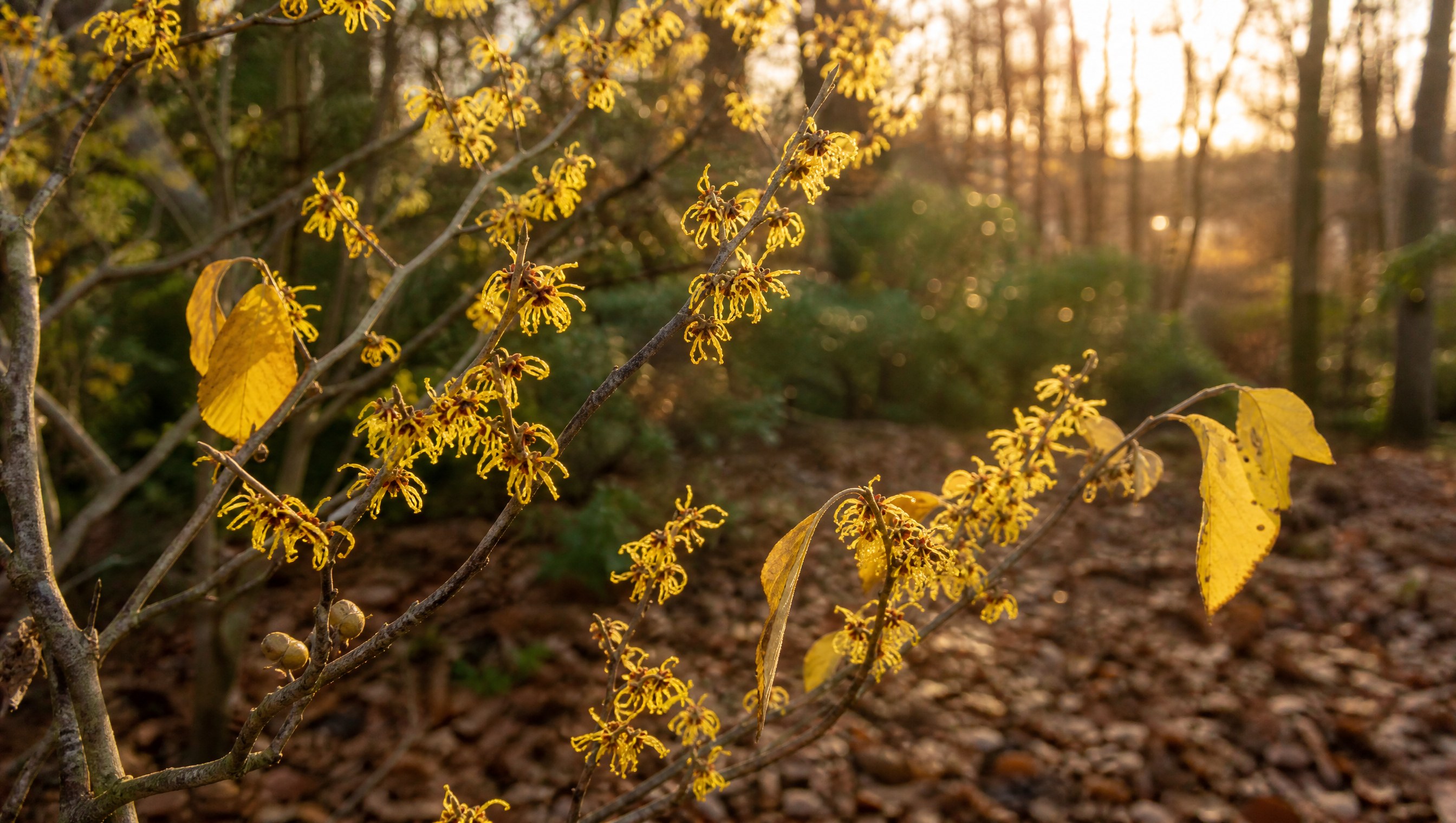

By November most gardens have said everything they have to say. The perennials have flopped, the last asters are going to seed, and the trees are dropping the final handful of leaves. Then, at the edge of the woods or in a corner of the yard, one shrub lights up in bright yellow. Common witch hazel does almost everything backwards, and that is the reason it is worth knowing.
THE SHRUB THAT BLOOMS LAST
The U.S. Forest Service puts it plainly. As the leaves of the trees are all but fallen, the witch hazel comes into bloom in late October to early November in the eastern United States. In its Plant of the Week profile, it notes that the bright yellow flowers are often the only sign of color in woods where all the autumn leaves already lie on the forest floor.
The Morton Arboretum near Chicago calls its yellow, strap-like flowers among the last blooms to appear in fall, and adds a detail worth knowing before you go looking. At first the flowers are often hidden by the leaves, which can still be hanging on the branches when the blooms open.
WHEN TO LOOK
Illinois Extension's horticulture educator writes that the native witch hazel typically blooms in early November each year, but that it is somewhat unpredictable and weather-dependent. The same writer has seen flowers as early as October in some years and as late as December in others, and says that depending on the weather, the flowers can last between two and four weeks.
So the window is long. If a witch hazel grows near you, start checking it in mid October and keep checking through Thanksgiving. The first sign is usually a fringe of yellow along the twigs, easy to mistake at a distance for a few leaves that have turned.
WHAT THE FLOWERS LOOK LIKE
Up close, a witch hazel flower looks like a small burst of yellow ribbon. The Forest Service describes four very slender petals, half an inch to three quarters of an inch long, creamy to bright yellow. Illinois Extension compares the flowers to mini fireworks exploding along the branches, with feathery thin petals reaching outward in all directions. They cluster tight against the twigs rather than hanging on stalks.
Stand close on a mild afternoon and you will notice the scent. The Forest Service says the yellow flowers give off a pleasant spicy fragrance, which is one more surprise in a month when almost nothing in the garden smells of anything but wet leaves.
WHO POLLINATES A NOVEMBER FLOWER
A flower that opens in November needs insects that are still flying in November. Illinois Extension says flies and wasps are the main pollinators that visit common witch hazel, and it describes the late bloom as an important late-season source of pollen and nectar for the pollinating insects still active in late fall.
The shrub feeds other insects through the summer as well. The same article notes that more than 20 kinds of native moth caterpillars have been recorded feeding on witch hazel leaves during the growing season, which makes it a quiet contributor to the food chain long before it blooms.
SEED PODS THAT FIRE
Look along the twigs of a blooming witch hazel and you will usually find small, hard, tan to gray capsules sitting beside the new flowers. They are not from this year. The Forest Service explains that the capsules from last autumn's flowers stay dormant through the winter, develop over the following growing season, and then in autumn forcibly expel two shiny black seeds, usually 10 to 20 feet and rarely as far as 40.
The Morton Arboretum confirms the same timing, saying the fruit capsules mature a year after flowering and split open to expel seeds that birds eat. So on a single branch in November you can find this year's flowers and last year's pods going off at the same time. Even after they land, the Forest Service notes, the seeds take another year to germinate.
WHERE THE NAME COMES FROM
The name has nothing to do with witches. Illinois Extension writes that in most accounts, the witch in witch hazel comes from water witching, also called dowsing, the old practice of searching for underground water sources. The same writer quotes the U.S. Geological Survey's dry explanation for why dowsing seems to work: in many areas, underground water is so close to the surface that it would be hard to drill a well and not find it.
NOT EVERY WITCH HAZEL WAITS FOR FALL
If you have seen a witch hazel blooming in February, you were not imagining it. Illinois Extension points out that the genus has other members that flower at very different times. The Ozark witch hazel, native to Missouri and south toward Texas, blooms in late winter or very early spring, and there are Asian species and hybrids that flower in very late winter too. Those are the ones usually sold for their winter show. The common witch hazel of the eastern woods is the one that closes out the year instead of opening it.
GROWING ONE
Common witch hazel is a native shrub of the eastern United States, commonly found in wooded areas, according to The Morton Arboretum. It takes full sun to part shade, and Illinois Extension notes that more sunlight will produce more flowers. The Morton Arboretum adds that in part shade it grows into a more open shape than in full sun.
Patience is part of the deal. The Forest Service notes that a witch hazel grown from seed does not start flowering until it is at least six years old, so a nursery-grown shrub is the faster route. Plant it where you will walk past it in November, because that is when it earns its place.
