
Garden myths · Sep 27, 2026 · By Nell Harding
Some of Your Blue Jays Will Fly South This Fall. Nobody Knows Why
Most blue jays stay put all winter, but every fall some of them join daytime flocks heading south, and not the same birds every year. Here is what is known about the jay's odd migration, why it is less of a feeder bully than it looks, and how to watch your own pair.
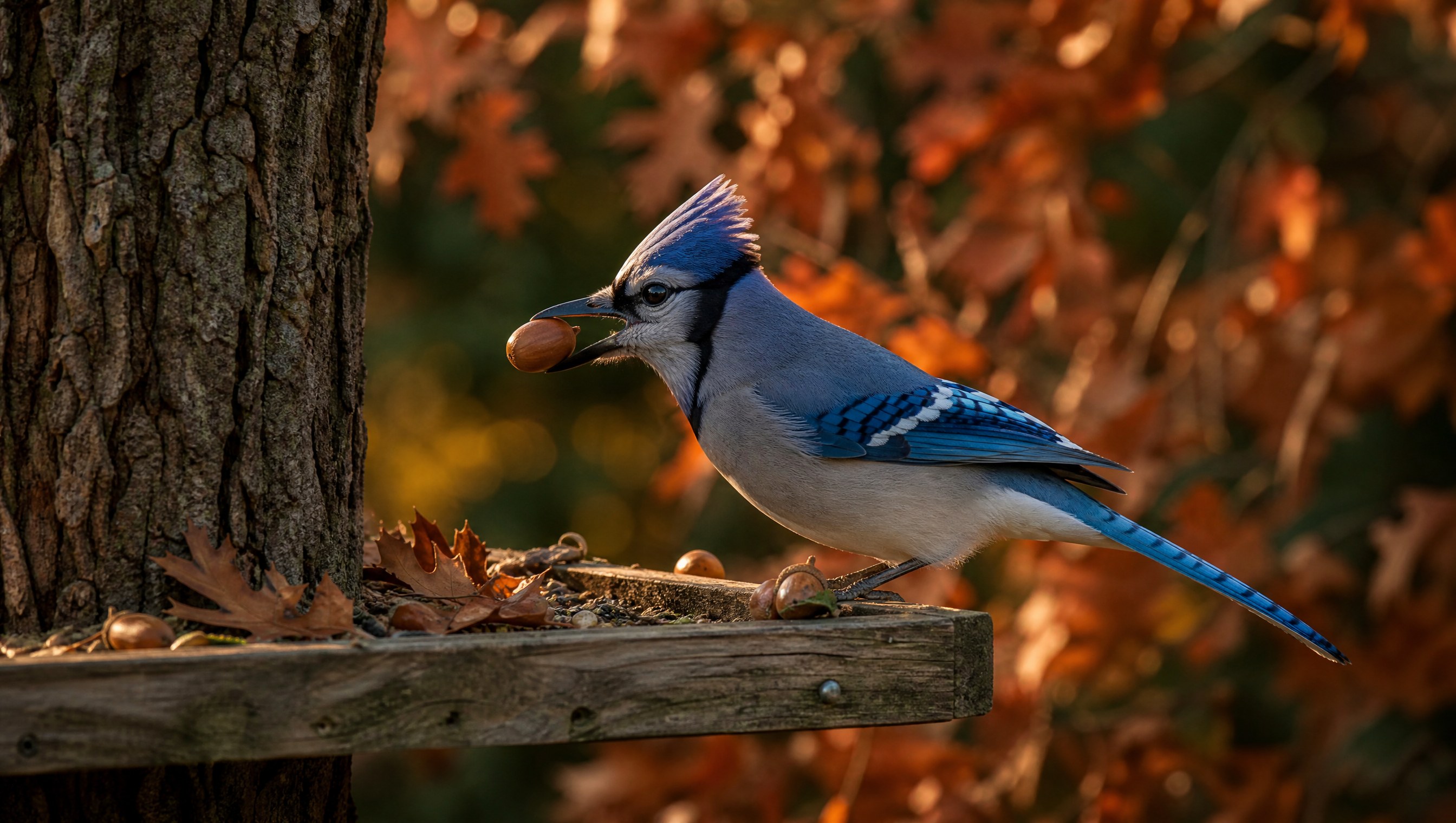

Some morning this fall, the loudest bird in the yard may go quiet. The blue jay that has been screaming from the top of the maple and landing on the feeder like it owns the place will simply be gone, or there will be three of them where there was one. Nobody can tell you in advance which will happen, because nobody knows. The blue jay is one of the most familiar birds in eastern North America, and its fall migration is still one of the open questions of ordinary backyard birding.
A BIRD THAT MOSTLY STAYS
Start with what is certain. Audubon's field guide describes the blue jay as present all year in most of its range. The Nature Conservancy's Cool Green Science blog puts it just as plainly: most blue jays don't migrate. If you watched jays at your feeder last January, the odds are good you will watch them again this January.
That is also why the fall movement surprises people. We think of migration as something a whole species does, the way the wrens and the flycatchers vanish for the winter and come back in spring. Blue jays do something stranger. Some of them go and most of them stay, in the same neighborhoods, sometimes from the same trees.
THE FLOCKS THAT DO GO
The ones that go are hard to miss once you know to look. Audubon's field guide says variable numbers migrate south in fall, with big southward flights in some years and thousands on the move. It also notes that they migrate by day, which means you can actually watch them pass. The Nature Conservancy says bird observatories report large flocks of blue jays heading south every fall, particularly along the Great Lakes and the Atlantic Coast.
On a good day at one of those places, loose strings of jays come over the treetops one group after another. Away from the lakes and the coast the movement is thinner, but a backyard watcher can still notice it: a few more jays than usual at the feeder for a day or two, then fewer, as birds from farther north pass through and some of the local birds slip away.
THE PART NOBODY HAS WORKED OUT
Here is where it gets interesting. The Nature Conservancy says, in so many words, that why blue jays migrate remains a mystery. It cites an estimate from the Cornell Lab of Ornithology that fewer than 20 percent of blue jays migrate in a given year. Even among the migrants, it notes, not all of them make the journey every year. A jay can go south one fall and stay home the next.
Researchers have not even settled which birds go. The Conservancy points out that some researchers believed the migrants were young birds dispersing, while others claimed they were the older birds. For a bird that lives on nearly every suburban street in the East, that is a remarkable gap in what we know, and a good reminder that the most ordinary animal in the yard can still be carrying a question science has not answered.
THE BULLY AT THE FEEDER
Blue jays have a reputation, and most people who feed birds could describe it without thinking: loud, pushy, the bird that clears everyone else off the feeder. The Nature Conservancy takes that reputation apart. If you have a feeder, it writes, you have probably seen all the birds clear out and a couple of jays swoop in, but it calls this an effective but apparently short-lived tactic, since most birds return to the feeder quickly.
The Conservancy also passes along a Florida study, cited by the Cornell Lab, which found that blue jays were not the rulers of the feeders at all. Red-bellied woodpeckers, red-headed woodpeckers, Florida scrub-jays, common grackles and gray squirrels strongly dominated them, often keeping them from getting food. Much of the pecking order at a feeder, it notes, comes down to size.
THE ACORN PLANTER
What jays do away from the feeder matters more to the yard than anything they do on it. Audubon's field guide says they harvest acorns and store them in holes in the ground, and that most of their diet is plant food, up to 75 percent over the year and more in winter, including acorns, beechnuts, seeds, grain and berries. The Nature Conservancy adds the part that makes this important: jays stash lots of acorns and never return for many of them, which makes them significant shapers of the eastern forest. It argues they should be celebrated as a vital part of the woodland rather than called destructive.
THE HAWK THAT ISN'T
One more habit to listen for this fall. Besides the loud jay, jay call everyone knows, Audubon says blue jays make a variety of musical sounds and can do a remarkable imitation of the scream of a Red-shouldered Hawk, and that one of their calls is almost identical to it. If you hear a hawk screaming from the feeder tree and see no hawk, look for a flash of blue.
WATCHING YOUR OWN PAIR
If you want to follow the mystery in your own yard, the jays make it easy. The Nature Conservancy notes that blue jays often mate for life and stay with their mate throughout the year, so a pair that has been coming to your feeder all summer is a good pair to keep an eye on. Audubon says they come to feeders for seeds or suet and are quick to take advantage of one when it is offered.
Count them now, in late September. Count them again in mid-October and in January. You will not solve why blue jays migrate, but you will know something no field guide can tell you: whether your jays are among the few that go this year, or the many that stay.
