
Garden myths · Sep 27, 2026 · By Nell Harding
The Tiny Ringed Snake Under Your Flowerpots Is No Threat
The ring-necked snake is one of the smallest and shyest snakes in the garden. Here is how to recognize it, where it hides, what it eats, why it will be gone underground within weeks, and what that corkscrew tail is for.
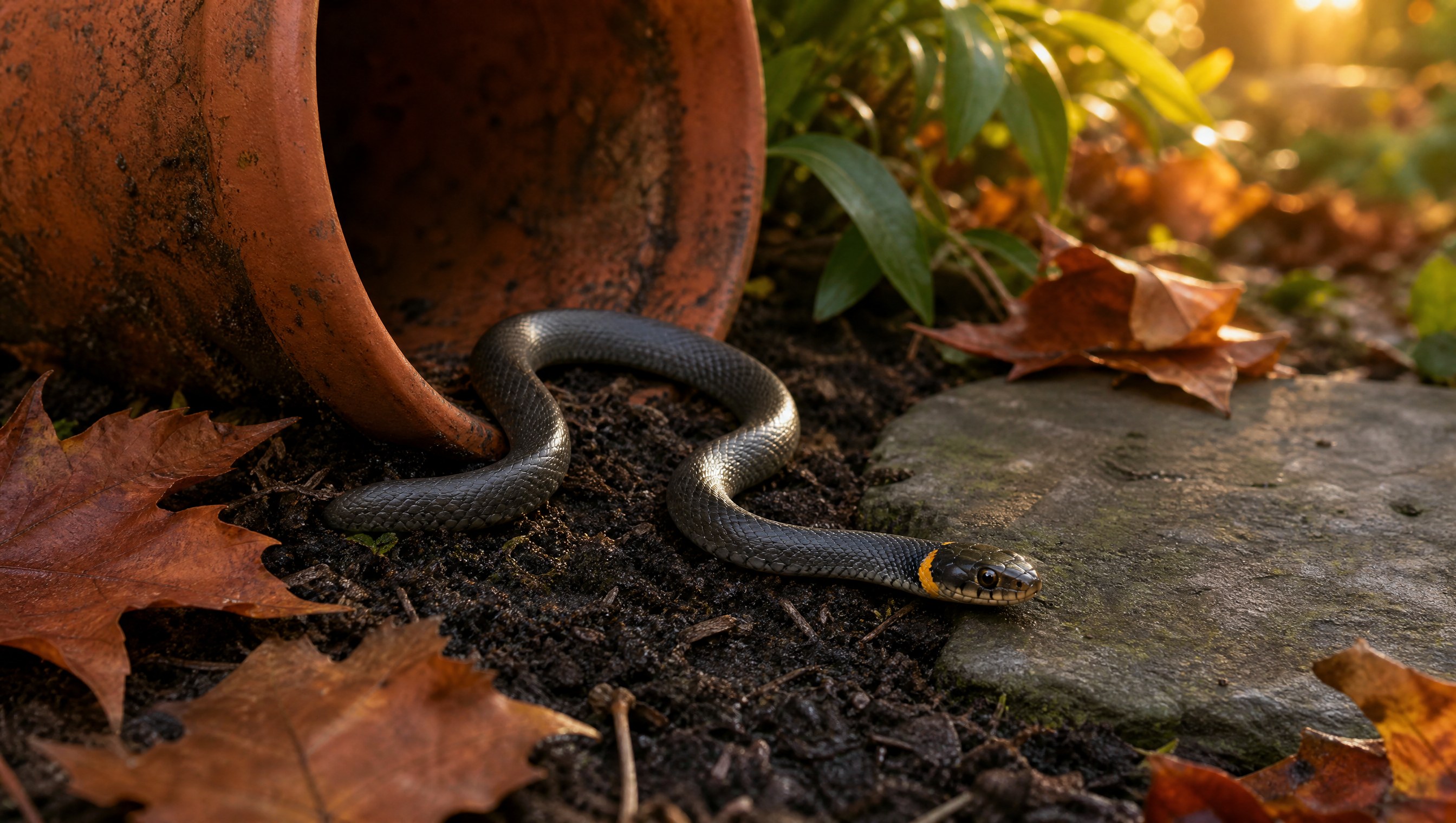

Tip up a clay pot at the end of the season, or lift a flat stone at the edge of the bed, and every so often something small and dark slides away from the light. It is about the length of a ruler, slate gray on top, and right behind its head there is a bright ring like a collar. Most people jump. There is no need to. This is the ring-necked snake, one of the least dangerous snakes you are likely to meet.
HOW TO KNOW IT
The Illinois Department of Natural Resources says the ring-necked snake averages 10 to 15 inches long and has a light ring around its neck. The Virginia Herpetological Society records the largest ones in Virginia at a little under 20 inches, but most you find under a pot will be smaller than that. The back is a plain dark gray, and the ring and the belly are usually yellow to orange, dotted with small dark spots.
Its other names tell you how long people have been finding it in gardens and woodpiles. The Virginia society lists fodder snake, ring snake, baby king snake, red-belly snake and yellow-belly ring snake among the common names it has gone by.
WHERE IT HIDES
You almost never see one out in the open. The Virginia Herpetological Society says they are seldom encountered in the open and that most are found under all types of objects, including logs, rocks, boards and debris. Illinois describes the species as secretive, most often found under rocks, bark or logs. The Virginia society adds that it usually turns up where there is some moisture, in junk piles and under logs in low damp ground, though in the mountains it also shelters under rocks in drier spots.
That is why gardens suit it. A garden edge is full of the things it likes: overturned pots, flat stepping stones, boards left lying on the soil, a pile of old bricks behind the shed, and the damp earth under all of them.
WHY THE STONE
There is a reason the snake is so often under a stone rather than just in the leaves. The Virginia Herpetological Society reports body temperatures for 21 ring-necked snakes found in April and July under exposed rocks in the mountains. The snakes ran from about 65 to 88 degrees Fahrenheit, averaging about 75, while the air around them was only about 63. A flat stone in the sun soaks up heat and holds it, and a cold-blooded animal lying underneath gets the warmth without the risk of lying out in the open.
Not every one uses a stone, though. The society notes a Kansas researcher's observation that ring-necked snakes do not always shelter where people can find them, and that many hide under mats of vegetation instead. The ones under your flowerpots are only the ones you happen to see.
WHAT IT EATS
Illinois lists small salamanders and snakes, insects, earthworms, slugs and frogs in its diet. The Virginia Herpetological Society's records for that state are mostly earthworms, small salamanders and little brown skinks. It is a hunter of the soft, small things that live under cover, which is exactly the world a flowerpot creates.
It is also food for a long list of other animals. The Virginia society cites a long-term study in Kansas that found great horned owls, hawks, several larger snakes and bullfrogs taking ring-necked snakes as prey. A small snake that lives under a stone has good reason to stay there.
NO THREAT TO YOU
The reason it is no threat comes straight from the people who study them. The Virginia Herpetological Society says ring-necked snakes do not bite when caught. What they do instead is release a foul-smelling musk and feces from glands near the tail. If you pick one up to move it, expect a smell that lingers on your hands, and wash them afterward.
Its other defense is theater. Illinois says its tail curls into a corkscrew when it is threatened. The Virginia society explains that this exaggerated tail coiling draws a predator's attention away from the head, and that it is seen in the forms whose tail is brightly colored underneath. In Virginia the society has not seen the full display, though the tail is often partly coiled when one is picked up.
GONE UNDERGROUND SOON
Enjoy the ones you find this month, because they are about to disappear. The Virginia Herpetological Society records the species as active from April 10 through October 20 in Virginia, though it can turn up at other times depending on the weather. Illinois says the ring-necked snake spends the winter in rock crevices or in the soil.
In spring it comes back to the same kind of cover it left. Illinois notes that mating can happen in either spring or fall, and that the female lays three or four eggs in June among rocks or rotting logs. The Virginia society's records put clutches at two to seven eggs, laid in moist spots under rocks and in or under logs between mid June and late July.
A GARDEN WORTH HIDING IN
If you would rather keep them around than move them along, you do not need to do much. Leave a few flat stones or boards lying on damp soil at the back of a bed, keep a corner where the leaves and old pots can sit through the winter, and go easy when you lift things in spring. The snake does the rest, working quietly through the slugs and small creatures under your feet.
And if one surprises you the next time you tip up a pot, set the pot back gently and let it be. It has somewhere to be before the end of October.
