
Planting & timing · Sep 26, 2026 · By Nell Harding
The Striped Sparrow Under Your Shrubs This Fall Is Here for the Winter
The white-throated sparrow travels south late and slowly, mostly at night, and then settles into backyards for the cold months. Here is how to recognize it, why its head stripes come in two colors, and how to set up a yard it will actually use.
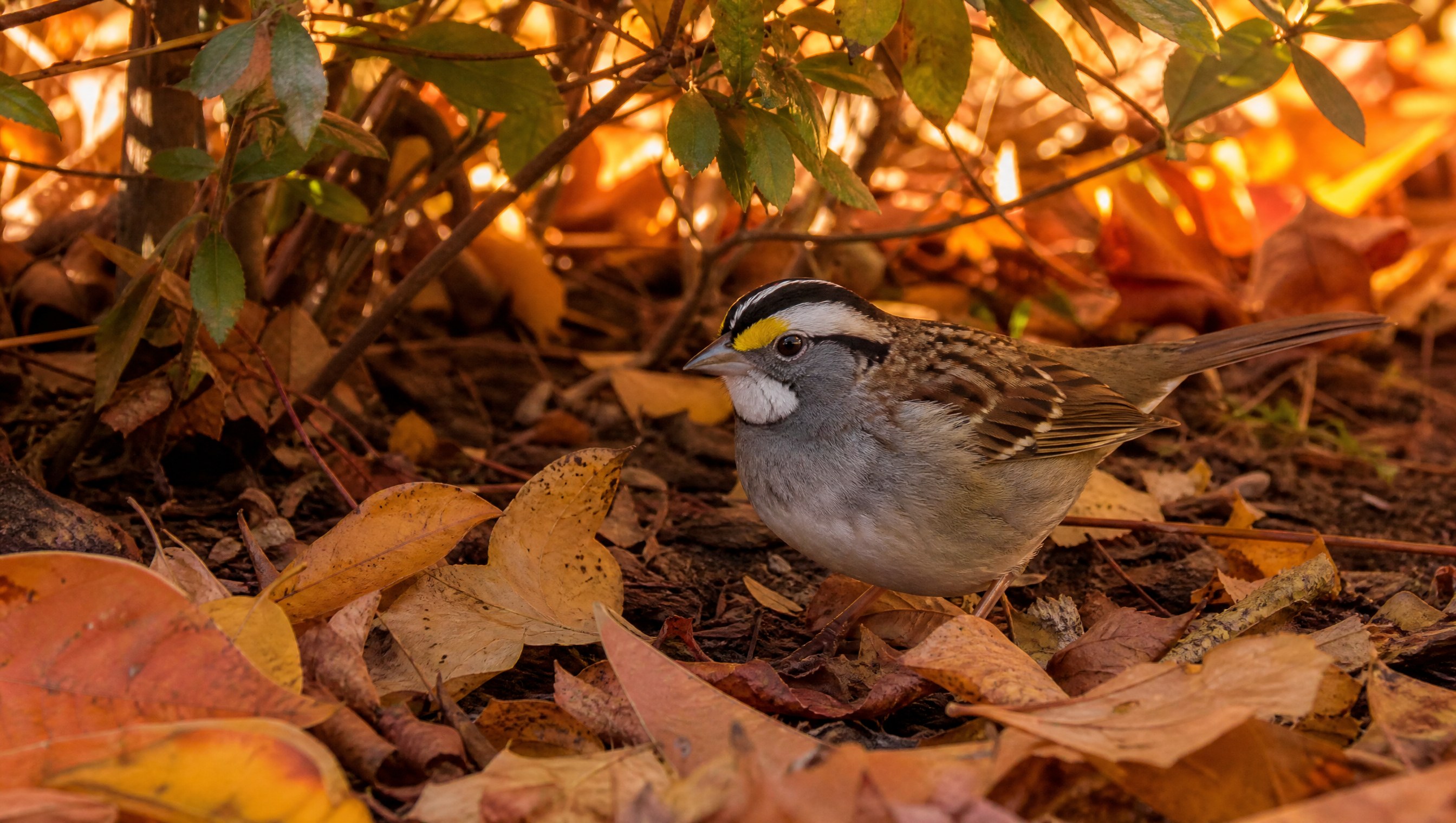

Some morning in the next few weeks, the leaves under the forsythia will start moving on their own. Look closer and there is a sparrow in there, kicking at the leaf litter with both feet at once, then stopping to peer at whatever it turned up. It is a little neater than the sparrows of summer: a gray breast, a clean white throat, a bright yellow spot above the eye and stripes across the top of its head. It is a white-throated sparrow, and if your yard suits it, it has not come to visit. It has come to stay the winter.
WHO IS UNDER THE SHRUBS
The white-throated sparrow is a medium-sized sparrow with a brown back streaked in black and a plain gray breast. The field marks that give it away are on the head. The Smithsonian's National Zoo and Conservation Biology Institute describes the square white throat and the yellow lores, the small area between the eye and the beak, as features every white-throated sparrow shares. Above them run bold stripes, and those stripes come in two versions, which we will get to below.
The behavior is as distinctive as the plumage. Audubon's field guide says the bird forages mostly on the ground under or close to dense thickets and often scratches briefly in the leaf litter with both feet. That little double kick, a hop forward and a scrape back, is the easiest way to pick one out from across the yard, long before you can see the yellow spot.
A LATE, SLOW TRAVELER
White-throated sparrows spend the summer in the north woods. The National Zoo says they summer from New England into Canada, in evergreen or deciduous forest, and that most of them spend the winter in the eastern United States. Audubon calls the species a common winter bird of eastern woodlots, and adds that it is also widespread in the West in winter, in much smaller numbers.
What makes this bird feel like a sign of the season is its timing. Audubon's field guide says it migrates mostly at night and tends to migrate relatively late in fall, moving south gradually toward its wintering areas. So while the warblers and the hummingbirds are already gone, the white-throats are only starting to trickle in, a few one week and a few more the next, until by late fall they are settled under shrubs across much of the East.
TWO KINDS OF STRIPES
Watch a small group for a while and you will notice that not all of them look alike. The National Zoo describes two forms of the bird. The tan-striped form has a dark brown crown with a tan central stripe; the other has black and white stripes. Both carry the white throat and the yellow spot. They are the same species, not a male and a female and not an adult and a youngster, and the two forms turn up side by side all winter.
The difference is more than color. Audubon's field guide says white-striped males are usually more aggressive and do more singing than tan-striped males, and that white-striped females also sing while tan-striped females usually do not. The National Zoo notes that the two forms even differ at nesting time: tan-striped males help raise the chicks and stay close to their mates, while white-striped males put less into parenting and more into looking for other mates.
The song itself is one many people know without knowing the singer: a thin, clear whistle that birders often write down as Oh sweet Canada, Canada, Canada. You are most likely to hear it on the mild days of late winter and spring, but a white-striped bird will sometimes try a few notes on a soft fall morning.
HOW IT SPENDS THE WINTER
In winter, the National Zoo says, white-throated sparrows prefer the edges of woodlots, thickets, fields, suburbs, backyards and parks, and they form pairs in the summer and flock during migration and in the winter. Audubon lists the winter habitat as areas with dense low cover, including forest undergrowth and edges, well-vegetated suburbs and parks. In practice that means the birds in your yard are likely to be a small loose group that works the same stretch of shrubs day after day.
Their winter diet, according to Audubon, is mostly the seeds of weeds and grasses, and they also eat many berries, especially in fall. That is worth remembering when you are tempted to tidy the garden. The seed heads you leave standing and the leaf litter you leave under the shrubs are the pantry and the dining room for these birds until spring.
SETTING UP A YARD IT WILL USE
The single most useful thing you can offer a white-throated sparrow is cover. Audubon notes that the birds come to bird feeders that are placed close enough to the shelter of thickets. A feeder hanging in the middle of an open lawn may bring in the chickadees and the finches, but the sparrows will hang back. Move it, or add a second one, within a short dash of a thick shrub or a brush pile and you give the ground feeders a place to eat and a place to flee.
Because they feed on the ground, they will happily clean up what the other birds spill. A little seed scattered on the ground near the shrubs, or a low platform tray, suits them better than a hanging tube. Leave a strip of leaves under the hedge rather than raking it bare, and let the dried seed heads of your flower beds stand until spring. None of this takes more work. Most of it takes less.
WHEN IT LEAVES
Your white-throats will stay through the cold months and head back north in spring to nest from New England into Canada. The best part of the arrangement is the way it bookends the season. The same bird that shows up scratching in the leaves this fall may be the one that fills a gray March morning with that thin, sweet whistle, just before it leaves. Until then it is a quiet, steady neighbor under the shrubs, and one of the few birds that arrives just as the rest are going.
