
Kitchen garden · Sep 16, 2026 · By Nell Harding
Why the Apple Is Red on One Side and Green on the Other
Turn an apple on its stem and the back of it is often a different colour from the front. The red is not sent up from the leaves and it is not a sign of ripeness. It is made in the skin, on the spot, and only where light lands. How the skin does it, why a green apple cannot, what the orchards in Japan do with paper bags, what cold nights add, and the one thing red never tells you about an apple.
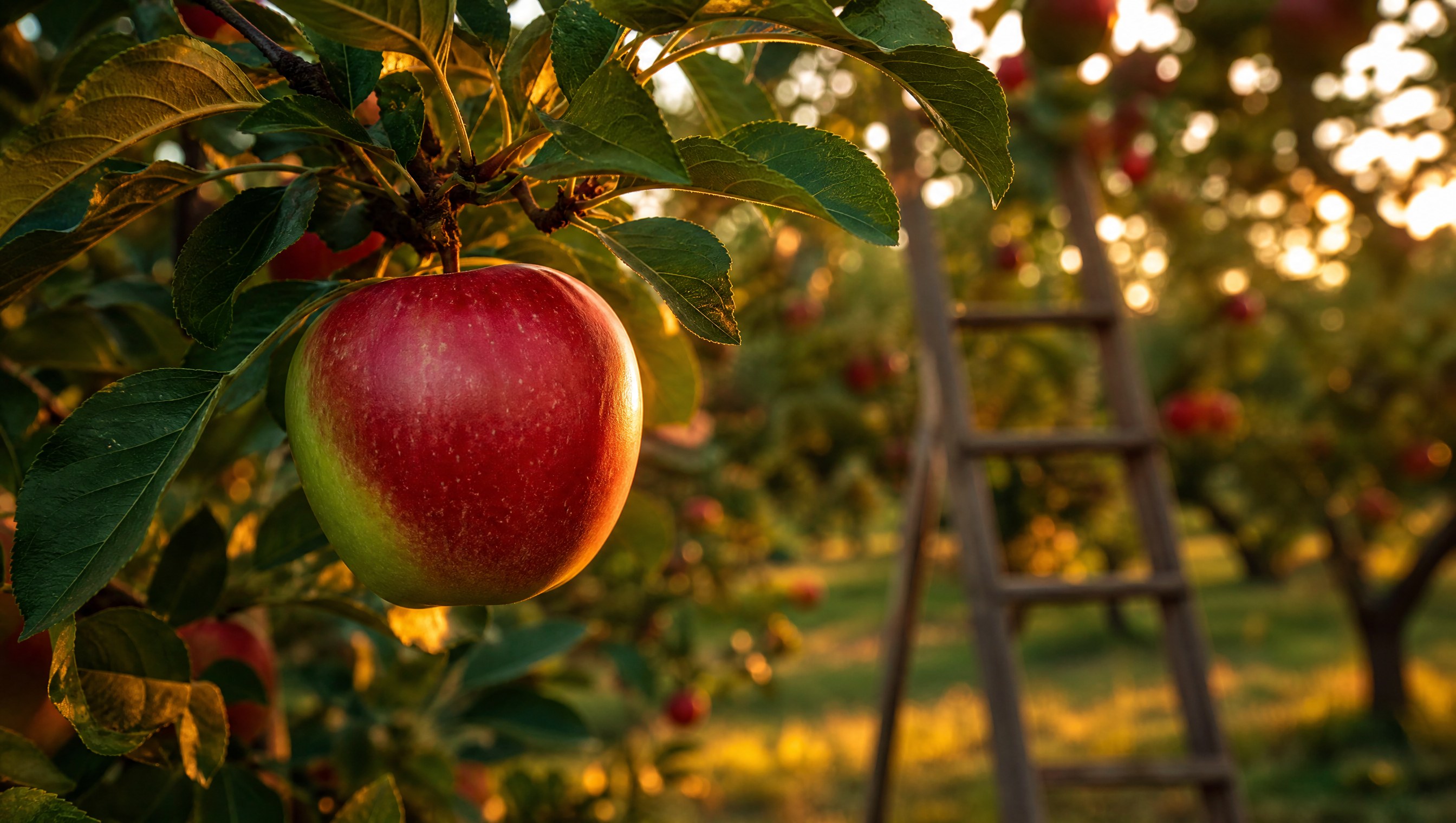

Go out to the apple tree with a flashlight and find a fruit hanging deep inside the canopy, or pressed against the trunk, or tucked behind another apple. Turn it over on its stem. The side that faced out is red. The side that faced in is green, and sometimes the line between the two is as sharp as a tan line on an arm. Nothing about that apple is unripe on one side. It is simply a record of where the sun landed all summer.
Where the red comes from
The red in an apple skin is a family of pigments called anthocyanins, the same pigments that colour a red maple leaf in October and a blueberry in July. They are not made in the leaves and shipped to the fruit. They are made in the skin of the apple itself, in the outer few layers of cells, and the skin makes them only when it is told to.
What tells it is light. A run of studies out of the apple-growing regions of China and Japan, and the older horticultural work behind them, all land on the same finding: light is the single most important thing controlling how red an apple gets. Fruit grown in the dark or in deep shade makes almost none of the pigment. Fruit in full sun makes it in quantity. The part of the spectrum that matters most is the ultraviolet, the same wavelengths that tan skin, which is why the line on a half-shaded apple looks the way it does.
Why one side and not the other
Because the signal does not travel. A cell in the skin that receives light switches on the genes that build the pigment, and it builds the pigment there, in that cell. The cell an inch away on the shaded side receives no light and builds nothing. There is no mechanism to share the red around the fruit, so the fruit ends up mapping its own exposure.
An apple hanging in the open on the outside of the tree turns on its stem in the wind and gets sun from every side, so it colours all the way round. One in the middle of a dense tree, or one resting against a branch, gets sun on one face for the whole season and none on the other. A tree that was never pruned, with a thick canopy, will have a ring of red apples on the outside and a core of green ones in the middle that never colour at all.
Why a green apple cannot do it
A Granny Smith in full sun stays green because the variety barely runs the pigment pathway at all. The genes are there but they are switched down, and no amount of ordinary sunlight turns them up. Researchers can force a faint blush on a Granny Smith with strong ultraviolet, or by bagging the fruit all summer and then unbagging it into September sun, but in a back yard a green apple is green for life. Yellow varieties are the same. Red varieties differ from each other in how readily the pathway runs, which is why a Red Delicious colours in half shade and a McIntosh wants the full sun.
The paper bag trick
In the orchards of Japan, and increasingly in China, every apple destined for the top of the market spends the summer inside a paper bag. The bag goes on in early summer when the fruit is the size of a walnut and comes off two to four weeks before harvest. Inside the bag the apple grows pale, almost white, with no sunburn, no scab, no insect marks. When the bag comes off the skin has never seen light, and it colours evenly and fast in the last weeks of sun, a clean blush all the way round with no green shoulder.
It works in a back yard on a small scale, and it is the cheapest way to get a perfect fruit off a tree that gets scab or codling moth. A brown paper lunch bag, folded over the stem and stapled, on a few dozen apples in July, off in early September. The rest of the tree can go on as it was.
What the cold nights add
The other thing everyone notices is that apples redden fastest in the weeks of warm days and cold nights, and that is real. Cool nights slow the fruit's own use of sugar, and sugar is what the pigment is built from, so more of it is available to the skin. Growers in warm regions lay reflective sheeting on the orchard floor for the same reason, to bounce light up into the shaded lower canopy and colour the fruit that would otherwise stay green. But cold on its own does nothing. The nights help only where the light reaches.
The one thing red does not tell you
Redder does not mean riper. The colour is a record of light, and ripeness is a matter of starch turning to sugar inside the fruit, which happens on the tree's own clock whether the skin is red or not. A fully green apple from the middle of the tree can be riper than a bright red one from the outside. To check, cut one open. Brown seeds mean the fruit is ready; white seeds mean give it a week. A ripe apple also comes off in the hand with a lift and a twist, without pulling, and smells of itself at the stem end.
The same rule explains the old orchard habit of picking the outside of the tree first and coming back for the middle a week later. It was never about ripeness. The outside apples were the red ones, and red sold.
What to look for tonight
Find an apple hanging against a branch or another apple, or a crabapple if that is what you have. Turn it over. The green back tells you which way the sun came from all summer, and if you look at the whole tree with that in mind you can read the shape of its canopy in the colour of its fruit. The apples that are red all round were in the open. The ones that are green all round were in the dark, and those are the branches to thin next winter.
