
Watering & care · Sep 15, 2026 · By Nell Harding
The Pumpkin Vine Plants Itself as It Goes, and That Is Why the Borer Did Not Kill It
Lift a pumpkin vine tonight and look under the leaf joints. At every joint that lay on damp soil there is a tuft of white roots, a second root system the plant grew for itself on its way across the bed. What those roots are for, which squash grow them and which cannot, how they save a plant the vine borer has hollowed out, and the one time in the season it is safe to move a vine.
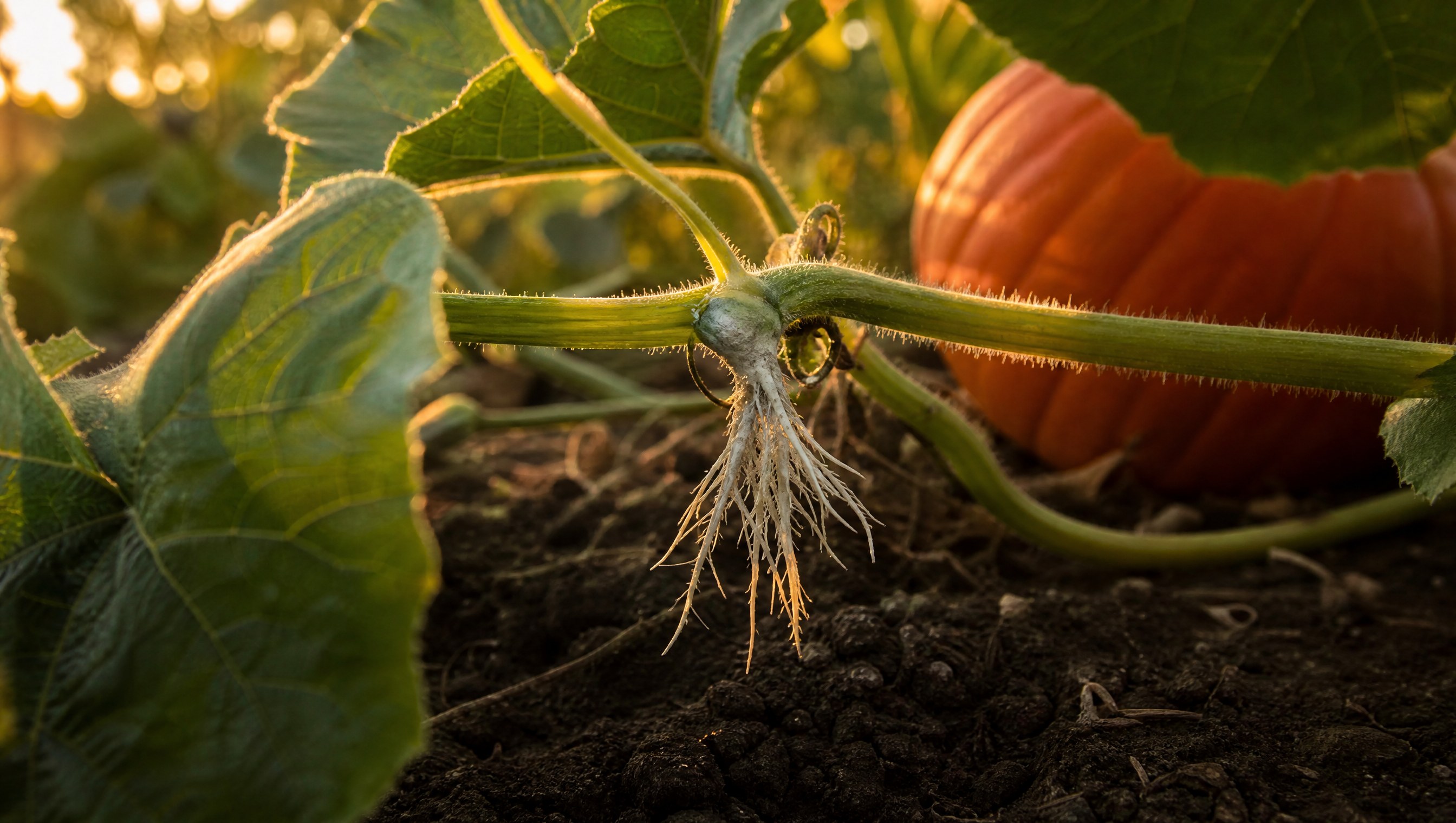

The pumpkin patch in September looks like a plant that has given up. The leaves at the hill where you planted it are yellow and flat, the main stem at the base is soft and frayed, and if you cut it open there is a fat white grub in there and a mess of orange sawdust. By every rule of gardening the plant should be dead. And yet twenty feet away, at the far end of the same vine, a pumpkin the size of a basketball is turning orange on schedule, and the leaves out there are as green as June. The plant is not dead because it is not, any longer, one plant.
What is under the leaf joints
Go out tonight with a flashlight and lift a section of vine a few feet from the hill. Be gentle. Where each leaf stalk comes off the stem there is a joint, a slightly thicker knot the botanists call a node, and under almost every node that was lying on bare damp soil you will find a tuft of thin white roots going straight down into the ground. Some are an inch long. Some, on a joint that has been in contact with the soil since July, are a hand's length and branched, and the vine will resist you when you lift it because it is anchored there.
These are adventitious roots, which is the botanical word for roots that grow from somewhere other than the root end of the plant. A pumpkin vine makes them wherever a node touches moisture. The vine crawls across the bed at a foot or two a week in high summer, and every few feet it puts down another set, so that by September a vine that started at one hill has planted itself six or eight times along its length. Each of those root clusters takes up water and nutrients for the section of vine around it. The plant is, in effect, a chain of small plants that happen to share a stem.
Why the plant does this
A vining squash is a plant that wants to cover ground. Its strategy is to get its leaves out over as much soil as possible, faster than the weeds, and to carry a heavy crop a long way from where it was sown. A single root at the hill cannot serve a plant that is thirty feet across, not in August when the leaves are losing water by the gallon. So the vine carries its own plumbing with it. It also anchors itself against the wind, which matters when a vine is carrying twenty pounds of fruit on a stem the thickness of a thumb.
The wild ancestors of our pumpkins grew in river bottoms and disturbed ground where the soil was damp and the competition fierce, and the habit of rooting as you go is what let them win. We have bred the fruit to be enormous and the flesh to be sweet, but we have not bred the wandering out of the plant, and on a vining variety the roots at the nodes are as reliable as the leaves.
Which squash do it and which do not
This is the part that explains why your zucchini died in July and your pumpkin did not. The habit belongs to the vining types: pumpkins, most winter squash, gourds, many melons, and cucumbers if you let them run on the ground. A bush zucchini or a bush summer squash was bred to stay compact, and it grows as a single crown with a single root system. It has one root and one chance. When a borer hollows out the base of a bush zucchini, there is nothing further along the plant to take over, and it wilts and dies within a week or two of the first damage.
The vining kinds have a backup for every section. The University of New Hampshire Extension puts it plainly in its squash vine borer guidance: vine-type plants often root at the nodes, and this lessens the effect of the larvae boring in the stems. The Wisconsin and Kentucky extension services say the same thing in their own words. A pumpkin that has rooted along its vine can lose the base entirely and keep ripening fruit on its own feet.
How this saves a plant the borer has found
The squash vine borer is a moth that looks like a wasp and lays its eggs at the base of squash stems in early summer. The larva tunnels inside the stem and eats it hollow from within, which is why the first sign is a sudden wilt of the whole plant on a hot afternoon and a pile of orange frass, which is sawdust in polite company, at a small hole near the soil line. By the time you see the wilt the stem is mostly gone.
On a vining plant you can rescue the crop. Find the hole and the frass. Slit the stem lengthwise with a sharp knife an inch or two above the damage, open it, and take the grub out. There may be more than one. Then heap moist soil over the wound and, more importantly, over the next two or three nodes down the vine from it. Water the mounds. Within a week the buried nodes will have rooted and the section of vine beyond them will be feeding itself. The plant behind the cut may die back. The pumpkin at the far end will not notice.
You can do the same thing without any borer at all, as insurance. In July, when the vine is running, bury a node every few feet under an inch of soil. It roots faster under soil than on top of it, and a vine with six rooted nodes is a plant that no single grub can kill.
The one time it is safe to move a vine
Every gardener has done it. The vine has wandered into the path, or over the beans, and you lift it and lay it back where it belongs. If you do that in June, on a young vine that has not rooted yet, no harm is done, and this is the moment to steer a vine where you want it to go. Do it in August or September and you are tearing out a root system. The vine will wilt for days, and if you moved a section that was feeding the fruit at the end, the fruit may stop growing.
So the rule is simple. Steer the vine early, while it is still a single plant. After midsummer, leave it where it lies, and if it is in the way, walk around it. The pumpkin patch is supposed to be untidy in September. The mess is the plumbing.
What to look for tonight
Take the flashlight out after supper and lift three or four sections of vine along its length. Count the rooted joints. Look at where the roots are thick and where they are absent, and you will see the map of where the soil was damp in July and where it was dry, or covered by a leaf, or lying on mulch. If your vine is running across plastic or straw it may have very few, and that is worth knowing before next summer, because a vine on bare soil is a stronger plant than a vine on a tidy mulch.
Then put the vine back exactly where it was, roots down, and leave it. It has done the work of planting itself all summer. All it asks is that you do not undo it.
