
Kitchen garden · Sep 14, 2026 · By Nell Harding
Why Sweet Corn Goes Starchy by Supper, and How to Keep It Sweet
An ear of corn is picked alive and keeps breathing on your counter, and what it burns is the sugar you bought it for. How fast it goes, which varieties hold on, and the two habits that keep a September ear tasting like the morning it was picked.
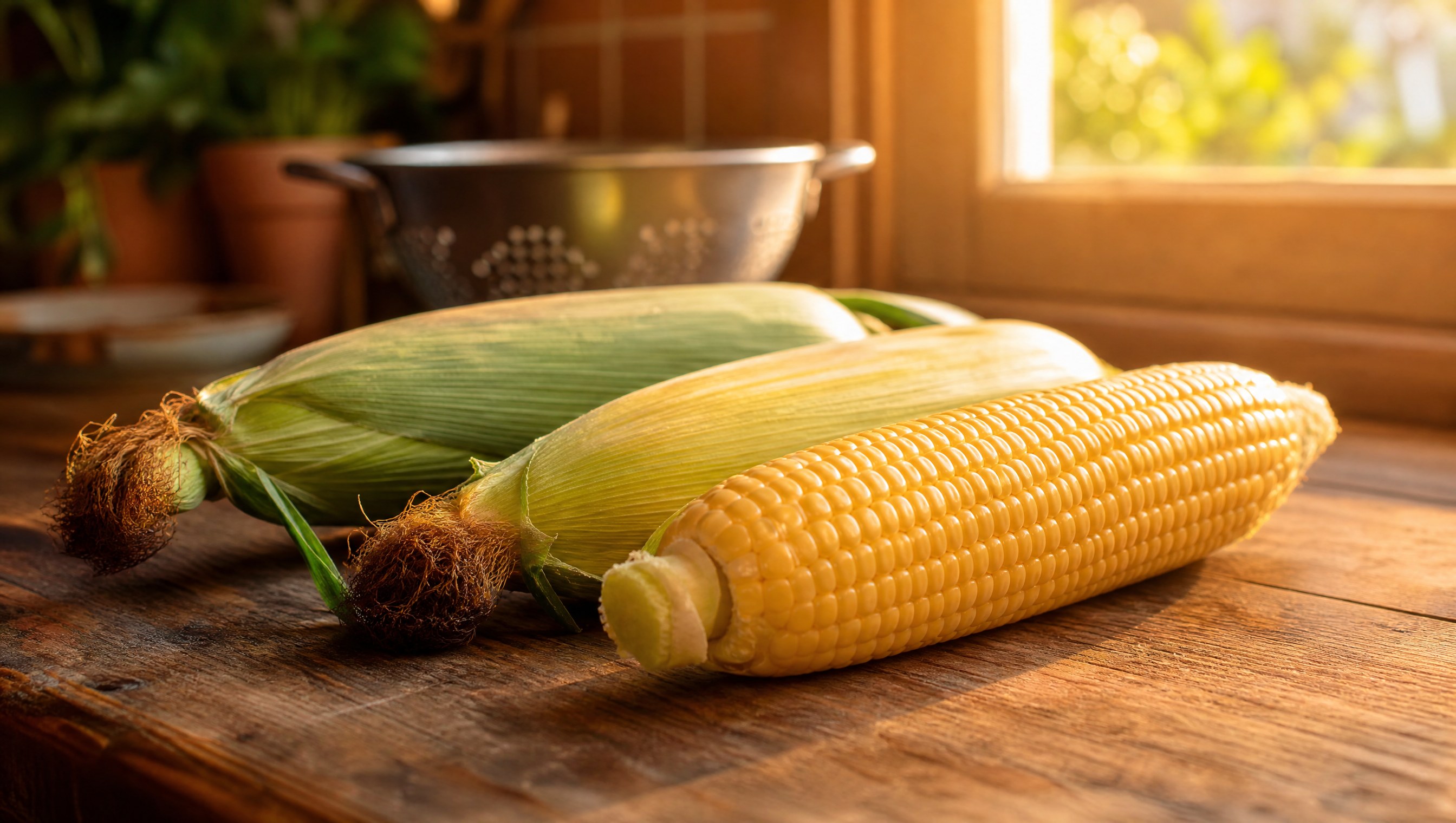

The best ear of corn I ever ate was boiled in a pot that was already at a rolling boil before I walked out to the patch to pick it. My grandmother did it that way and was not shy about why. The corn is changing from the moment you snap it off, she said, and she was right in the way old gardeners are usually right, which is to say she had the mechanism slightly wrong and the practice exactly right.
What the ear is doing on your counter
A kernel of sweet corn is a living seed, and a picked ear is a few hundred living seeds that have just been cut off from their water and food supply. They do what any living tissue does when the supply stops. They keep breathing. Respiration burns sugar to keep the cells running, and the sugar it burns is the same sugar that makes sweet corn sweet. Some of it is also converted directly to starch, the seed's storage form, because a seed that expects to be planted wants starch, not sugar.
Both processes are fast, and both are driven by temperature. The old standard sweet corn, the type your grandmother grew, can lose about half its sugar in twenty-four hours if the ear sits somewhere warm, and Iowa State's figure for that is a counter at roughly eighty-six degrees. At ordinary room temperature a third in a day is the usual estimate. Near freezing, the loss slows to something like eight percent a day. That is the whole story of corn storage in three numbers: warm is fast, cold is slow, and there is no setting on which the loss stops.
Why the corn from Saturday's stand was still good on Monday
Because it was almost certainly not the old type. Sweet corn comes in three broad families now, and the family decides how fast the clock runs. The standard sugary types, which seed catalogs mark su, are the fast ones. The sugary-enhanced types, marked se, carry more sugar to begin with and lose it more slowly. The supersweets, marked sh2, hold two or three times the sugar of the old types and convert it to starch so slowly that a refrigerated ear can be fine after most of a week.
Most farm stands and nearly every grocery store sell se or sh2 corn today, which is why the half-in-a-day warning sounds like an exaggeration to anyone under fifty. It was not an exaggeration. It was written about a different corn. If you grow your own from an heirloom packet, or buy from a grower who plants the old varieties for flavor, the old rule is your rule.
There is a fair question to ask at the stand, and most growers are happy to answer it: is this a supersweet? If yes, you have days. If no, you have hours, and you should plan supper around it.
The morning ear
Corn that is picked in the cool of the morning starts its clock at a lower temperature, and an ear that starts cool and goes straight into a cooler loses far less by evening than one picked at noon and left in the back of a hot car. Extension advice is uniform on this. Harvest early, cool immediately, keep it cool. A grower who picks at dawn and ices the bins is selling you a better ear than one who picks at ten, and the difference is real by the time you eat it.
The same logic applies to your own patch. Pick it when the dew is still on, and pick it when you are ready to cook it or ready to chill it, not before. An ear left on the plant is still connected to its water and sugar supply and is not losing anything. The plant is the best refrigerator you own.
How to keep it
Leave the husk on. The husk slows water loss, and a kernel that dries out loses flavor and texture on top of losing sugar. Put the ears in a plastic bag with the end open, or wrap them loosely, and put them in the coldest part of the refrigerator. Eat within a day or two for the old types, within four or five for supersweets. If you cannot eat it in time, blanch it and freeze it the day it comes home rather than the day it goes soft. Frozen corn is only as good as the ear was the moment it hit the water.
Do not wash it, do not shuck it early, and do not leave it on the counter to look pretty in a bowl. The bowl is where the sugar goes.
How to tell where an ear is
The old milk test still works. Pull the husk back an inch and press a thumbnail into a kernel near the middle. If the juice runs milky, the ear is at its peak. If it runs clear and thin, it was picked early and never had its full sugar. If the kernel is doughy and the juice is thick, it is past, either left on the plant too long or sitting too long since. A doughy ear is not lost. It is chowder corn, fritter corn, cornbread corn, where a little starch is the point.
The short version
Sweet corn is alive after it is picked and it burns its own sugar to stay that way. Warm is fast, cold is slow. The old varieties lose about half in a day on a warm counter, the supersweets take days. Buy or pick it in the morning, leave the husk on, get it cold within the hour, and cook it tonight. Your grandmother had the pot boiling for a reason.
