
Garden myths · Sep 17, 2026 · By Nell Harding
Why Some Oaks and Beeches Keep Their Dead Leaves All Winter
Walk past a young oak or American beech in January and you will often find it still fully leafed, every leaf brown and papery, rattling in the wind while its neighbors stand bare. It is not a dead tree and it is not confused about the season. It is marcescence, an unfinished step in how a tree normally lets a leaf go, and nobody is fully certain why some trees do it and others do not.
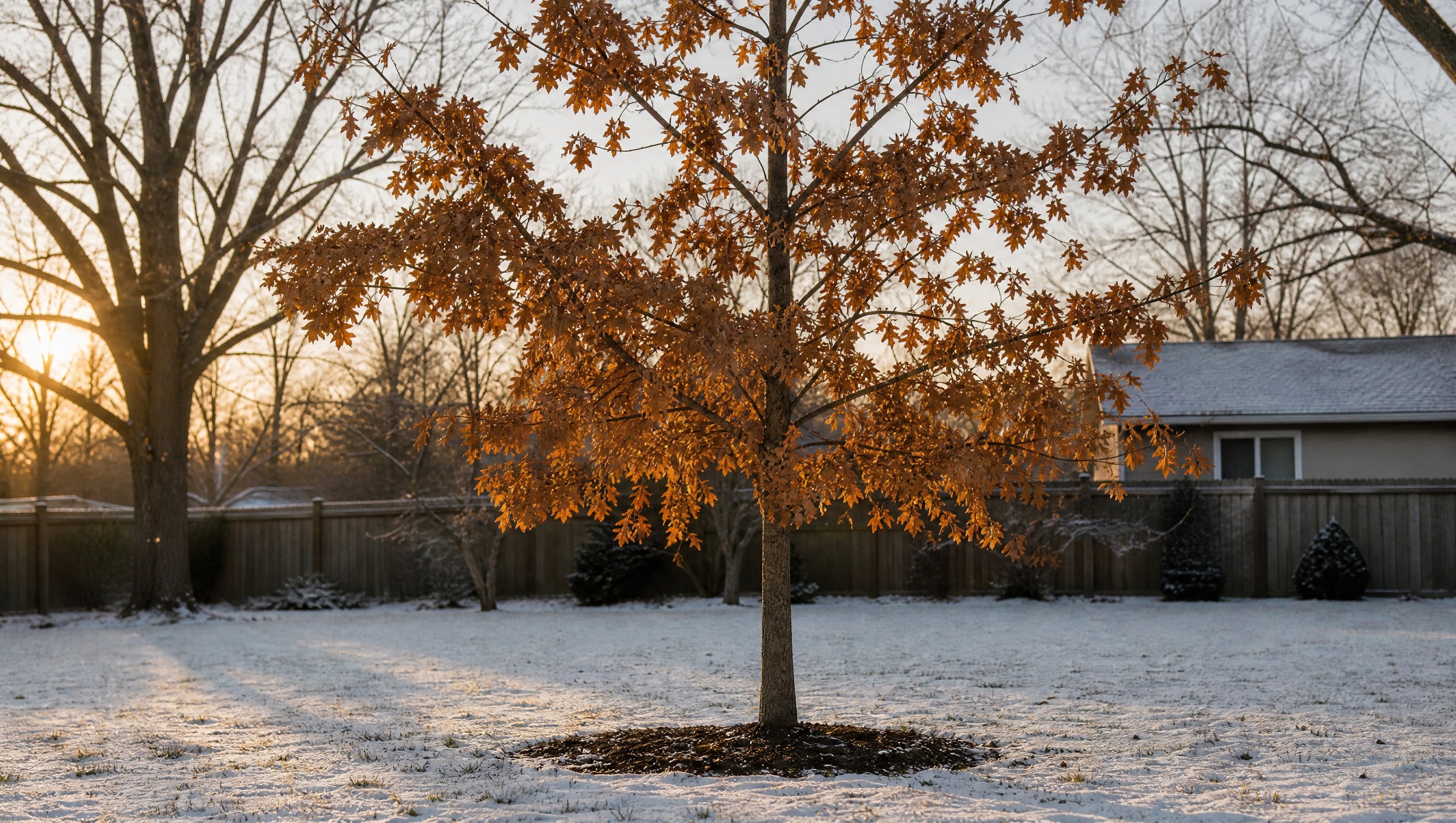

Most trees do not lose a leaf so much as release it on a schedule, and the schedule is a wall the tree builds itself.
At the base of every leaf stalk, where it meets the twig, a deciduous tree grows a layer of cork cells each fall called the abscission layer. Once that layer finishes sealing across the stalk, the connection between leaf and tree is cut off cleanly, and the leaf lets go on its own, whether or not a strong wind ever touches it. That is why a maple can drop most of its leaves on a perfectly still day.
Young oaks and American beeches are two of the most reliable trees in North American yards for skipping that step, at least on part of the tree. Some of their leaves, usually the lower branches and the inner, shaded parts of the crown on a juvenile tree, never finish the seal. The leaf still dies. It still turns brown and dry the same as any other autumn leaf. It simply does not get cut loose.
That retained dead leaf is what botanists call marcescence, from a Latin root that means to wither without falling. It shows up almost every winter on the same handful of species: young white oaks and their relatives, young American beech, and to a lesser degree hornbeam and a few others, while the same species' older, taller branches usually finish the abscission wall normally and drop on schedule like everything else nearby.
The pattern inside a single tree is the tell. It is common to look at one oak in January and see a bare crown forty feet up with a skirt of brown, rattling leaves clinging to everything below head height. That is not two different problems. It is the same tree finishing the job on its mature wood and leaving it unfinished on its young, low growth, which is exactly the part of a tree most exposed to browsing animals at ground level.
Why marcescence happens at all is genuinely not settled, and it is worth saying that plainly rather than picking one explanation and presenting it as fact. A few hypotheses circulate in the literature and among arborists, and none of them has been proven to be the whole answer.
The browse-deterrence hypothesis holds that a skirt of dry, low-nutrition, unpleasant leaves around a young tree's most vulnerable growth makes it a less appealing mouthful for deer and other browsers through the winter, when green forage is scarce and every low branch is a target. A sapling that keeps its dead leaves may simply taste like less of a meal than one with bare twigs.
A second hypothesis points to timing rather than taste. Some researchers have suggested marcescent leaves shed later precisely because doing so in spring, rather than fall, delivers a fresh pulse of leaf litter and nutrients to the soil right when the tree's roots and the surrounding understory are waking up and can use it, instead of the material sitting under snow all winter doing comparatively little.
A third points to the buds themselves. The dead leaves clinging around a twig through the coldest months may act as a small physical buffer for the dormant buds just behind them, taking the brunt of wind, ice, and the drying effect of winter air that would otherwise hit an exposed bud directly. None of these three ideas rules out the others, and a tree's real reason may well be some mix of all of them, which is a normal state for a question in plant biology to be in.
What finally moves a marcescent leaf is not autumn wind and not a hard freeze. It is spring. When the new bud behind a retained leaf begins to swell in April or May, the pressure of that growth is what finally pushes the old leaf stalk free, completing mechanically what the fall abscission layer never finished chemically. The tree essentially clears its own way as it leafs out again.
This matters for a very ordinary reason: a fully leafed young oak or beech in the dead of winter gets mistaken for a sick or dying tree constantly, and the two look nothing alike once you know what to check. A marcescent tree's leaves are uniformly dry, papery, and tan to light brown, evenly distributed on the lower and inner branches, and they rustle in wind the way dry paper does. They have looked exactly like that since sometime in November and will look the same in February.
A genuinely stressed or dying tree tells a different story with its timing. Leaves that go brown and cling on in July or August, weeks before anything nearby has started to color, or a tree that drops leaves unusually early alongside dead twigs, cracked bark, or thinning higher branches, is describing a root or trunk problem, not marcescence. The season of the browning is the fastest field check: marcescence is a winter-long feature that arrives on schedule every year on the same young growth, while decline shows up out of season and tends to get worse.
Walk your own yard on the next bare, cold day and look specifically for a young oak or beech still fully dressed below head height while its neighbors and its own upper branches stand bare. That contrast, working tree above and clinging skirt below, is marcescence doing exactly what it does every winter, not a tree in trouble.
