
Garden myths · Oct 3, 2026 · By Nell Harding
Why Chickadees Travel in a Winter Flock, and Who Tags Along
This is the month the yard's little birds start moving together: a few chickadees calling, a nuthatch on the trunk, a downy woodpecker and a kinglet keeping up. Here is what a winter flock is, who leads it, why the others follow, and how to keep it coming through your yard.
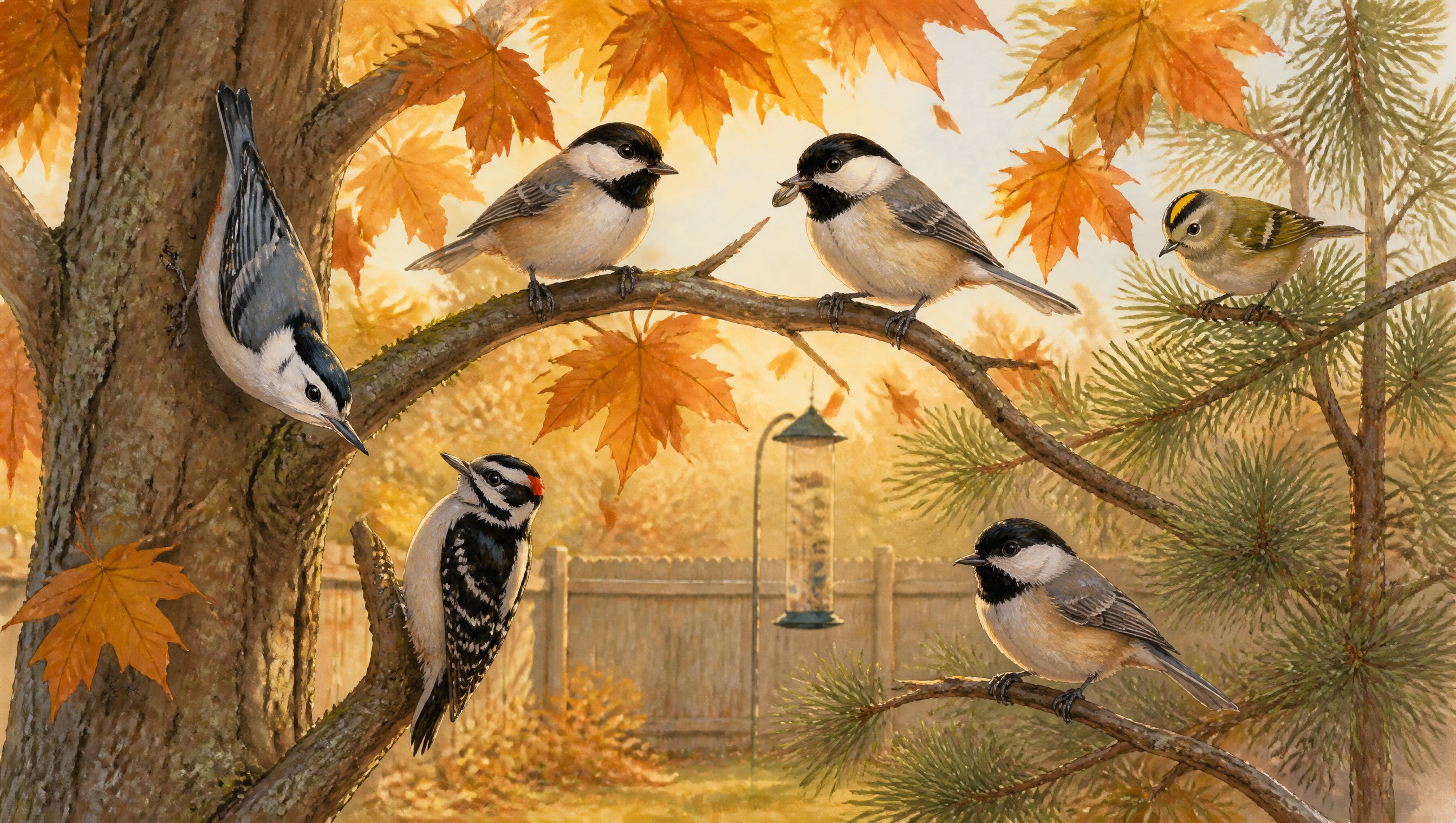

Stand at the kitchen window on a cool October morning and you may notice the yard's small birds have stopped arriving one at a time. They come through in a little stream instead: a chickadee calling from the maple, another answering from the pine, a nuthatch working down the trunk, a downy woodpecker tapping a branch, something tiny and olive flicking at the twig tips. A minute later they are gone, and the yard goes quiet until they come round again.
WHAT A WINTER FLOCK IS
That little stream is a winter flock, and fall is when it comes together. The Pennsylvania Game Commission says that in winter chickadees live in flocks, generally of three to 12 birds, made up of mated pairs as well as single birds.
Audubon's field guide describes the same thing in its own words: little flocks of chickadees that enliven the winter woods with their active behavior. It also explains the timing. Pairs typically form in the fall and stay together as part of the winter flock, and the flocks break up in late winter, when the pairs head off to nest.
So the gang you are watching this month is, at heart, a handful of chickadee couples and a few singles, settling in for the cold months together.
WHO TAGS ALONG
The chickadees are rarely alone. The Pennsylvania Game Commission says they associate with downy woodpeckers and kinglets in mixed-species foraging flocks. Audubon adds that the chickadee flocks are often accompanied by an assortment of nuthatches, creepers, kinglets and other birds.
That is why the flock looks so mixed. The brown creeper spiraling up a trunk, the white-breasted nuthatch coming down it headfirst, the downy woodpecker on a branch and the kinglet at the very tip of a twig are all hunting in the same tree at the same time, each in its own spot.
A FLOCK WITH A HOME RANGE
A winter flock is not a wandering crowd. The Pennsylvania Game Commission says a flock will defend its territory against other chickadee flocks, and that it forages around a territory of 20 or more acres. Your yard is one stop on a regular round.
That is why the same little company tends to pass through at roughly the same times, and why you may hear them coming before you see them. The Game Commission says the birds keep in contact with their familiar chick-a-dee-dee-dee calls while they search for food.
THE ALARM EVERYONE HEARS
Part of the reason other birds follow chickadees is that chickadees are loud about danger. When a predator turns up, the Pennsylvania Game Commission says, chickadees mob it while sounding zee-zee-zee alarm calls. In a flock full of small birds busy with their heads down in the bark, a sharp warning from the noisiest member is worth staying close to.
THE SEED HIDERS
Watch the chickadees at your feeder and you will see them leave with a seed rather than eat it on the perch. Audubon says they may take sunflower seeds one at a time and fly away to stuff them into bark crevices. Audubon says the tufted titmouse, which also joins small flocks in winter, carries sunflower seeds away one at a time too, and will store food to retrieve later.
WHERE THEY SLEEP
The flock forages together by day but splits up at dusk. The Pennsylvania Game Commission says that at night chickadees roost individually in tree cavities or among the dense boughs of conifers. A thick spruce, pine or hemlock near the feeder is the closest thing to a bedroom many of these birds have.
Then the next morning the calling starts, the flock gathers, and the round begins again, through your yard and twenty acres of the neighbors' trees, until the pairs split off in late winter.
