
Garden myths · Sep 3, 2026 · By Nell Harding
Where the Robins Really Go in Winter
The robin on your lawn is about to vanish, and most of them are not going south. Here is what the flock does from now until March, why the first robin of spring is usually a bird that never left, and the four shrubs that keep the flock on your street.
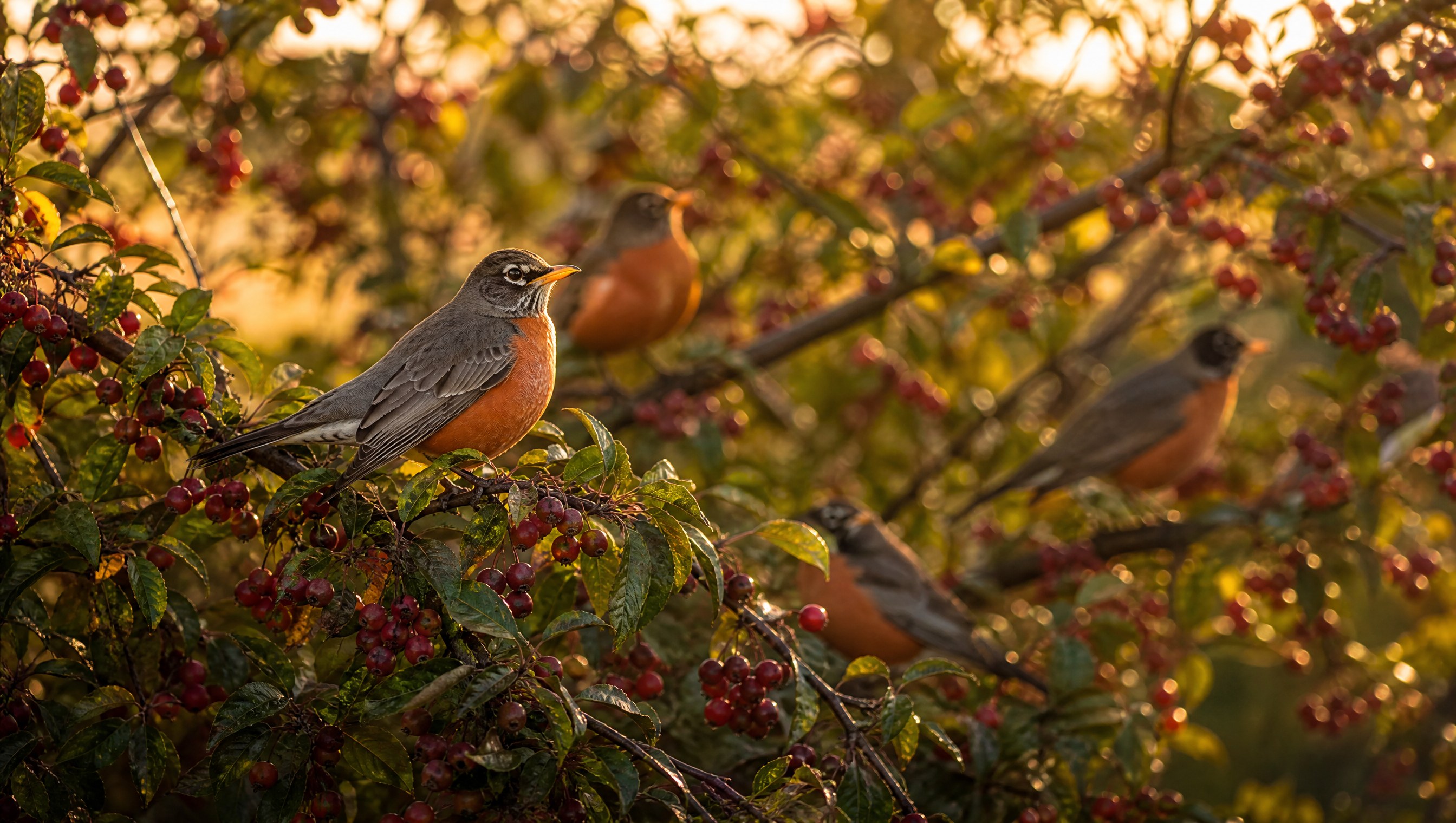

The robin that worked your lawn all summer, the one that stood there at dawn with its head cocked and came up with a worm every third try, is about to disappear. It happens every year in the last weeks of September and the first of October, and every year somebody says the robins have gone south. Most of them have not. They have gone about four hundred yards, into a tree you have never looked at, and they will be there all winter.
The lawn robin is a summer creature. From April to September a pair holds a territory, chases every other robin off it, and hunts the open ground for earthworms and beetle grubs. That is the bird we know, because it works in plain sight on the one piece of ground we look at every day. It is also a bird that only exists for half the year. When the nights cool and the worms go deep, the robin changes almost everything about how it lives.
The switch
The first change is the diet. A robin cannot dig, so once the soil cools and the earthworms drop below the reach of a bill, the worm supply simply ends. The bird switches to fruit. Not seed, and not the feeder, which is why you never see a robin at the sunflower tube. It wants soft fruit that hangs on a branch. Crabapple, dogwood, holly, juniper berries, hackberry, wild grape, the fruit of the sumac, and the winterberry that lights up the wet ground in November.
The second change is the crowd. In summer a robin will not tolerate another robin within shouting distance. In fall the same bird joins a flock. These flocks start small, a dozen birds in a hedgerow, and build through October into gatherings that can run to several hundred. A flock is a fruit-finding machine. Hundreds of eyes cover a lot of ground, and when one bird finds a loaded tree, the rest follow. They land, strip the tree in an afternoon, and move on to the next one.
The third change is the hours. The summer robin sings before dawn and works the lawn through the morning. The winter robin is quiet, moves in a loose group through thickets and field edges, roosts in dense evergreens at night, and spends the day wherever the fruit is. None of that happens on a lawn. So the bird does not leave the neighborhood so much as leave the one place you look for it.
Who goes and who stays
Some robins do migrate. Birds from the far north, from Canada and the northern tier of states, drift south in October and November, and robins that summered in Minnesota may winter in Texas or the Gulf states. But the movement is not the clean north-to-south exodus we picture for geese. Robins are nomads in winter. They go where the fruit is, and they stay as long as the fruit lasts. If the crabapple and holly crop is good, a flock will sit out a whole New England winter within a few miles of where it nested. If the crop fails or the snow buries the ground fruit, the flock picks up and moves, sometimes a few miles and sometimes a few hundred.
That is why winter robin sightings surprise people. A flock of two hundred robins in a cemetery full of junipers in January is not lost. It is exactly where it wants to be. The bird count data bears this out. Robins turn up on Christmas counts across nearly every state, and the northern winter population has been growing for decades as winters soften and as suburbs fill up with planted crabapples and ornamental hollies. We built the winter robin habitat ourselves, one foundation planting at a time.
The first robin of spring
Which brings us to the oldest bit of robin folklore. The first robin of spring, the bird that shows up on the lawn in March and gets announced at the breakfast table, is often a bird that wintered a mile from your house. What changed is not its location but its behavior. The ground thawed, the worms came up, and the flock dissolved back into pairs that fanned out onto the lawns to hold territories. The robin did not arrive. It came back to the grass.
There is a real migration folded into the story. True northern breeders do move back up in March, following the thaw line north at roughly the pace the ground softens. But the bird you see first is at least as likely to be a local that spent February in the hollies behind the grocery store. The folklore is not wrong so much as pointed at the wrong bird.
Keeping the flock
If you want the robins to spend the winter on your street, the answer is fruit that hangs on. Plant the shrubs that hold their berries through the cold instead of dropping them in September. Four do the job in most of the country. Winterberry holly, which keeps its red berries into February on bare stems. Crabapple, the small-fruited kinds whose apples stay on the branch and soften with frost. The native dogwoods, especially the gray and red-osier types, which fruit heavily and feed a flock for weeks. And eastern red cedar, the juniper, whose blue berries are the flock's fallback in the deep cold and whose dense branches are where they sleep.
Plant them now. Fall is the best time to put in shrubs in most of the country, because the roots grow in cool soil while the top goes dormant. A winterberry planted this October will fruit in a year or two, and once a flock finds your street it tends to come back.
The lawn robin has a few weeks left. When it goes, look up. It is in the crabapple across the road with two hundred of its relatives, eating the fruit you thought was decorative.
