
Planting & timing · Sep 7, 2026 · By Nell Harding
What to Plant Near a Black Walnut
A black walnut poisons the ground for fifty feet in every direction, and this is the month its leaves and hulls carry that poison into your beds and compost. Which plants die, which ones never notice, and how to garden inside the line.
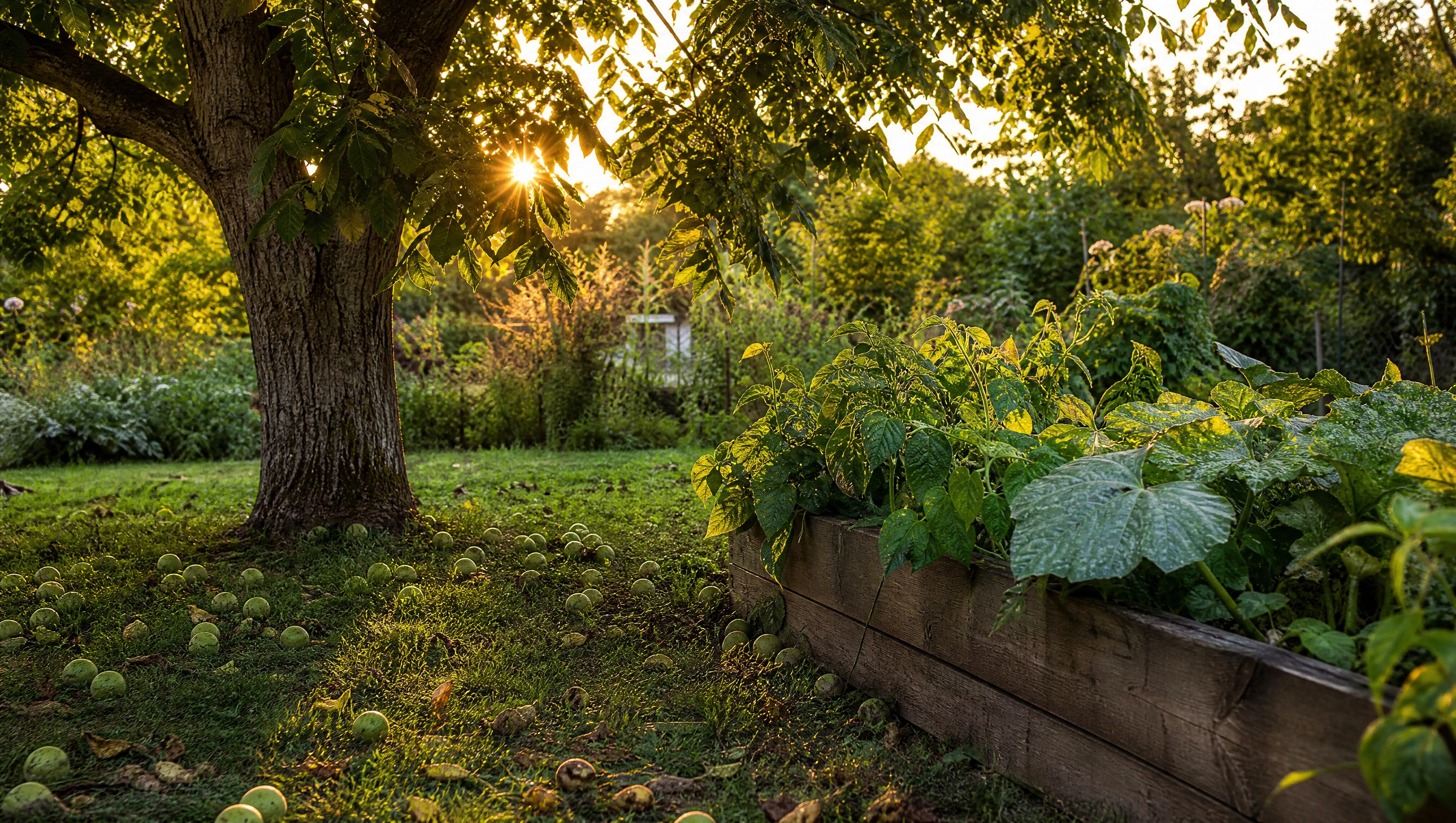

Two thousand years ago Pliny wrote that the shadow of a walnut tree was poison to whatever grew beneath it. He was wrong about the shadow and right about everything else. A black walnut makes a chemical called juglone in its roots, hulls, buds, and leaves, and it puts that chemical into the soil around it on purpose. To a tomato, juglone is a slow death. To a bean, it is nothing at all. The whole art of gardening near a walnut is knowing which list a plant is on.
The black walnut, Juglans nigra, is native across the eastern and central United States and grows in almost every old farmyard and along almost every fencerow from Vermont to Kansas. It is a handsome tree with dark, deeply furrowed bark and long compound leaves made of many narrow leaflets, and in September it drops green hulls the size of tennis balls that stain everything they touch. If you have one, you know it. If you have inherited a garden that will not grow tomatoes no matter what you do, there is a fair chance one is standing within fifty feet of the bed.
Juglone works by interfering with the way a sensitive plant breathes. The roots take it up, the plant's respiration falters, and the symptoms look exactly like drought or disease. Leaves yellow from the bottom up, stems twist and pucker, the plant wilts in the afternoon even when the soil is damp, and within a few weeks it is dead. Because it looks like a watering problem, most people water more, which changes nothing. The diagnosis is the tree.
How far the line runs
The toxic zone is the root zone, and the root zone of a mature black walnut is wider than its crown. The Morton Arboretum and the state extension services put the average radius at fifty to sixty feet from the trunk of a large tree, and it can reach eighty feet where roots have followed a drainage line or an old bed of good soil. A young tree has a smaller footprint, but the roots grow faster than the branches, so a walnut that shades only ten feet of lawn may already be reaching twenty.
The concentration is highest close to the trunk and under the drip line, where the hulls fall and rot every autumn. It fades with distance but does not stop cleanly. A tomato planted at forty feet may limp along and produce a few fruit. The same tomato at twenty feet dies by July. If you want a rule of thumb, stand at the trunk, walk fifty long paces, and consider everything behind you walnut country.
The plants that die
The nightshade family is the classic casualty. Tomatoes, peppers, potatoes, and eggplant are all badly affected, and tomatoes are the most sensitive of the four. Among the ornamentals, lilac, azalea, rhododendron, mountain laurel, and many peonies suffer. Blueberries, which want acid soil and would otherwise be happy under a big tree, do not tolerate it. Apple trees, pine, birch, and some of the crab apples decline near a walnut too. Cabbage and its relatives are variable, and asparagus and rhubarb are often listed as sensitive.
If a plant on this list is already in the ground near your tree and looking sick, the kindest thing is to move it now, in the cool of early autumn, to a spot well outside the line. Amending the soil will not help. The chemical is renewed every year by the living roots, and no amount of compost outruns it.
The plants that never notice
The good news is that the tolerant list is long, and it includes most of what a kitchen garden actually needs. Beans of every kind, corn, squash and pumpkins, melons, carrots, beets, parsnips, onions, garlic, and leeks all grow within reach of a walnut without complaint. Most of the grasses are fine, which is why the lawn under the tree looks normal. Among the flowers and shade plants, hostas, daylilies, ferns, bee balm, black-eyed Susans, coral bells, astilbe, and most of the spring bulbs are untroubled. Many native woodland plants evolved beside walnuts and shrug at juglone entirely.
That list is not a compromise. A bed of beans, squash, and onions under a walnut, edged with hostas and daylilies, is a fine garden. What you give up is the nightshades, and the honest answer for those is a separate bed outside the fifty feet, or containers on the sunny side of the house, filled with soil that never touched the tree.
Keep the debris out
This is the month that matters most, because the leaves and hulls are coming down and it is very natural to rake them into the nearest bed or onto the compost pile. Do not. Walnut leaves, hulls, and even the sawdust from a felled tree carry juglone with them, and it breaks down slowly. A mulch of walnut leaves on a tomato bed will do in a season what the roots do in three. Rake the debris off the beds, bag it, and send it to the municipal yard-waste stream, where the hot commercial composting does eventually break it down.
If you must compost it at home, keep a separate walnut pile and let it cook for a full year before it goes anywhere near a vegetable, and even then use it only on the tolerant beds. The extension advice is that thoroughly composted walnut leaves lose most of their toxicity after several months, but nobody can tell by looking, and the tomatoes are the ones that pay for a mistake.
Raised beds inside the line
A raised bed with a physical barrier underneath, a layer of landscape fabric or a solid bottom, filled with soil brought in from elsewhere, lets you grow sensitive plants inside the fifty feet for a few years. The walnut roots will eventually find their way in and up, and the hulls will land in it every fall unless you cover it, so it is a stopgap rather than a fix. Keep the bed as far from the trunk as the yard allows, cover it in September, and expect to rebuild the soil every third year.
The last question people ask is whether to cut the tree down, and the answer from the old almanacs was always the same. A mature black walnut is worth more standing than any tomato patch, for its shade, its timber, and the squirrels and the woodpeckers it feeds. Move the tomatoes. Keep the tree. Plant the beans right up to the trunk and let Pliny have his shadow.
