
Garden myths · Sep 7, 2026 · By Nell Harding
What the Chickadee at Your Feeder Does All Winter
It does not fly south and it does not freeze. Starting this month the chickadee hides thousands of seeds, grows a bigger brain to find them, and spends every winter night alone in a tree hole with its body turned down twenty degrees. The whole winter of the smallest bird on the feeder.
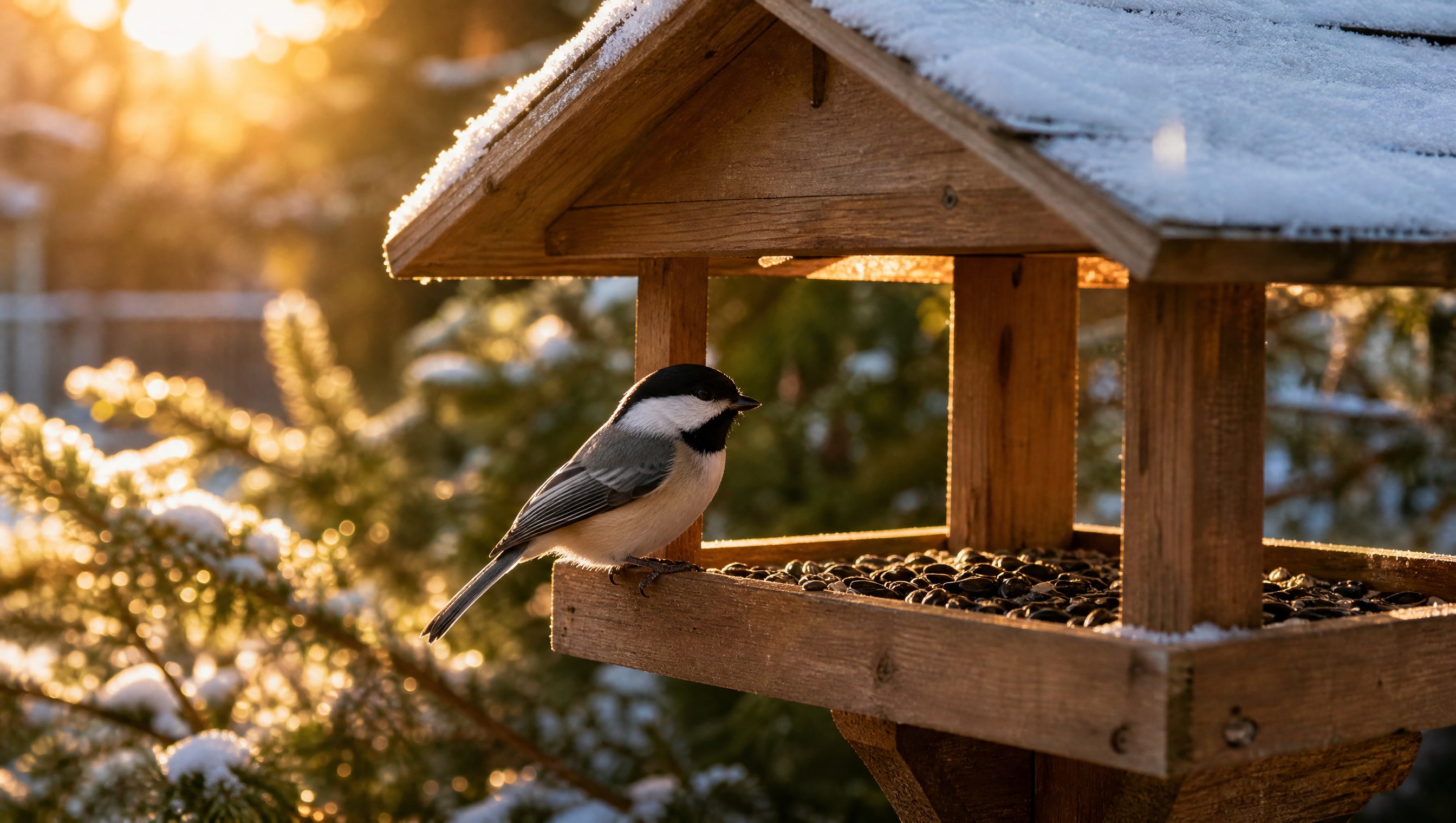

The two most common things people believe about the chickadee are that it flies south for the winter and that it would die if it did not. Neither is true. The chickadee on your feeder this week will be on the same feeder in January, in the same square mile of yard and woods it lives in year round, and it will get through the winter with a set of tricks that no other bird its size can match. Most of them start in September.
A black-capped chickadee weighs about eleven grams, roughly two nickels. It has no down coat to speak of, it cannot store much fat on a body that small, and it lives in places where January nights run to twenty below. On paper it should not survive a single one of them. It survives about half of them, which for a bird that size is a triumph, and the half that make it are the ones you see in spring.
September: the family breaks up
Through the summer the chickadees you see are family groups, a pair and the young they raised in a tree cavity in May. In late summer that ends. The young disperse a few miles to find flocks of their own, and the adults settle into the winter flock that will hold their territory until spring. A winter flock is usually six to ten chickadees with a strict order of rank, and it picks up hangers-on as the weeks go by. Nuthatches, a downy woodpecker, a pair of titmice, sometimes kinglets and a brown creeper, all travel with the chickadees through the cold months because the chickadees know where the food is and call the alarm first when a hawk comes through.
October: the hiding, and the brain
This is the part that sounds invented. Beginning now and running hard through October, a chickadee caches food. It takes a sunflower seed from the feeder, flies off, tucks it into a crack in the bark or a curl of dead leaf or a knot of lichen, and comes back for another. It does this thousands of times across an area of several square miles, one seed to a hiding place, and it does not use the same hiding place twice.
To find them again it grows a bigger brain. Researchers measuring chickadee brains across the year found that the hippocampus, the region that stores spatial memory, expands by roughly thirty percent in autumn by adding new neurons. The bird can remember where it put a seed a month ago, and which hiding places it has already emptied. When spring comes and the map is no longer needed, the hippocampus shrinks back to its summer size and the old memories are, in effect, thrown away to make room for next year's. The chickadee rebuilds its brain every fall of its life.
November: the flock and the feeder
By November the winter flock is set, and if you watch a feeder for ten minutes you will see how it works. The birds do not crowd the feeder the way finches do. One comes in, takes one seed, and leaves to eat it or hide it while the next comes in. The order they come in is the order of rank, the dominant pair first, and a bird that jumps the line gets a sharp gargled scold and moves off. The lower-ranked birds spend more time at the risky feeders out in the open, which is one reason the dominant birds are the ones still there in spring.
Your feeder matters more than you think and less than the bird does. Studies of winter chickadees with and without access to feeders found that feeder birds had a better survival rate in the harshest weeks, but the birds never came to depend on it. Even with a full feeder ten feet away, a chickadee takes most of its winter food from the wild: insect eggs and dormant spiders picked out of bark, seeds from birch and hemlock, and the thousands of sunflower seeds it hid in October.
January: the long night
The night is the real enemy, and the chickadee handles it in two ways. First, it roosts alone. Each bird finds its own cavity, an old woodpecker hole, a rotted knot, a crack behind loose bark, small enough that its own body heat warms the space. Second, once inside, it turns itself down. A chickadee's daytime body temperature runs near a hundred and eight degrees. On a cold night it lowers that by as much as twenty to twenty-two degrees in a controlled state called regulated hypothermia, shivering steadily to hold the new lower setting, and it saves about a quarter of the energy it would otherwise burn keeping warm. The fat it put on during the day, sometimes ten percent of its body weight, is spent by dawn.
It does this every night for four months, and each morning it must find enough food to build the fat back before the next night. That is why the first hour after sunrise and the last hour before dusk are the busiest times at the feeder in winter, and why a stretch of ice that seals the seeds and the bark for two or three days is more dangerous to a chickadee than any single cold snap.
February: the whistle
The end comes with a sound. On the first mild morning of late winter, often in February when the snow is still deep, a chickadee climbs to an open branch and gives two clear whistled notes, the first higher than the second. People write it as fee-bee. It is the spring song, and it has nothing to do with the chick-a-dee-dee call the bird uses all year. The male sings it to claim the nesting territory, the flock begins to loosen, and by April the winter order has dissolved into pairs looking for cavities.
So the bird on your feeder this week is not passing through. It is staying, and it is already working. Keep black-oil sunflower seed in the feeder from now until April, keep a source of open water if you can, leave the dead snags and the loose bark standing, and understand that half of what it takes today is not for today. It is going into the map.
