
Garden myths · Sep 6, 2026 · By Nell Harding
The Pack You Heard Last Night Was Four Coyotes
September is the month the coyotes start singing behind the field, and it always sounds like twenty of them. It is usually a family of four, sometimes two. Why your ear doubles the count, what the biggest urban coyote study ever done found in their diet, and the one honest rule for the cat.
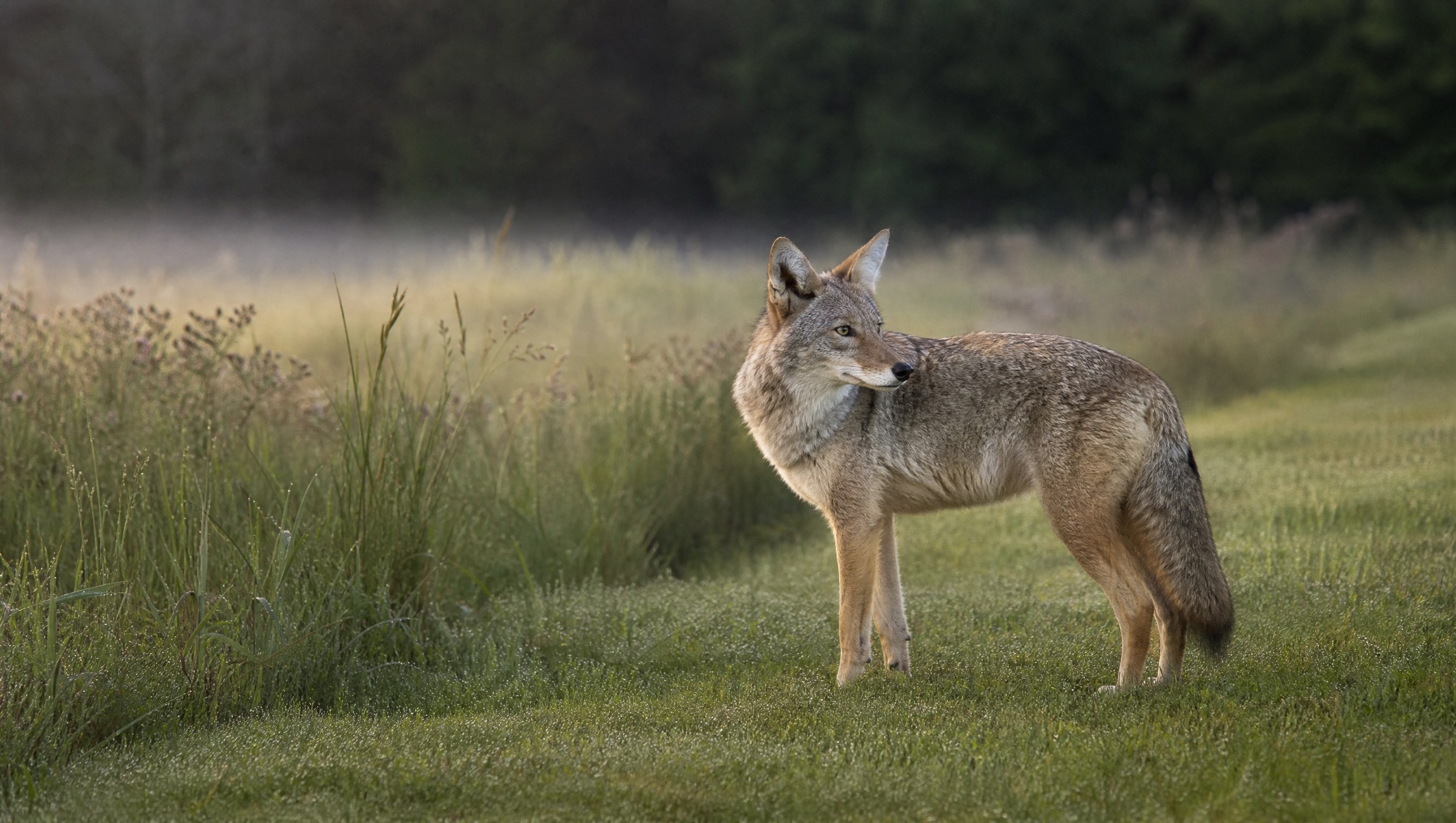

It starts with one long note from the trees behind the field, and inside ten seconds the whole treeline is yipping and howling and it sounds like twenty animals out there in the dark. Most of us do the same thing. We count the dogs on the street, we think about the cat, and we lock the door. The sound is real. The count is not. What you heard last night was almost certainly a family of four, and it may have been two.
The trick is in the voice. A coyote does not hold a note the way a wolf does. It slides up and down the scale in the middle of a single howl, breaks into yips, drops back, and comes up again at a different pitch. Every hill, fencerow, barn wall, and treeline between the animal and your porch bounces that sound back at you a fraction of a second late and a fraction of a tone off. Your ear, which evolved to count voices in a crowd, hears each echo and each pitch change as another animal.
Biologists have a name for it. They call it the beau geste effect, after an old adventure novel in which a besieged garrison props its dead soldiers up on the wall so the enemy will think the fort is fully manned. When researchers at a Texas wildlife institute played recordings of one, two, three, or four coyotes to listeners and asked them how many animals they heard, people overestimated by nearly double, every time. A biologist in Vermont who has spent years recording them puts it plainly. Two coyotes can sound like seven or eight.
Why September is the loud month
There is a reason the singing picks up right now. Coyote pups are born in April, and by late summer they are big enough to leave the den area and travel with their parents. A family group in September is typically the adult pair plus this year's young, and sometimes one or two yearlings that never left. Four to six animals, moving together, learning the family's territory before the young disperse in the fall and winter to find ground of their own.
Group howls are how a family says two things at once. To each other, they say here I am, here is where we are. To the family on the next section of land, they say this is ours. The chorus you hear at nine o'clock, and again at three in the morning, is a roll call and a fence line, and the pups are practicing. Their voices are higher and sloppier, which adds to the sense of a crowd.
What they are actually eating
The biggest study of what coyotes eat inside a city was done in Cook County, Illinois, home to Chicago and about five million people. Researchers pulled apart more than a thousand scats from animals living in parks, cemeteries, golf courses, and back lots. Small rodents, mice and voles mostly, turned up in 42 percent of them. Fruit, meaning windfall apples, mulberries, and berries, in 23 percent. Deer in 22 percent, most of it carrion or fawns. Rabbits in 18 percent. Domestic cats appeared in 1.3 percent, and dogs in essentially none.
That is the honest number, and it cuts both ways. A coyote is not hunting your pets. It is hunting the voles that ate your tulip bulbs and the mice that moved into the garage, and it is doing it every night without being asked. But one scat in eighty is not zero, and a cat out after dark in coyote country is taking a risk it does not understand. The rule is simple and it has not changed. The cat comes in at dusk. Very small dogs go out on a leash after dark, with you on the other end. Everything else in the yard is safer for the coyote being there.
How to count them for real
If you want to know how many are really behind the field, listen to the ending rather than the middle. A family group stops all at once. The chorus builds, holds, and cuts off as if someone dropped a hand, and then there is silence. A single animal keeps going, howling and pausing and howling again, waiting for an answer that may come from a mile away. Listen also for the pitch. The pups are higher and thinner. If you can pick out two deep voices under the noise, that is the pair, and everything else is children.
You can also simply look. Coyotes leave a straight, purposeful line of tracks, one foot almost directly in front of the other, where a dog wanders. The track is narrower than a dog's, with the two front toenails close together. Scat on a trail or a driveway apron, full of fur and berry seeds, is a coyote's business card, and a single family will use the same few spots for weeks.
Living next to them
A coyote weighs about what a beagle weighs, twenty five to thirty five pounds across most of the country, a little more in the Northeast where the population carries some wolf ancestry from its march east a century ago. It wants nothing from you. What it wants is for you to be boring. Do not feed it, on purpose or by leaving cat food and fallen fruit out. Do not run from it. If one stands its ground on the trail, make yourself big and loud and it will leave, because a coyote that has learned people are unpredictable stays a shadow in the treeline, which is where both of you want it.
So tonight, when the treeline lights up and it sounds like an army, sit on the step and listen for the cutoff. That was four animals, maybe two, telling the next family where the line runs. They will be gone before you are awake, and the voles will be a few dozen fewer.
