
Planting & timing · Sep 6, 2026 · By Nell Harding
How to Collect and Sow Milkweed This Fall
The pods splitting along the roadside this month are the easiest wildflower you will ever plant, and fall is the only season that works without a refrigerator. Which pods to pick, how to get the silk off in thirty seconds, where the seed goes, why you never bury it, and the one milkweed not to plant in the South.
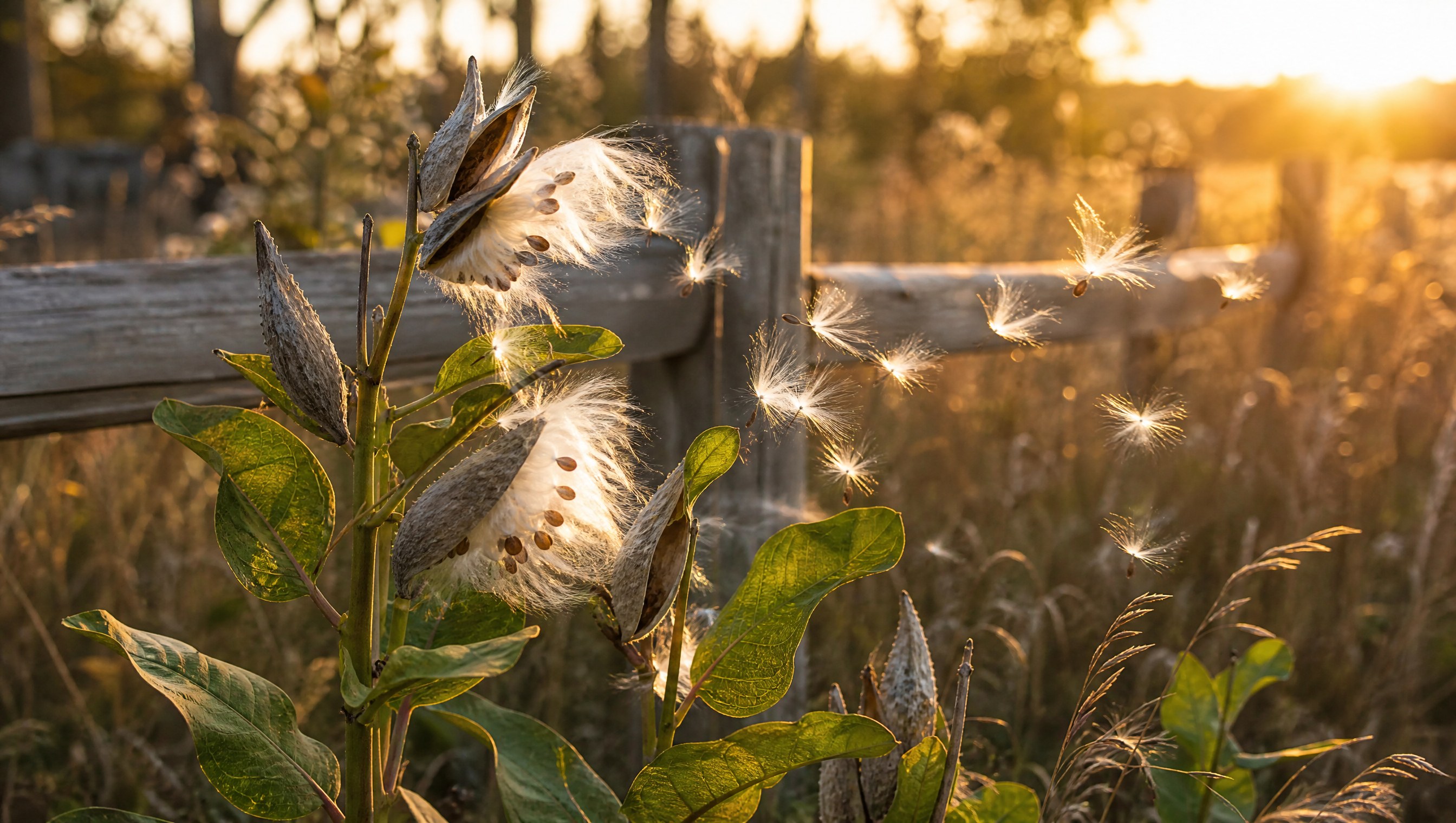

Every ditch and fence line east of the Rockies is about to turn white. The warty green pods on the common milkweed split along one seam in September and October and let go of a hundred or more flat brown seeds, each on a parachute of silk that will carry it a mile on a good afternoon. Most land on pavement. A few of them could land in your garden, on purpose, and in two years you would have the plant the monarch cannot live without. This is the season to do it, and the whole job takes an afternoon.
The reason fall matters is inside the seed. Milkweed seed will not germinate straight off the plant. It carries a chemical lock that only cold and damp will open, a safeguard that keeps it from sprouting in a warm October and dying in November. Gardeners who sow in spring have to fake that winter in a bag of damp sand in the refrigerator for a month. Gardeners who sow in fall let the weather do it. The seed sits on the cold ground, freezes and thaws a dozen times, and comes up in May on its own schedule.
Picking the right pods
Go for pods that are just starting to split, or that split when you press the seam gently with a thumbnail. Inside, the seeds should be brown, flat, and papery, packed in overlapping rows like fish scales around the white silk. Green or pale seeds are not ripe and will not grow. A pod that is fully open and blown is fine too if the seeds are still in it, but the wind usually gets there first. Take a paper bag, not plastic, because a damp pod in plastic molds in a day.
You do not need many. One pod holds anywhere from fifty to two hundred seeds, and a single common milkweed plant will spread by its roots once it is established. Six pods is a patch. Leave the rest for the wind and for the neighbors' gardens, and never strip a small stand bare. If the plant is on someone's land, ask. Most people are glad to have you take the weeds off their hands until they learn what the weeds are.
Getting the silk off in thirty seconds
The silk is the hard part, or seems to be, until you know the trick. Hold the pod closed over a paper bag, pinch the pointed end where all the silk is attached, and pull the seeds off the bundle with your other thumb, stripping downward. The silk stays in one tuft in your fingers and the seeds fall into the bag. Done that way, a pod cleans in under a minute. Done the other way, by pulling silk off seeds one at a time, you will be at the kitchen table until Thanksgiving.
If you have a lot, put seeds and silk together in a paper bag with a couple of coins, close it, and shake it hard for a minute. The seeds knock loose and settle to the bottom, and you cut a small corner off the bag to pour them out while the silk stays behind. Spread the cleaned seed on a plate for a day somewhere dry, then store it in a paper envelope in the cool until you are ready to sow. Do not leave it in a warm room for weeks.
Where it goes and how
Milkweed wants sun and does not want to be fussed over. Pick a spot that gets six hours or more, ideally one you will not till or mow, because common milkweed spreads by underground runners and will wander a few feet a year. The edge of a fence, the back of a bed, the strip along the drive, the corner by the shed. Clear the surface of grass and weeds so the seed touches bare soil. That is the only preparation it needs.
Then scatter the seed on the surface and press it in with the flat of your hand or the sole of your boot. Do not bury it. Milkweed seed needs light as well as cold, and a seed an inch down is a seed that never comes up. A quarter inch of fine soil or a dusting of sand over the top is as deep as you should ever go, and none at all is fine. Do not water. The fall rain and the snow will settle it. Mark the spot with a stake, because in May you will not remember, and the seedlings look like nothing for a month.
Which milkweed for which ground
Common milkweed, the tall one with the broad leaves and the fat warty pods, is the workhorse of the East and Midwest and the plant most monarch caterpillars are raised on. It is also the one that spreads, so give it room. Swamp milkweed has narrow leaves, pink flowers, and slender smooth pods, stays in a clump, and takes wet ground and heavy clay that common milkweed sulks in. Butterfly weed is the short orange one with a long taproot and no milky sap, best for dry banks and thin soil, and it takes an extra year to bloom. Any of the three, sown the same way, will do.
The one to leave out is tropical milkweed, the red and yellow one sold in garden centers in the South and in pots everywhere. It does not die back in a frost-free winter, and a monarch parasite that would normally be killed off each year builds up on it and infects the caterpillars. From about the Carolinas south and along the Gulf, plant the native species instead. Farther north it freezes and is harmless, but the natives feed more caterpillars anyway.
What to expect
Seedlings show in May as pairs of small oval leaves on a reddish stem, easy to mistake for a weed, which is what the stake is for. The first year they make a foot of growth and a root. The second year most of them bloom, and the third year you have a stand. Once the flowers open in June the plant runs a restaurant. Bees, wasps, beetles, and a dozen kinds of butterfly work the pink globes, and if a monarch passes within a mile she will find the leaves and leave you a striped caterpillar to watch.
Then, in September, your own pods split and let go of their silk, and the afternoon you spent in the ditch this week repeats itself in your yard, without you. Save a handful for a friend.
