
Planting & timing · Sep 5, 2026 · By Nell Harding
How to Grow an Oak From an Acorn This Fall
The acorns hitting the driveway this month are the cheapest tree you will ever plant, and the next four weeks are the only time of year to do it. Which acorns to gather, the sink test, why a white oak sprouts the week you plant it while a red oak waits for spring, and how to keep the squirrels out of the pot.
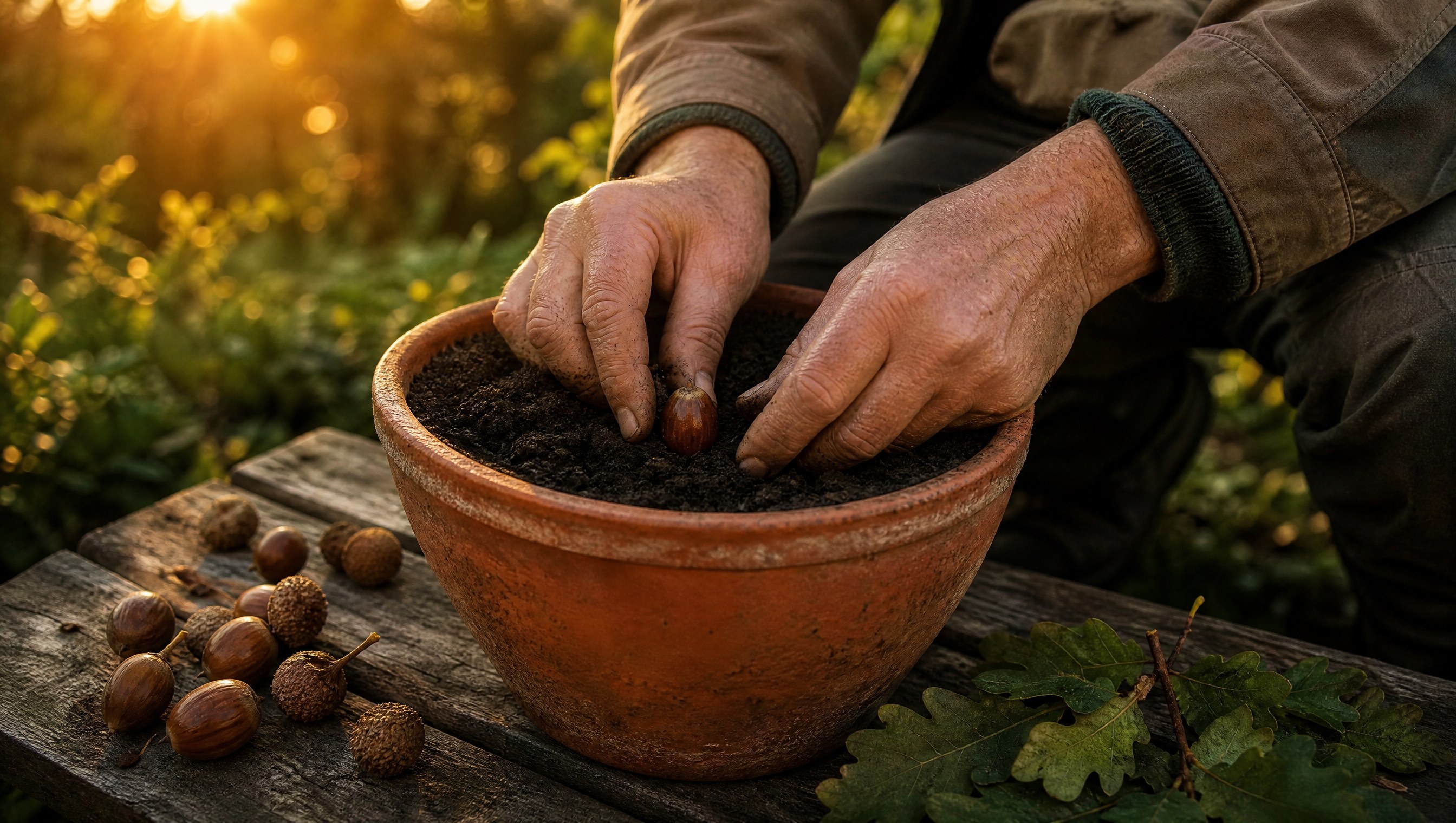

Every oak you have ever stood under started as one of the nuts that is bouncing off your roof this week, and the tree asks almost nothing of the person who plants it. No nursery, no root ball, no bill. An acorn, a pot of dirt, a square of chicken wire, and a winter outdoors. The catch is timing. Acorns do not keep. They are shed in September and October with the water still in them, and an acorn that dries out on a windowsill until spring is a dead acorn. If you want an oak from this year's crop, the work happens in the next four weeks.
Start by deciding which oak you are dealing with, because it changes what happens next. Oaks come in two great families. The white oak group, which includes white oak, bur oak, swamp white oak, and chestnut oak, has leaves with rounded lobes and no bristles at the tips, and its acorns ripen in a single season. The red oak group, which takes in red oak, pin oak, black oak, and scarlet oak, has leaves with pointed lobes that end in a fine bristle, and its acorns take two years on the branch. You can tell them apart from the leaf under the tree, and the difference matters in the pot.
A white oak acorn has no patience at all. It germinates almost as soon as it hits damp ground, in the fall, and sends a root down before the first frost while the shoot waits for spring. A red oak acorn will not sprout until it has sat through a cold, damp winter. Extension trials put the requirement at about thirty to forty five days between thirty two and forty one degrees for red and pin oak, and thirty to sixty for bur oak. That is not a problem to solve. It is a schedule. Both kinds go into the pot this fall. The white oak will be rooting by Thanksgiving, the red oak will be waiting, and both will have a shoot up by May.
Gathering the right acorns
Take them from the ground, not the tree, and take them early in the drop, in the first week or two after they start falling. An acorn that comes off the branch with its cap still fixed tight is not ripe. The good ones are brown, plump, and have shed the cap or let it go with a slight twist. Look at each one for a small round hole in the shell. That is the exit of an acorn weevil grub, and anything with a hole is empty. Squirrels sort the crop for you if you wait, and they take the sound ones first, which is another argument for going out early.
Then the sink test. Drop the acorns in a bucket of water and wait a minute. Most of the sound ones sink and most of the bad ones float, because a weevil grub or a shriveled kernel leaves air inside. It is a rough sort, not a guarantee. Extension people who have run the numbers find that some good acorns float and a few bad ones sink, so treat it as a way to throw out the obvious duds, and plant a few more than you need. Do not let them soak longer than a few hours, and do not let them dry afterward. Plant the same day or keep them in a bag of barely damp peat in the refrigerator for a week at most.
Pot or ground
There are two honest ways to do this. The first is to plant the acorn where the tree is going to stand for the next two hundred years. An oak grows a taproot before it grows much of anything else, and a seedling that has never been moved is the strongest oak you can make. Pick the site the way you would site a house. Full sun, well drained ground, at least twenty feet from foundations and further from the septic field, and nowhere near a power line. Push the acorn in on its side, half an inch to an inch deep, water it, and cover the spot with a square of hardware cloth pinned down with rocks. That last step is not optional. A squirrel will find one acorn in a lawn the size of a football field.
The second way is a pot, which is easier to protect and easier to move. Use a deep one, a tree pot or a tall nursery container at least ten inches deep, so the taproot has somewhere to go. Fill it with ordinary potting mix, lay the acorn on its side an inch down, water until it drains, and put the pot outdoors in a spot that gets rain and winter cold. It needs the cold. A red oak acorn kept in a warm garage will simply sit there. Cover the top of the pot with chicken wire or hardware cloth, bent over the rim and tied, and check it after every hard wind. Two or three acorns to a pot is fine. You will thin to the strongest in spring.
What the first year looks like
In a white oak pot, if you tip out the soil in November, you will find a pale root as long as your finger already reaching down from the split nut. Leave it alone. In April or May a red loop of stem pushes up, straightens, and opens a handful of leaves that look nothing like the adult tree. Take the wire off the pot the week the shoot appears, because it will grow through it. Water through the first summer whenever the top inch of the pot goes dry, and keep it in sun. By fall the seedling will stand a foot tall with a root twice that length.
That first fall is the time to plant it out, and it is the only time that is easy. A one year oak moves without complaint. A three year oak in a pot has wound its taproot around the bottom and never fully recovers. Dig a hole deeper than the root, set the seedling at the depth it grew, water it in, and put a wire cage around it for the first two winters against rabbits and deer. Mulch it, keep the grass back a foot in every direction, and then the job is done, because an oak on its own ground does not need you.
How long you are waiting
Be honest with yourself about the timeline. A red oak from an acorn can bear its first acorns in something like twenty years, a white oak closer to thirty, and neither is a shade tree in the sense of sitting under it for a decade. What you get sooner is the pleasure of a tree that is unmistakably yours, the one you can point at from the porch and say you planted from a nut you picked up in the driveway. Plant three. Give two away. The person who gets the sapling will have it longer than they have the house.
There is an old accounting in this. For most of English history the acorn crop was the year's pig feed, and a wood was valued in the Domesday Book by how many hogs it could fatten in October. The word itself is older than the oak in it, and meant the fruit of the open land before anyone tied it to a tree. So when you press one into a pot this month, you are doing the oldest thing a person can do with an acorn short of eating it, and you are doing it at the only time of year it works.
