
Garden myths · Sep 5, 2026 · By Nell Harding
The Box Turtle in Your Garden May Be Older Than Your House
Box turtles live past a hundred and almost never leave a patch a few hundred yards across, so the one eating your fallen tomatoes has likely been there for decades. The kindest thing most people do for one, carrying it somewhere safer, is the thing that kills it. What to do instead, this fall and on the road.
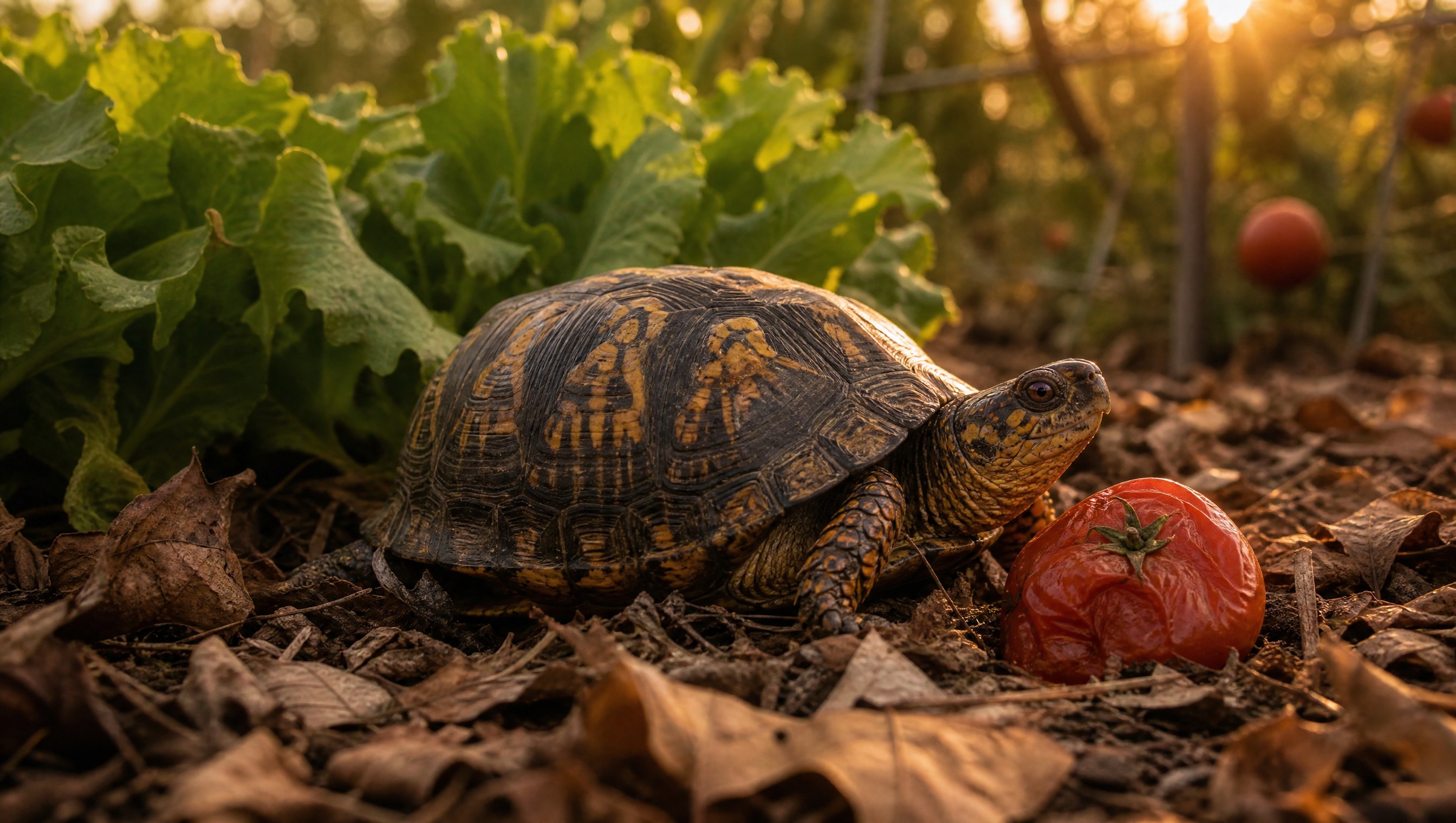

Somebody finds a box turtle in the garden every September, usually under the tomatoes, and does the decent thing. They pick it up, drive it to the woods or the pond a mile off, and set it down somewhere that looks like turtle country. It is one of the most common kindnesses in American gardening, and it is a myth in the exact sense we use the word here. It feels right, everyone does it, and it is wrong in a way that costs the animal its life. The turtle in your garden is not lost. It is home, and it has probably been home longer than you have.
Start with how long they live, because everything else follows from it. An eastern box turtle that makes it past its first few years can expect fifty, and a hundred is documented. The one in your yard could have hatched during the Depression. It has watched the lot go from field to house to garden, and it has done that watching from an astonishingly small piece of ground. Radio tracking puts a box turtle's home range at a circle a couple of hundred yards across or less, and most individuals spend their entire lives within about two hundred and fifty yards of the nest they crawled out of. They know every log, every damp corner, every place a tomato falls.
Why moving it goes wrong
A box turtle carries a map of that patch in its head, and a homing sense that points back to it from a surprising distance. Set it down a mile away and it does not settle into the new woods. It starts walking home. Researchers who tracked relocated turtles found their ranges ballooned to three to seven times the size of a resident's, because the animal was searching, and searching means crossing roads, lawns, dog runs, and highways that it would never have met on its own ground. Many die on the road. Many more simply wander until winter catches them somewhere with no good place to dig in. A turtle moved more than a mile or so usually never finds its way back and never stops trying.
The population math makes it worse. Box turtles do not replace themselves quickly. A female lays a handful of eggs a year, most nests are dug up by raccoons and skunks within days, and a hatchling the size of a quarter is food for nearly everything. The species survives by having adults that live for decades and keep laying. Every adult taken out of a neighborhood, whether by a car, a bucket, or a well meant drive to the state park, removes a breeder that took twenty years to make. That is why the eastern box turtle is listed as vulnerable across its range, and why several states now make it illegal to take one home.
What it is doing in your garden
Eating, mostly, and doing you a favor while it does. Box turtles are omnivores with a sweet tooth. In September that means fallen tomatoes, the split figs, windfall apples, and any berry they can reach, plus mushrooms, which they eat in quantities that would put a person in the hospital. They also eat slugs, snails, earthworms, beetle grubs, and the occasional small frog. A turtle working the edge of a bed is a slow, patient slug patrol that asks nothing but a soft place to sleep. The tomato it takes was one you were going to lose anyway.
It is also, right now, running out the clock. When the nights settle under fifty degrees, usually in the second half of October in the middle of the country and a little later south, the turtle pushes into leaf litter under a hedge, the soft ground by a compost pile, or an old stump, and stops. Most do not go deep. A few inches, sometimes just under the leaves, with the shell closed. In cold regions they work further down, to eighteen or thirty inches, below the frost. And box turtles carry an insurance policy almost no other animal their size has. If the ground freezes around one, the turtle can freeze with it, more than half the water in its body turning to ice and the heart stopping, and then thaw out days later and walk away. Researchers who measured it found nothing else that large on the continent could survive that.
What to do instead
Leave it where it is. That is the whole rule, and nearly everything else is a footnote to it. Take a photograph if you like, note the pattern on the shell, which is as individual as a fingerprint, and let it go about its business. You will see it again next year, and the year after, and if you keep a garden journal you may find it becomes the oldest entry in it.
The one exception is the road. A turtle on the pavement is in real danger, and the right move is to carry it across in the direction it was already heading and set it down on the far shoulder, on the same road, no further. Do not turn it around and do not take it to water. A box turtle is a land animal and cannot swim well. Do not drive it anywhere. If it is injured, a wildlife rehabilitator will take it, and most can be found through the state wildlife agency in a few minutes.
Then make the yard worth staying in, which is cheap. Leave the leaves in at least one corner and let a brush pile stand, because that is where it will winter and where it hunts. Set a shallow dish of water at ground level, a plant saucer sunk to the rim, and keep it full through dry spells. Skip the slug pellets and the lawn chemicals, since the turtle eats what they poison. Mow high and walk the tall grass before you cut it, because a mower is the second biggest killer of box turtles after the road. If you have a dog that carries things, a low wire fence around the vegetable garden protects the turtle and the tomatoes at once.
The hinge
The reason the same animal can live through sixty years of raccoons and dogs is the bottom of its shell. A box turtle's plastron has a hinge across it, and when it pulls in its head and legs it closes the front and back doors up tight against the top shell, so tight a knife blade will not slide in. Nothing in a suburban yard can open it. That is what made a hundred year life possible in the first place, and it means the only thing in your garden that can really hurt the turtle is you, with the best of intentions and a bucket.
So this fall, when the tomatoes are down and you find it under the vines with orange spots on the shell and a red eye looking up at you, put the bucket away. It knows where it is. It has known for longer than the house has stood there, and if you leave the corner of the bed unraked, it will be there in April to prove it.
