
Garden myths · Sep 4, 2026 · By Nell Harding
The Groundhog Under Your Shed Is About to Vanish
By late October the groundhog that has been flattening your beans will seal itself into a chamber below the frost line and slow its heart to five beats a minute. Here is what it is doing down there, what the burrow is doing to your ground, and the one fence detail that actually keeps it out of a bed.
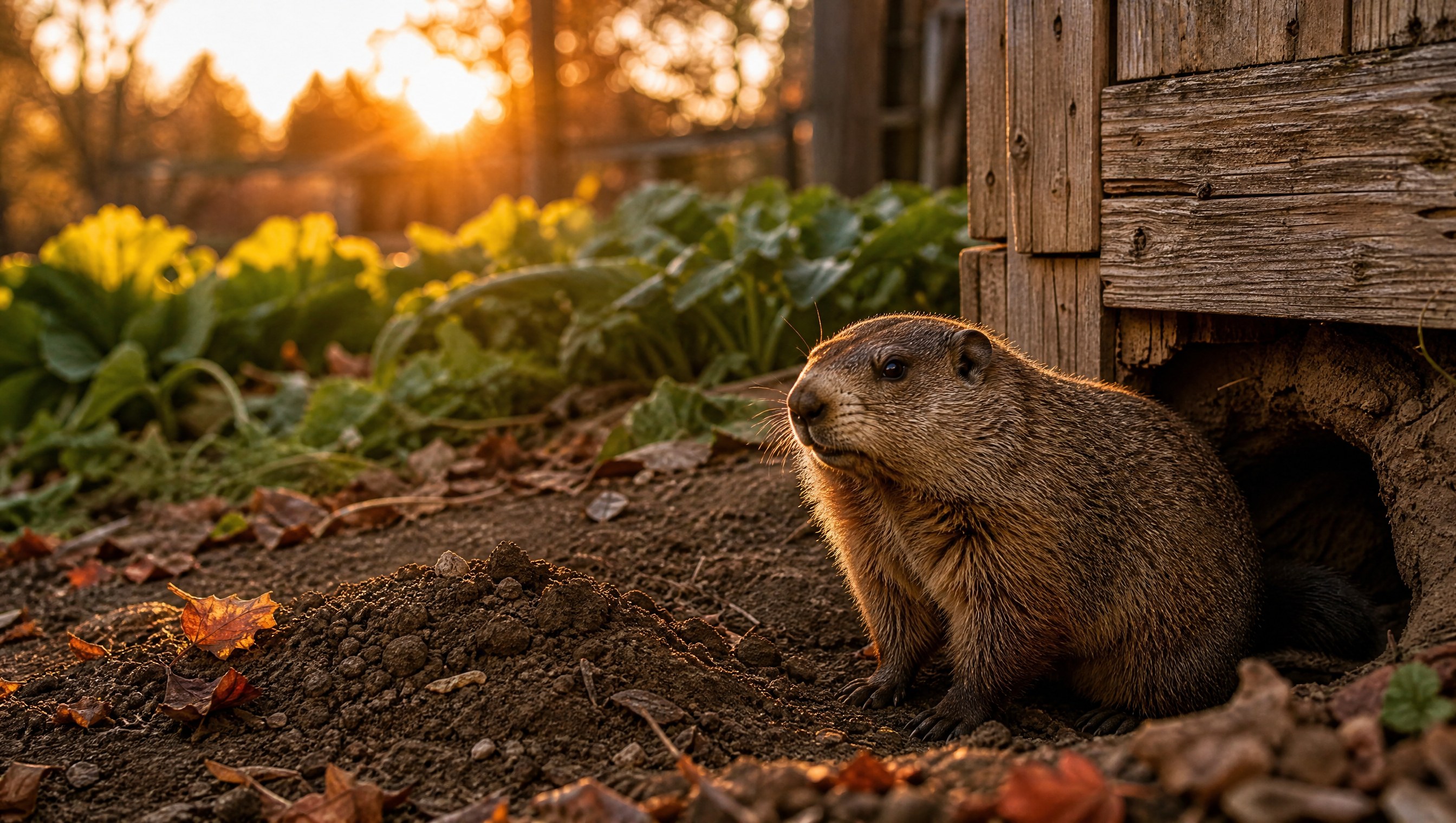

The groundhog under the shed has been eating like it has a deadline, because it does. Sometime in the last two weeks of October, a little earlier up north and a little later toward the Carolinas, it will walk down its main tunnel for the last time this year, turn into a side chamber dug below the frost line, backfill the passage behind it with dirt, and shut its body down almost to the point of death. It will not come up again until February. Everything it is doing to your garden right now is preparation for that.
Most of the animals we say hibernate do not. Bears sleep lightly and wake. Chipmunks go into a torpor they break every few days to eat from a stored pile. Skunks and raccoons den up and come out in mild spells. The groundhog, also called the woodchuck and in some places the whistle pig, is one of a very short list of true hibernators in North America, and it does the real thing. Its body temperature falls from around ninety nine degrees to the high thirties, a few degrees above the soil around it. The heart, which runs at eighty beats a minute in September, slows to four or five. Breathing drops from sixteen breaths a minute to two. In that state it burns almost nothing, and it burns only fat.
That is why it is so fat now. A groundhog cannot store food in its burrow the way a chipmunk does, and it cannot wake to hunt the way a fox does. Every calorie it will spend between Halloween and Valentine's Day has to be on its body when it goes down. So from August on it eats more than a pound of green vegetation a day, mostly in the early morning and again in the late afternoon, and it favors exactly the things we plant for ourselves. Beans, peas, broccoli leaves, lettuce, the tops of carrots, and the blossoms off the squash. A groundhog that weighed seven pounds in May can weigh twelve by October, and it will lose a quarter of that or more lying still in the dark.
What the burrow is doing under there
The tunnel system is bigger than most people expect. A main entrance, usually under something that gives cover, which is why it is so often the shed, the deck, or the woodpile, drops steeply for a foot or two and then levels out. From there the tunnels can run twenty five to thirty feet with several chambers off them. There is a nest chamber lined with dry grass, a separate toilet chamber, and in fall a hibernation chamber dug deeper than the rest so that it sits below the frost line. There are also one or more spy holes, plunge holes dug from below with no mound of dirt beside them, which is how the animal vanishes so fast when the dog comes around the corner.
Moving that much soil has consequences. A groundhog can shift several hundred pounds of dirt digging one system, and the mound at the main entrance is the sign. Under a shed on skids, the digging can undermine a corner until the floor sags. Under a deck it usually does no harm. In an open bed the collapsed side tunnels are what turn an ankle. The one real benefit, and it is real, is that an abandoned burrow is the winter home for half the neighborhood. Rabbits, skunks, opossums, foxes, and snakes all use old groundhog holes, and a good one is occupied for decades after the digger is gone.
The part Groundhog Day gets right
The February holiday is a fiction with a true fact under it. Groundhogs do come up in early February, weeks before there is anything to eat, and it is the males who do it. They walk their territory, visit the burrows of the females in it, and go back down for another month. Mating happens in March, right after the females emerge. The cubs, usually four or five, are born in April and out on the lawn by June. So the animal you see poking its head out in a February thaw is not checking the weather. It is checking who is still home.
By the way, it cannot see its shadow in the sense the story means, and it would not care if it could. It is a nearsighted grazer that lives by smell and by the whistle, the sharp alarm note that gives it the whistle pig name. Hear that whistle across the yard and you can be sure there is a second one somewhere, because the whistle is for family.
Getting it out of the bed, honestly
Almost nothing sold to repel groundhogs works for more than a day or two. Scent granules, ultrasonic stakes, and the pinwheels on the fence post all fail, because a hungry animal that has already found a bean row learns fast that the smell is not attached to anything. Trapping and moving one is illegal in many states and pointless in most of the rest, since the burrow is what draws the next groundhog in.
What works is a fence, and it works only if it is built for the way a groundhog moves. It climbs well and it digs well, so a fence that stops it has to answer both. Use welded wire or chicken wire at least three feet high. Bury the bottom a foot deep, and bend that buried foot outward in an L shape away from the bed, so that an animal digging at the base hits wire and gives up. Then leave the top foot of the fence unattached to the posts so it wobbles. A groundhog that starts to climb a fence that flexes under its weight backs down. That floppy top is the detail almost everybody leaves out, and it is the one that matters.
If the burrow is under a structure you want it out from under, wait until the animal has gone down for winter, which is easy to tell because the fresh dirt at the entrance stops appearing and the grass at the hole stays uncut. Then, and only then, block the entrance and any spy holes you can find with hardware cloth and rocks. Doing it in September seals a live animal in or, more often, teaches it to dig a new door under the same shed. Doing it in December means it wakes in February against a wall and moves on.
And if the groundhog is under the back corner of the lot where nothing you care about grows, there is a reasonable case for leaving it. It is a native animal doing a native thing, its burrow will house a fox next year, and it will keep the clover down. Watch it in October. There is a week, always, when it stops coming out in the afternoon, and then a morning when it does not come out at all. That is the season turning, six inches under your feet.
