
Garden myths · Aug 2, 2026 · By Nell Harding
Old weather signs, put on trial
Crickets, pine cones, red skies, and cows lying down. Which folk forecasts hold up, and which are barn-door decoration.

First shared on the Facebook page in May 2026, and kept here since the site opened in August.
Before radar, gardeners read the sky, the insects, and the cows, and a surprising amount of that reading was sound. Folk weather signs split cleanly into two camps: the ones that track real physics on a one-to-two-day horizon, and the ones that claim to see whole seasons ahead. The first camp earns its keep. The second is charming furniture. This entry sorts the best-known signs into their camps, because a gardener who knows which is which gets a genuinely useful free forecast.
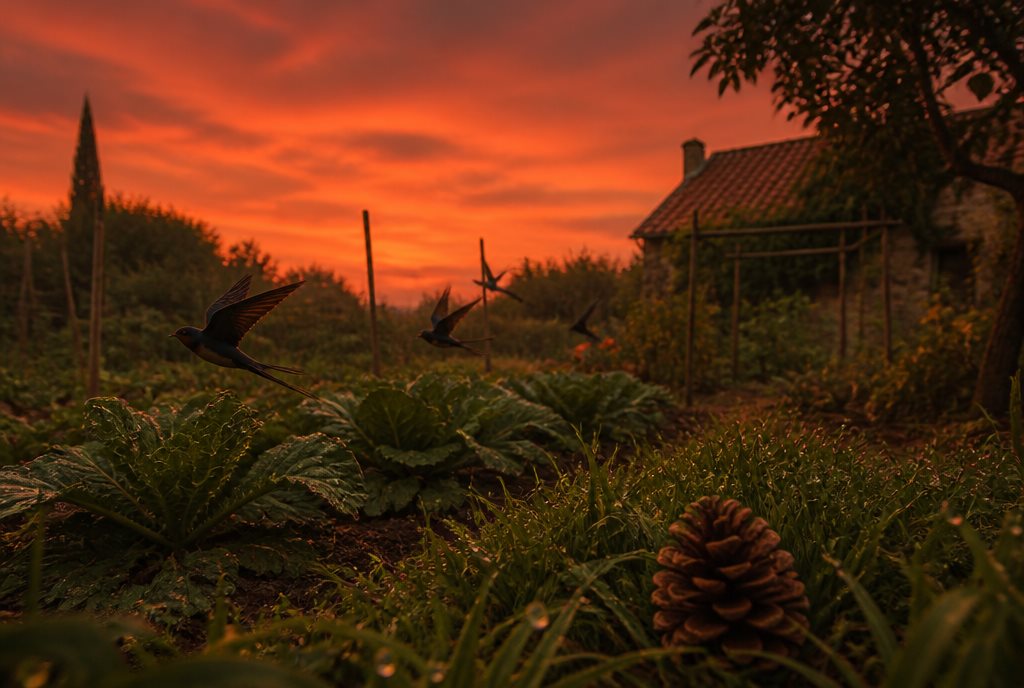
Start with the best of them: red sky at night, sailor's delight; red sky in morning, sailor's warning. In the mid-latitudes weather mostly travels west to east, and a red evening sky means the setting sun is shining through clear, dry air to the west, which is the air arriving tomorrow. A red morning sky means the clear air has already passed east and something wetter may be following. It is not a guarantee, but meteorologists give the old couplet real credit; it fails mostly when weather arrives from an unusual direction.
The cricket thermometer is better than sound; it is arithmetic. Crickets are cold-blooded, and their chirp rate rises and falls with air temperature so reliably that the relationship has a name, Dolbear's law: count the chirps in fourteen seconds, add forty, and you have the temperature in Fahrenheit within a few degrees. On a summer evening it is the cheapest thermometer in the garden, and the slow, laborious chirping of a cool night really is the sound of the season turning.
Dew and its absence make another honest one-day sign. Heavy dew forms on clear, calm nights, and clear, calm nights usually belong to fair-weather high pressure, so a soaked morning lawn leans toward a dry day; when dew is on the grass, rain will never come to pass. A dry morning after a mild night often means wind or cloud moved in overnight, and rain may be closer than the sky admits. It reads tomorrow only; it knows nothing about the afternoon after.
Swallows flying low is real, with an asterisk. Falling pressure and humid air ahead of a storm push the insects swallows hunt closer to the ground, so the birds follow them down. Watch on a heavy afternoon and you can see it happen. The asterisk is that insects also fly low for reasons that have nothing to do with weather, so treat low swallows as a nudge to check the sky, not a verdict.
Leaves turning their backs before a storm is half real. The saying goes that trees show their silver undersides when rain is coming, and the humid, gusty air ahead of a front genuinely does flip the leaves of maples, poplars, and oaks. But so does any stiff wind on any dry day. The sign is the combination: silvered leaves plus a heavy sky plus that green storm light is a fine cue to get the tools under cover.
Now the other camp, starting with the pine cone. Cones do open in dry air and close in damp; the scales flex as they lose and gain moisture, and a cone on the porch rail is a working, if slow, hygrometer. What it is not is a forecast: it reports the humidity you are already standing in. Useful for judging whether the morning will dry out for hay or laundry; useless for tomorrow.
The woolly bear caterpillar wears the most beloved false reputation in the garden. The brown band's width supposedly predicts the winter ahead; in truth it records the caterpillar's age and how good its growing season was, which is to say, the summer just finished. Entomologists have counted bands for decades without finding a winter signal. The same verdict lands on thick onion skins, heavy acorn crops, and high hornet nests: each reflects the growing conditions of the season past, not knowledge of the season coming. A fat acorn year means the oaks had a good spring, and nothing else.
Cows lying down before rain rounds out the trial, and it fails on the simplest grounds: cows lie down to rest and to chew, many times a day, in every weather. Studies that bothered to check found no link. If the whole herd bolts for the tree line, believe them; a lying cow is just a cow.
So the honest scorecard: trust the sky signs and the insect signs on a one-to-two-day horizon, enjoy the seasonal prophets as decoration, and remember why the good ones work: they are all reading pressure, humidity, and temperature, the same instruments the forecast reads, just worn as feathers and chirps. The gardener's edge is that these signs report from your exact yard, which no regional forecast does.
This almanac keeps a soft spot for the whole tradition, tested honestly, the way the folklore entries here always are. Watch the evening sky, count a cricket some August night, and check the morning grass with your finger like the watering entries taught. The forecast on your phone is better at the week ahead. The garden is better at right here, tonight.
