
Garden myths · Sep 28, 2026 · By Nell Harding
The Turtles on Your Pond Log Spend Winter Under the Ice
Painted turtles bask on every sunny log they can find this time of year. Soon they will sink into the mud under the ice and stay there for months, with almost no oxygen. Here is how they do it, and how to leave them in peace.
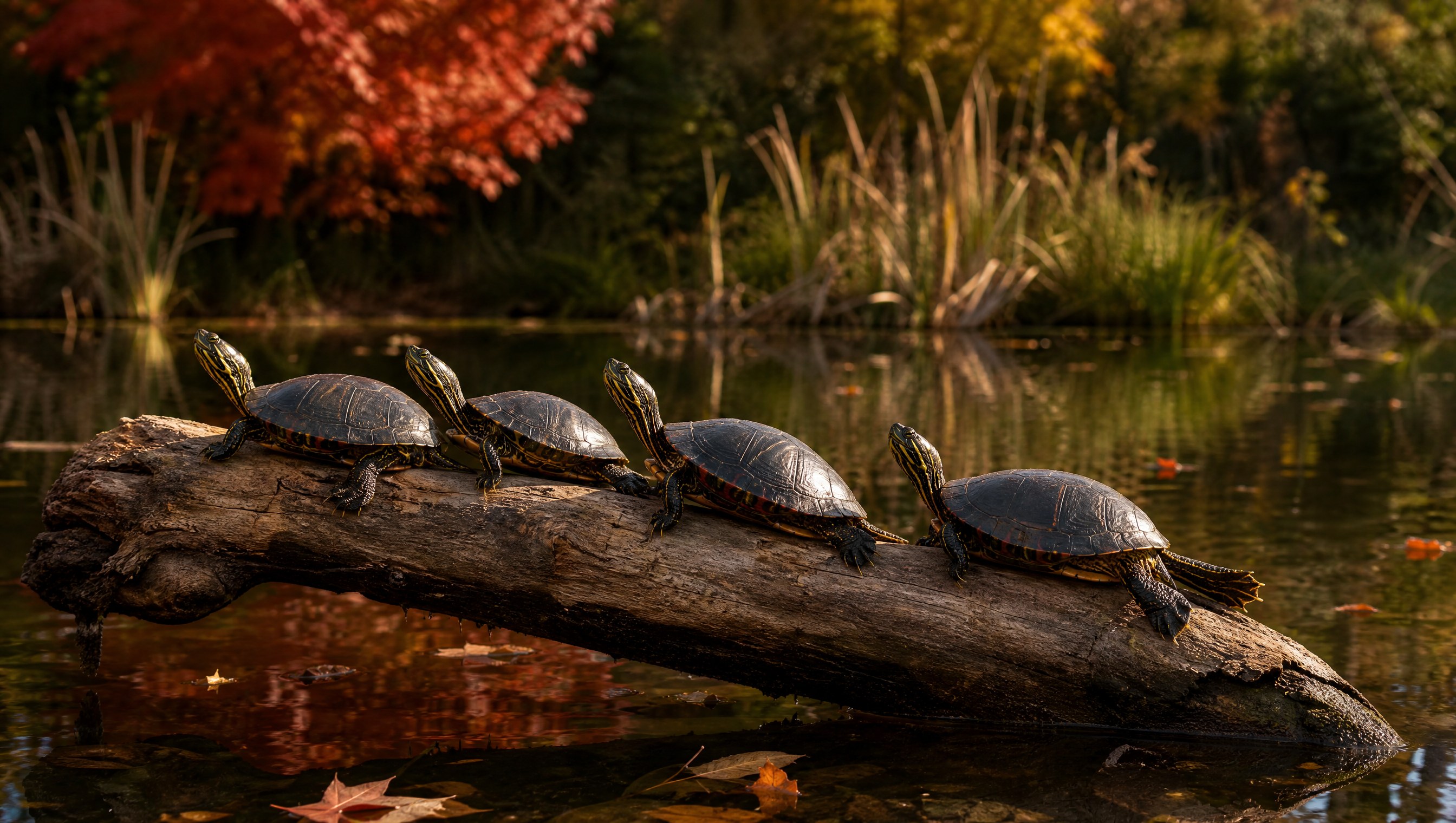

On a warm afternoon at the end of September, almost any pond with a fallen log has a row of turtles on it. They sit in a line with their necks stretched out and their back legs splayed behind them, and at the first footstep on the bank they slide off into the water one after another. In a few weeks they will be gone from the logs entirely, and they will not come back until spring. Where they go, and how they last the winter there, is one of the strangest survival stories in the backyard.
WHICH TURTLES THESE ARE
In most of the country, the turtles lined up on a pond log are painted turtles. Carleton College's Cowling Arboretum in Minnesota describes them as named for their bright orange undersides and streaks of yellow, and calls the painted turtle the most common turtle on its grounds. The shell on top is smooth and dark, edged with thin lines of yellow and red, and the head and neck carry yellow stripes.
They are pond and slow-water animals. The Nature Conservancy notes that painted turtles spend most of their time in ponds and slow-moving freshwater, which is why a backyard pond, a farm pond or a quiet cove of a lake is where people meet them.
WHY THEY BASK SO HARD NOW
A turtle cannot make its own body heat the way a bird or a mammal does, so a log in the sun is a heater. In the fall, basking is the last chance to warm up before the long cold. Carleton's arboretum writers describe the turtles in their neighborhood basking in the late afternoon as fall creeps in, and The Nature Conservancy has a photograph of a painted turtle in the Portland, Oregon area still out and basking in November.
Once the water turns cold for good, the basking stops, and the turtles go down.
INTO THE MUD, UNDER THE ICE
The Nature Conservancy calls the painted turtle the king of winter. It says a sheet of ice does not stop painted turtles, it only slows them down, and that even in the northernmost parts of their range adults spend the winter under the ice, sometimes buried up to 45 centimeters, about a foot and a half, in the mud beneath the water.
Kurt Buhlmann of the University of Georgia told the Conservancy that if you cut through the ice you would think they were dead, and that it would take hours for them to move. In lab experiments, the Conservancy reports, adults have survived for more than 100 days in water at 3 degrees Celsius without food or oxygen. In the wild, some northern turtles stay dormant for up to six months.
HOW THEY BREATHE, OR DON'T
Painted turtles have lungs, and in summer they get most or all of their oxygen by breathing air like we do. Under the ice they cannot reach the surface, and Carleton's arboretum puts the problem in stark terms. Within hours of going under, a turtle's blood oxygen drops to near zero. With the same level of oxygen in our blood, a person would survive for three or four minutes. Painted turtles survive for three or four months.
Part of the answer is that they take in a little oxygen through the water itself. The Nature Conservancy says that while submerged for the winter, they can absorb some oxygen through their skin, their mouth and their cloaca, the opening at the hind end. Carleton describes it as drawing oxygen from the water as it passes over blood vessels in those places.
The bigger part of the answer is that they almost stop. The Conservancy says a painted turtle's metabolism in winter drops by as much as 95 percent when it has some oxygen, and as much as 99 percent when it has none. At that pace its body needs so little energy that it can go months without food or air.
WHEN THE OXYGEN RUNS OUT
In a small pond under thick ice, the oxygen in the water can run out entirely. Most animals die in minutes without oxygen, because the heart and the nervous system fail. A painted turtle switches to a backup. The Nature Conservancy explains that it breaks down stored glycogen, which releases just enough energy to keep it alive but also produces lactic acid, the same acid that builds up in tired muscles, and enough of it can be deadly.
The turtle's answer is its own shell. According to the Conservancy, painted turtles change their blood chemistry by borrowing materials from their skeleton and shell to balance out the acid, and they can also store some of the lactic acid in the skeleton and shell. Carleton's writers describe the shell and bones releasing carbonate buffers to neutralize it. The shell that protects the turtle all summer is also its chemistry set all winter.
WHY THEY ARE DESPERATE FOR SPRING
By the time the ice goes out, a painted turtle has months of acid to clear. Carleton's arboretum says that come spring, turtles are desperate to bask in sunlight, which raises their metabolism and helps rid their bodies of the acidic by-products of the winter. That is why the first warm days of spring bring them straight back to the same logs, sometimes stacked on top of one another.
Their young take a different route through the cold. The Conservancy notes that hatchling painted turtles come out of their eggs in autumn but stay underground in the nest on land for the winter, and only emerge in spring.
HOW TO HELP THEM
The best help is to leave the winter alone. The Nature Conservancy says that sometimes you can see turtles lying still under clear ice, and asks people not to break it. The ice is a buffer between the turtle and the colder air above, and a turtle pulled out might freeze.
If you own a pond, the Conservancy's warning about wetlands applies to you too. Draining the water in fall exposes turtles resting on or in the mud to freezing temperatures, and it will kill them. Keep the water in, keep a log or two where the sun hits it, and the same turtles will be lined up there again when the ice lets go.
