
Planting & timing · Sep 30, 2026 · By Nell Harding
The Tree by the Streetlight Keeps Its Leaves Longer
Every fall there is one tree on the block that hangs on after the rest have gone bare, and it is almost always the one beside the streetlight. It is not a hardier tree. It is a tree whose clock has been tampered with.
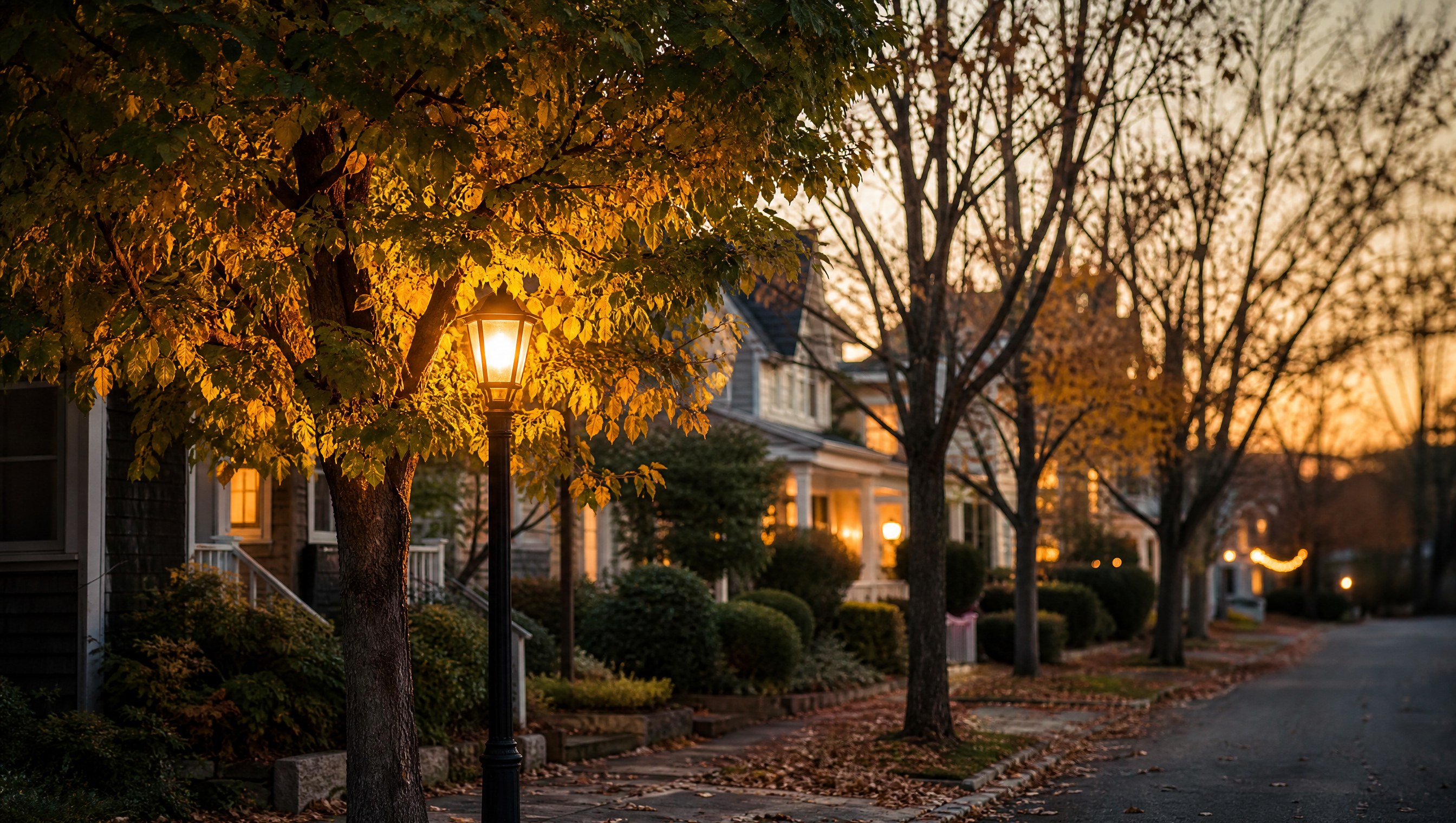

Walk your street some evening in late October and look for the odd one out. The maples and lindens and oaks down the block have mostly let go, and their leaves are drifted along the curb. But one tree, usually the one standing right beside a streetlight, still carries a full crown of leaves, lit from below like a lampshade. It looks like the healthiest tree on the street. What it really is, is a tree that has lost track of the calendar.
TREES KEEP TIME BY THE DARK
We tend to think of fall as something the cold does to a tree. The first frost comes, and the leaves drop. But the cold is only part of the signal, and for many trees it is not the most important part. Ecologist Nalini Nadkarni, emeritus professor at the University of Utah and The Evergreen State College, explains it in her KUER TreeNote segment on city lights: trees use light, and darkness, to measure time.
The changing length of days and nights, she says, is their seasonal clock. It guides how they respond to the turning year. As the nights lengthen through September and October, a tree reads that growing darkness as the cue to wind down, to pull what it can out of its leaves and let them go before winter.
WHAT A STREETLIGHT DOES TO THAT CLOCK
A streetlight shines all night, every night. To the branches nearest it, the long nights of fall never quite arrive. Nadkarni says artificial light at night can scramble the signals trees rely on, and that trees growing near streetlights often open their buds earlier in spring and hold their leaves longer in fall, by days or even weeks.
It is not only single trees, either. Researchers at Vanderbilt University, led by Lin Meng and Huidong Li, looked at satellite data from 428 cities across the Northern Hemisphere, combining nighttime light measurements, air temperature and plant greenness. They found that city vegetation leafs out about twelve days earlier in spring and holds onto its leaves about eleven days later in autumn than vegetation in the countryside nearby.
The surprise in their study, published in Nature Cities, was the cause. Most of us would have guessed the warmth of the city was stretching the season. The Vanderbilt team found that artificial light at night was the strongest driver of the change, often outweighing temperature.
WHY A LONGER SEASON IS NOT A GIFT
It is tempting to see the green tree by the lamp as lucky. It gets a few more weeks of leaves, a few more weeks of making food. The trouble is what comes at the end. Nadkarni says delayed dormancy can leave trees less prepared for winter cold and drought. A tree that is still in summer mode when the first hard freeze arrives has not finished closing up shop.
The spring side has its own risk. In Utah, she notes, early leaves are vulnerable to the late frosts that are common there. A bud that opens a week early under a streetlight can be caught by one cold April night.
The light reaches beyond the tree itself. Many trees are pollinated by moths and beetles that fly at night and navigate by moonlight and starlight, Nadkarni says. Bright lights disrupt those signals, which can mean less pollination and fewer seeds for the birds and animals that depend on them.
WHAT IT MEANS IN YOUR OWN YARD
You cannot do much about the city streetlight. You can do something about the lights on your own house. A porch light, a floodlight over the driveway or a security light on a timer can play the same trick on a young tree or shrub planted close by, especially one you are still nursing through its first few winters.
If a tree grows right beside a light that stays on all night, it is worth aiming the light away from the branches, shielding it, or putting it on a motion sensor so it only comes on when you need it. The goal is simply to give the tree its long, dark fall nights back.
Holiday lights are a different matter, since they go up after the leaves are down. The Morton Arboretum's Plant Clinic still advises taking them down promptly. It points out that although deciduous trees and shrubs may be bare in November and December, most have already formed the flower and leaf buds that will open in spring, and the Arboretum removes its own lights right after the holidays so its trees are free before spring growth begins in March.
So the next time you pass that one green tree glowing under the lamp, take a second look. It is a small, visible sign of something we rarely think about: that trees are counting the dark, and that our lights are changing the count.
