
Garden myths · Sep 30, 2026 · By Nell Harding
The Blue-Tailed Lizard on Your Deck Is a Young Skink
That slim striped lizard with the tail so blue it looks painted is a young five-lined skink, hatched this summer from an egg its mother guarded for a month. Here is where it came from, where it goes for the winter, and why you should never grab it by the tail.
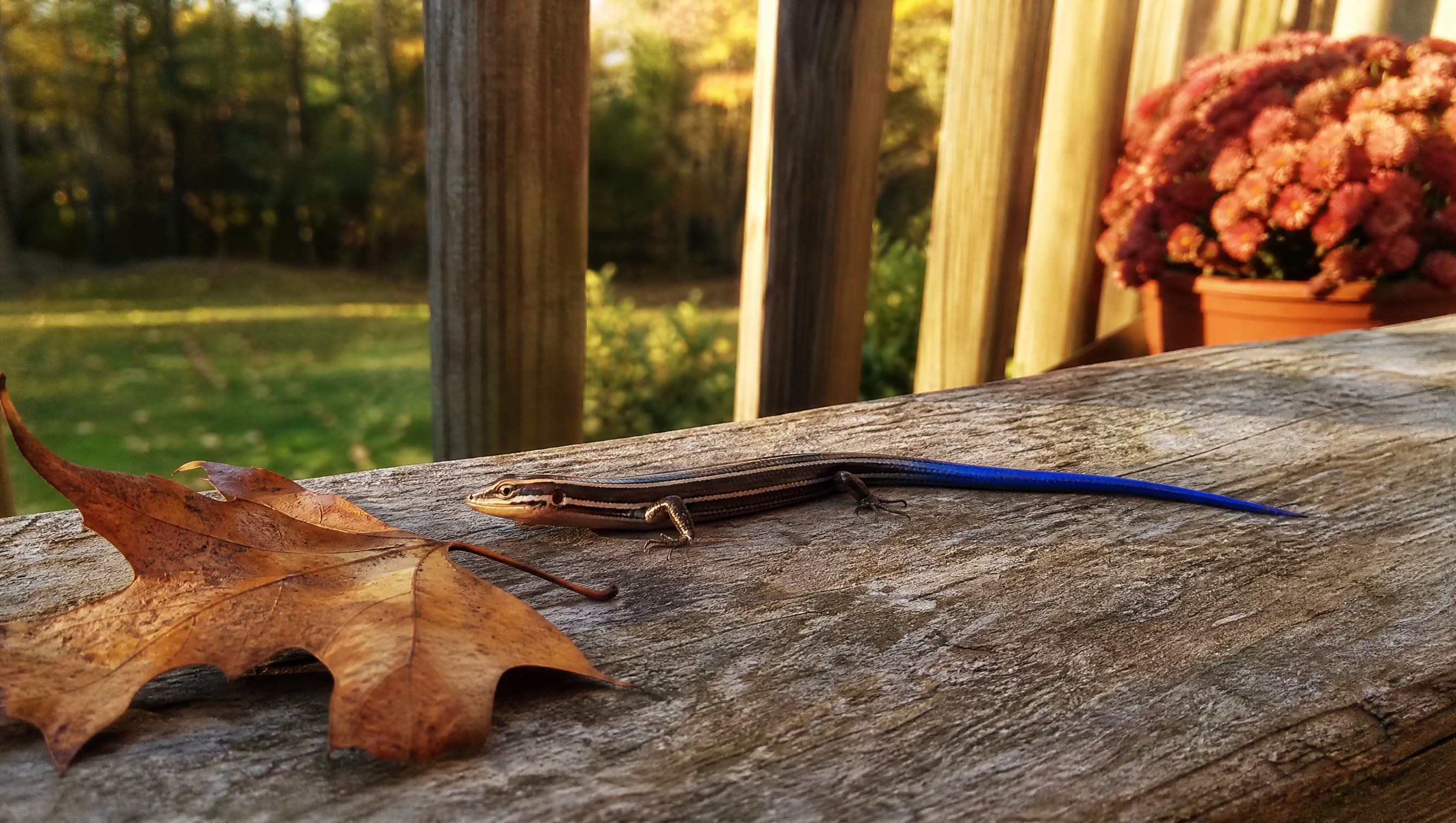

It is there one moment, flattened against a sunny deck board or the top of a stone wall, and gone the next. What you remember is the tail. It is a blue so bright it hardly looks real, running off the end of a slim, striped little body. If you have seen one this fall, you have met a young five-lined skink, and it has had a more eventful first summer than you might guess.
HOW TO KNOW IT
The Connecticut Department of Energy and Environmental Protection describes the young plainly: five white or yellowish stripes on a blackish body, and a bright blue tail. Adults measure 5 to 8.5 inches long, including the tail. The Chesapeake Bay Program notes that the stripes run from nose to tail, which is where the common name comes from.
The look does not last. As skinks grow older and larger, Connecticut's fact sheet says, the pattern becomes less conspicuous. The stripes darken, the body lightens, and the blue tail turns gray. So the bright blue ones you see are the youngsters, and a plain, brownish lizard on the same wall may well be one of their parents.
Why the blue? The Illinois Department of Natural Resources says the bright tail is believed to be an identifying feature that protects the young from attack by adult males. In other words, the color may be a signal to other skinks that this one is a juvenile and not a rival.
A MOTHER THAT STAYS WITH HER EGGS
Most reptiles lay their eggs and leave. The five-lined skink does something rarer. In Connecticut, the state's biologists write, courtship and mating happen in April or May, and about six weeks later, in June or July, the female digs a small nest in leaf litter, a rotting log or loose soil and lays between 4 and 20 eggs, typically 9 to 12.
There is no covering on the nest, but the female guards the eggs through the month-long incubation. The Illinois Department of Natural Resources says she stays with them until they hatch, a period of one to two months. The Chesapeake Bay Program adds that skinks tend to choose large decaying logs or stumps in moist spots for their nests, which lets several females care for and defend their eggs together.
The eggs are small and papery, about half an inch long according to the Chesapeake Bay Program, and they need a humid place to develop. Connecticut notes that the eggs actually grow larger as they incubate. The Chesapeake Bay Program reports that in colder weather they may take nearly two months to hatch.
Then the care ends abruptly. The eggs hatch in August and September, Connecticut says, and one to two days after they hatch, the female leaves the young on their own and does not return. The blue-tailed lizard on your deck this fall has been fending for itself for weeks.
THE TAIL IS BUILT TO BREAK
The single most important thing to know about a skink is how its tail works. When grasped by a predator, Connecticut's fact sheet says, both adults and young will readily lose most of their tails. There are breaking points built into the bones of the tail, much like the perforations on a sheet of paper that make it easy to tear.
The detached tail keeps thrashing on the ground, holding the predator's attention while the lizard escapes. The Chesapeake Bay Program describes the same trick: the tail continues to twitch while the skink runs away to hide. A new tail grows back, but Connecticut notes that it is somewhat shorter than the original and somewhat gray.
So if a child in your family wants to catch one, the kindest rule is simple. Look, do not grab, and never by the tail. The lizard can survive losing it and will grow another, but the new one is never quite the tail it lost.
WHERE IT GOES FOR THE WINTER
Enjoy the sightings now, because they will not last much longer. The Chesapeake Bay Program says that during the winter months, skinks hibernate, and the young one on your deck will soon disappear until spring warms the boards again.
The places skinks choose for their nests are worth keeping, too. Connecticut's biologists list leaf litter, rotting logs and loose soil, and the Chesapeake Bay Program points to large decaying logs and stumps in moist spots. If you have an old log at the edge of the garden, it may be a skink nursery next summer.
