
Garden myths · Sep 29, 2026 · By Nell Harding
The Titmouse at Your Feeder Is Stocking a Winter Pantry
The small gray bird with the crest never seems to stay at the feeder. It grabs a single sunflower seed and flies off, again and again. It is not being fussy. It is putting food away for winter, and by spring it will be doing something even stranger.
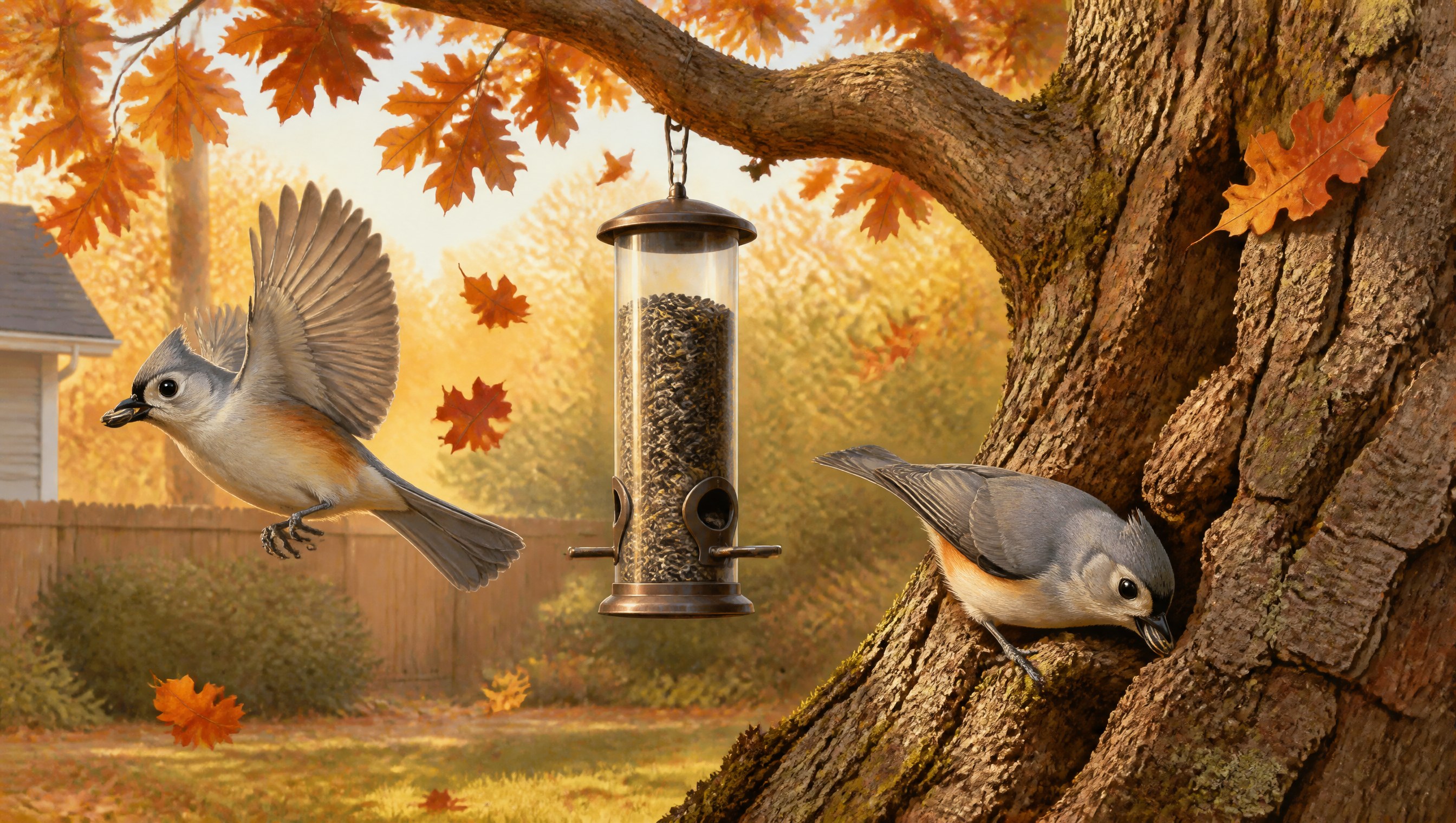

Watch a feeder in the eastern half of the country for a few minutes this fall and you will probably see it: a small gray bird with a pointed crest and big dark eyes that lands, takes one sunflower seed, and is gone. A few seconds later it is back for another. The tufted titmouse is one of the most common feeder birds there is, and almost everything it is doing right now is about the months ahead.
A BIRD THAT STAYS ALL YEAR
The National Audubon Society describes the tufted titmouse as a rather tame, active, crested little bird that is common all year in eastern forests. It does not migrate. The titmouse at your feeder in October is very likely the same bird you will see in January and the same one that nests nearby next spring.
Audubon also notes that it is related to the chickadees, and like them it readily comes to bird feeders. Feeders may even be helping it spread. In recent decades, Audubon says, tufted titmice have been steadily pushing their range north, and surveys suggest the population is increasing in much of that range.
ONE SEED AT A TIME
The grab-and-go habit is the thing most people notice. Audubon's field guide says the titmouse often carries away sunflower seeds one at a time. It holds acorns and seeds with its feet and pounds them open with its bill, and it will store food items and retrieve them later.
That storing matters more as the season turns. Audubon says that seeds, nuts, berries and small fruits are important in its diet, especially in winter, when the insects it eats through the summer are hard to find. Each trip away from the feeder may end with a seed eaten on a nearby branch, or with a seed tucked away somewhere for a colder day.
WINTER IN A SMALL FLOCK
Titmice do not spend the winter alone. Audubon says pairs may remain together all year, joining small flocks with other titmice in winter. If you see three or four titmice working the same feeder and the same row of trees through the cold months, you are probably looking at one of those small winter groups moving through its territory together.
The flocks do not last. Audubon says they break up in late winter, and the pairs go off to establish nesting territories of their own. That is also when you are most likely to hear the titmouse song, a whistled series of notes that sounds like peter, peter, peter. Audubon says it may be heard even during mid-winter thaws.
THE HAIR THIEF OF SPRING
The strangest part of the titmouse year comes at nesting time. Titmice nest in holes in trees, either natural cavities or old woodpecker holes, and Audubon notes that they do not dig their own the way chickadees can. They will also use nest boxes. Inside, the nest has a foundation of grass, moss, leaves and bark strips, lined with soft materials, especially animal hair.
Some of that hair is taken from animals that are still wearing it. Audubon says the bird may pluck hair from a live woodchuck, a dog or another animal, even from humans. For a long time that sounded like a tall tale. Then researchers at the University of Illinois went looking.
According to the University of Illinois News Bureau, the scientists found only a handful of descriptions of the behavior in published research, but dozens more in videos posted online by bird watchers. Collectively, the videos show titmice, and in one case a black-capped chickadee, plucking hair from 47 humans, 45 dogs, three cats, three raccoons and a porcupine. The researchers named the behavior kleptotrichy, from the Greek roots for theft and hair, in a paper in the journal Ecology.
One of the scientists, Jeffrey Brawn, first noticed it when he saw a tufted titmouse plucking hair from a sleeping raccoon. As he told the News Bureau, the raccoon did not seem to mind, because it did not even wake up.
WHY TAKE THE RISK
Landing on a raccoon is a dangerous way to collect nesting material, so the researchers asked what the hair is worth. It may simply insulate the nest. But the News Bureau reports that the smell of a mammal could also help keep nest predators such as snakes or other birds away, and that the hair may repel the parasites that are a common threat to chicks, especially in cavity nests like those of titmice.
WHAT TO WATCH FOR
This fall, watch where the titmouse goes after it leaves the feeder. Through the winter, count how many turn up together. In late winter, listen for the peter, peter song on a mild morning. And next spring, if a small gray bird lands on your dog in the yard, or on the hat on your head, hold still. It is building a nest.
