
Watering & care · Oct 4, 2026 · By Nell Harding
The Shiny Band on Your Cherry Twig Is a Tent Caterpillar Egg Mass
Once the leaves fall off the wild cherry and the crabapple, some twigs show a dark, glossy collar. It holds next spring's tent caterpillars. Here is how to recognize it, when it hatches, and the easy way to deal with it this winter.
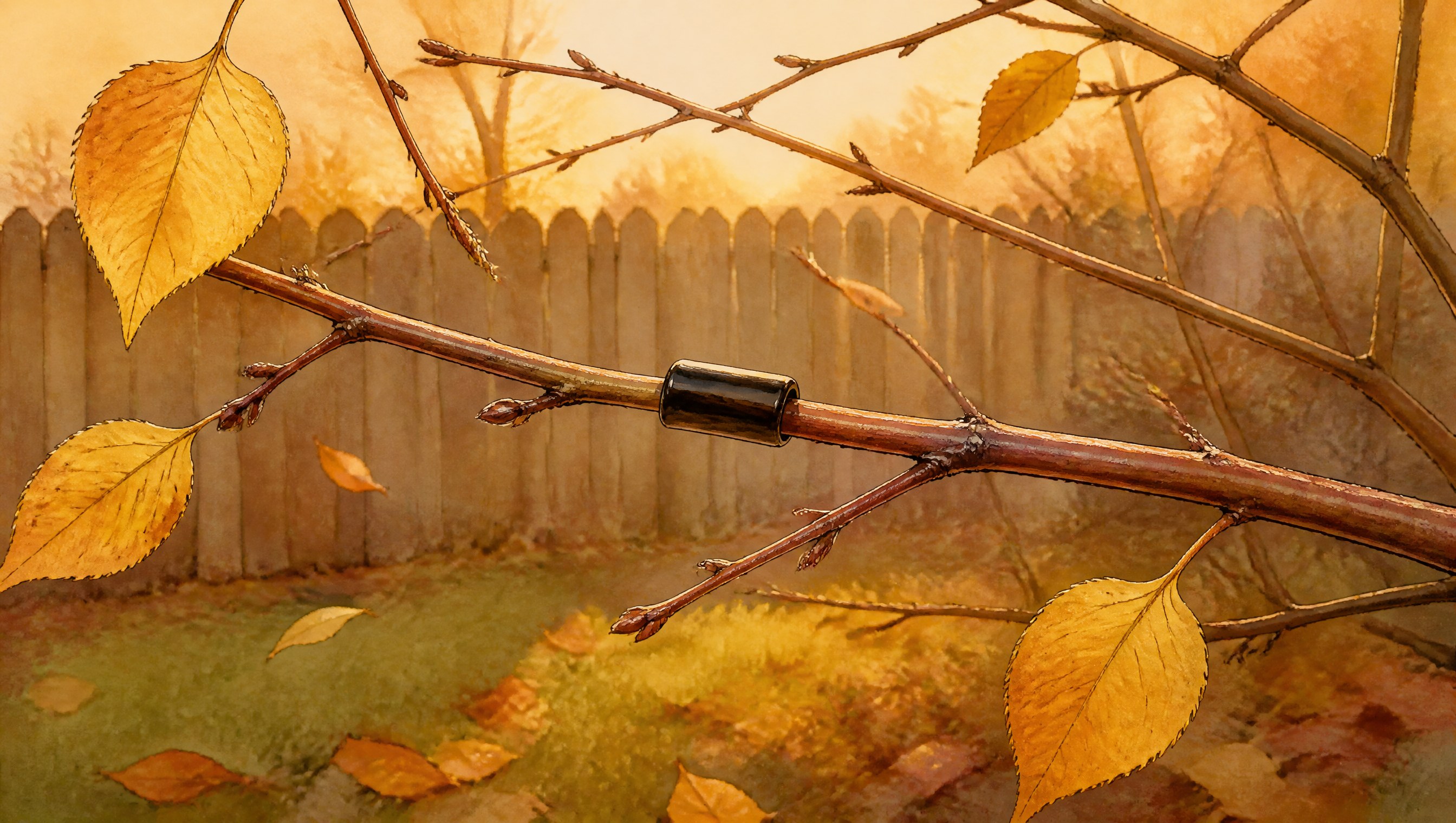

October is when the wild cherry along the fence line starts to let go of its leaves, and the bare twigs underneath tell you things the summer canopy hid. Look along the thin outer twigs and you may find one wearing a small, dark, shiny collar, wrapped all the way around as if someone had painted it on. It is not a bud and it is not a bump in the bark. It is next spring's tent caterpillars, already in place.
WHAT THE BAND IS
The Missouri Botanical Garden describes eastern tent caterpillar eggs as laid in distinctive masses encircling the twigs of the host plant. The egg masses are about three-quarters of an inch long and are covered with a dark substance that makes them look varnished.
Penn State Extension entomologist Michael Skvarla describes them the same way: black masses that wrap around small twigs, smooth and shiny. Each one, he writes, contains 150 to 350 eggs.
So a band no longer than the last joint of your little finger is holding a few hundred future caterpillars.
WHERE TO LOOK
Start with the trees the caterpillars like best. Skvarla says they prefer trees in the rose family, including cherry, crabapple and apple. The Missouri Botanical Garden lists apple, wild cherry and crabapple as favorite hosts, and adds that the caterpillars will also turn up on ash, birch, maple, oak, poplar, cherry and plum.
Check the thin twigs out near the ends of the branches, where the bands circle the wood. A wild cherry at the edge of the yard is the most likely place to find one.
WHAT HAPPENS OVER THE WINTER
Nothing you can see. Both sources say the same thing plainly: tent caterpillars overwinter as eggs, right there in the mass on the twig. Through snow and cold, the band simply stays where it is.
Then the timing turns precise. The Missouri Botanical Garden says the eggs hatch in spring, about the time wild cherry leaves begin to unfold, so the young caterpillars arrive just as their first food does. Skvarla puts it simply: the caterpillars hatch out in early spring.
That is when the familiar silk tents start to go up in the forks of the branches.
THE EASY FIX IS NOW
The good news is that the egg stage is the easiest one to deal with. The Missouri Botanical Garden says future damage on small trees can be reduced by locating and removing egg masses during winter, because they are most obvious at that time. They can be scraped off with a thumbnail or pruned out.
Penn State Extension agrees that caterpillar numbers can be reduced by pruning out egg masses during the winter before they hatch, and by removing the silk tents with a stick if any go up later.
Skvarla adds one warning, in capital letters on the original page: caterpillar tents should never be burned with fire.
So the next time you are out with the pruners on a bare winter afternoon, take a slow walk past the wild cherry. A thumbnail and five minutes now saves a branch full of tents in April.
