
Garden myths · Oct 1, 2026 · By Nell Harding
The Rusty Sparrow Scratching Under Your Feeder Is a Fox Sparrow
That big, rust-red sparrow kicking leaves out from under the shrubs with both feet at once is a fox sparrow, down from the Canadian north for the winter. Here is how to know it, where it came from, and why a layer of fallen leaves is the best feeder you can give it.
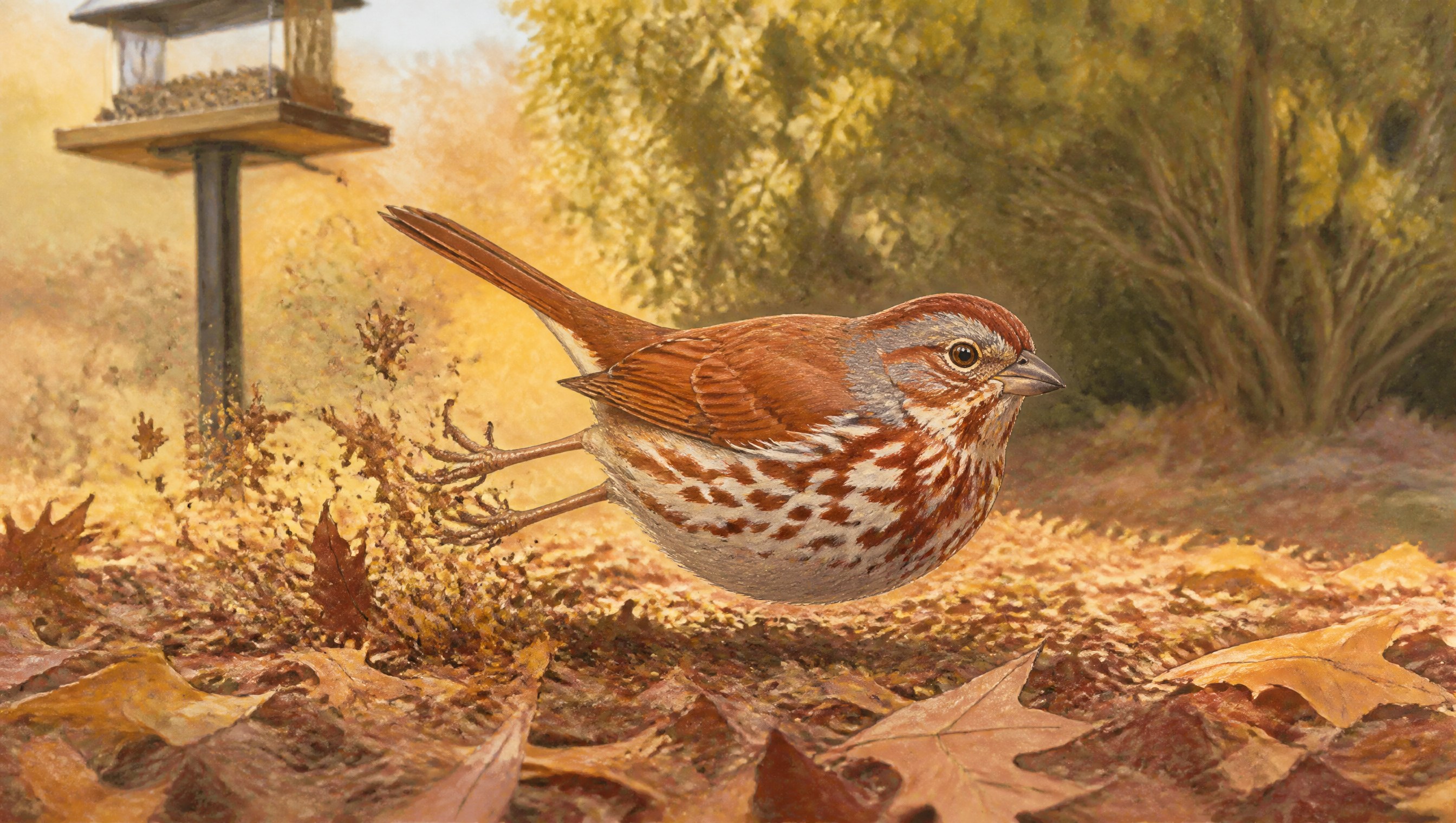

You usually hear it before you see it. Under the shrubs near the feeder, the dry leaves rustle and fly, as if something much bigger than a bird were digging in there. Then it hops into the open: a heavy, round-headed sparrow, rusty red on the wings and tail, its white breast splashed with red-brown spots. If you have seen one this fall, you have met a fox sparrow, and it has come a long way to be under your shrubs.
HOW TO KNOW IT
The Tennessee Wildlife Resources Agency describes it as a large, stocky, round-headed sparrow, heavily streaked on the chest, with a messy spot in the middle of the breast and a reddish tail. The red form that most of us in the East will see has a reddish back with a gray rump, reddish streaks on the chest, and a face patterned in gray and red.
Audubon notes that the name refers to the bright foxy red of the eastern and northern birds. Fox sparrows out West are a different story, and many of them are mostly gray or a sooty brown. Tennessee's biologists say the species comes in four distinct color forms across its huge range.
It has an old pedigree on this continent's bird lists. Tennessee's agency notes that the fox sparrow John James Audubon first described in 1834, from southern Labrador, would have been the red form, and that the oldest fox sparrow on record lived to 10 years and 4 months.
THE DOUBLE SCRATCH
The surest sign is the way it feeds. Audubon describes it exactly: the bird forages on the ground, scratching in the soil or the snow, making a small jump forward and then scratching back with both feet at once. It is a quick little two-step, repeated over and over, and it sends leaves flying.
The Tennessee Wildlife Resources Agency says this noisy double-footed scratching is what makes the bird easier to find while it forages in the leaf litter. Audubon adds that it is usually found on the ground under dense thickets, scratching busily with both feet.
What is it after? During the breeding season, Audubon says, a fox sparrow eats many insects, including beetles, flies and true bugs, as well as spiders and millipedes. The leaf layer under a shrub is full of exactly that kind of food, and the double scratch is how the bird uncovers it.
WHERE IT COMES FROM
The red fox sparrow nests far to the north. Tennessee's wildlife agency says the eastern form breeds in the boreal forest of Canada and spends the winter in the southeastern United States. Audubon notes that many birders know the fox sparrow only as a migrant or a winter visitor, because it nests in the far north and in the western mountains.
The timing is reliable. The Tennessee Wildlife Resources Agency says it usually arrives by mid-October and departs by early April. Audubon adds that it migrates at night, which is why one seems to appear out of nowhere: the yard is empty one evening, and the next morning there it is under the forsythia, kicking leaves.
Along the way and on its wintering grounds, Audubon says it uses brushy fields, well-planted suburbs and parks. Tennessee lists shrubby habitats, woodland edges and feeders, where it often visits.
MAKING IT WELCOME
The best thing you can do for a fox sparrow costs nothing. Leave a layer of fallen leaves under the shrubs near your feeder instead of blowing every bed bare. That leaf litter is where it finds its food, and a dense shrub nearby gives it the cover it likes.
Tennessee's biologists say it also visits feeders, so scatter some seed on the ground at the edge of that cover, right where it already likes to scratch, rather than only filling the hanging feeders.
And keep an ear out on mild days this winter. Tennessee's biologists say its song, a low, rich, melodious warble, can be heard now and then on warm winter days, a small preview of spring from a bird that will be gone north by April.
