
Garden myths · Oct 1, 2026 · By Nell Harding
The Butterfly on Your Fallen Apples Is a Question Mark
That rusty-orange butterfly with ragged wing edges sipping the windfalls is most likely a question mark, named for a tiny silver mark under its wings. Some will fly south, but some will spend the winter right here as adults, tucked into the bark. Here is how to know one and how it gets through the cold.
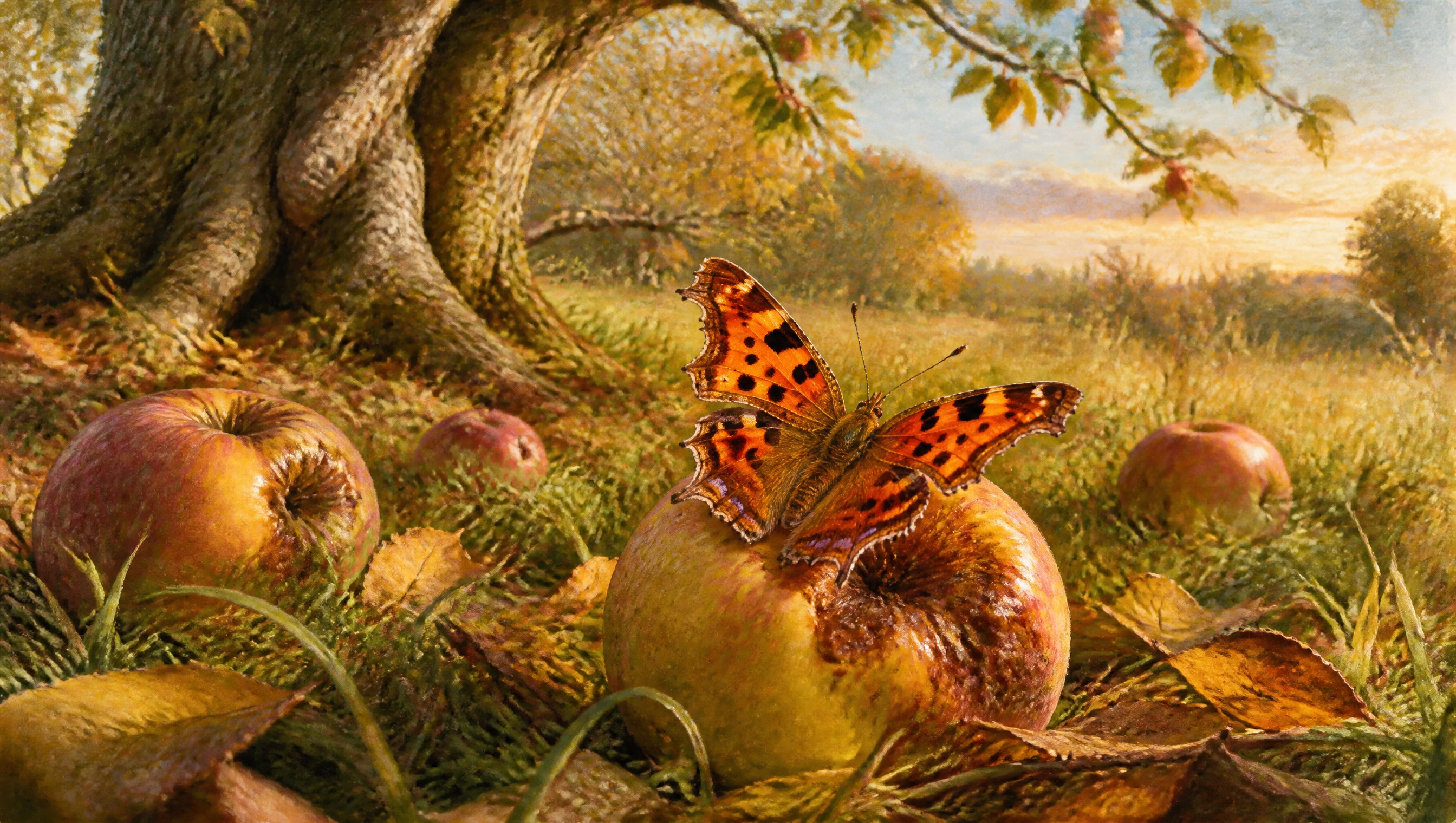

Most butterflies are gone by October, so this one stands out. It sits on a soft windfall apple in the grass, wings opening and closing in the sun, so busy at the fruit that you can lean right in. The wings are rusty orange with dark spots, and their edges look torn, as if someone cut them out with pinking shears. That is most likely a question mark, and it has a surprising plan for the winter.
HOW TO KNOW IT
The Missouri Department of Conservation groups the question mark with the anglewings, butterflies with irregular, ragged wing margins. The way to be sure is underneath. Close up, its wings look like a dead leaf, mottled brown and gray, and in the middle of each hind wing there is a small silver mark.
That mark gives the butterfly its name. Missouri's naturalists say the question mark is the only one of its close look-alikes with a dot next to the curved silver line. Its near twin, the eastern comma, has the curve without the dot.
The season changes its colors, too. Missouri says the summer brood has the top of the hind wing almost entirely dark, while the fall brood that overwinters has an orange hind wing, brighter markings and violet gray tails. Animal Diversity Web notes the forewing ends in a small hook, and that the margins can look purplish, which is why some people call it the violet tip.
WHY IT LOVES ROTTEN FRUIT
Question marks are not flower visitors at heart. The Missouri Department of Conservation says the adults rarely visit flowers, and take moisture and nutrients from damp soil, decaying fruit, dung and carrion instead. Animal Diversity Web says they turn to flowers such as milkweed and aster only when those other foods are not available.
The University of Wisconsin-Milwaukee's field station adds a lovely detail. Citing Robert Michael Pyle's Audubon field guide to butterflies, it says anglewings can become intoxicated when the fruit they sip has been fermenting in the sun too long. A tipsy question mark may sit still for pictures, and may even tuck in its legs and play dead.
So the windfalls under your apple tree, the split plums and the overripe pears on the compost are exactly what this butterfly is looking for in October.
WHERE IT SPENDS THE WINTER
Here is the part most people never guess. Many question marks fly south for the winter; Animal Diversity Web says most migrate and return in spring. But some stay. Missouri's naturalists say the fall brood hibernates, and that the winged adults, not the eggs, caterpillars or chrysalides, are the stage that gets through the winter.
They do it in hiding. UWM's field station says anglewings overwinter in cracks and crevices in rock piles and tree bark. They freeze there, more or less, but their blood contains glycerol, a natural antifreeze, that lets their tissues survive the winter's cycles of freezing and thawing.
They do not stay put the whole time, either. The Missouri Department of Conservation says overwintering adults may fly on any warm winter day. If you see an orange butterfly drifting across the yard on a mild afternoon in January, this is very likely who it is.
COME SPRING
The survivors are among the first butterflies of the new year. Animal Diversity Web says overwintered adults lay their eggs in spring, and Missouri lists the caterpillars' host plants as elm, hackberry and nettles. UWM notes the females often lay their eggs in stacks, and the spiny caterpillars may feed near their siblings.
If you want them around, the recipe is simple. Leave a few old trees with rough bark, keep a rock pile or two, and do not rush to clear away every fallen fruit while the butterflies are still feeding on it.
