
Garden myths · Sep 8, 2026 · By Nell Harding
The Praying Mantis Egg Case in Your Garden: Find It, Leave It, Do Not Bring It In
The mantis on your porch dies at the first hard frost, and everything she leaves behind is a tan foam case the size of a walnut, glued to a stem. What it is, how to find it when you cut the beds down, and the one mistake that fills a kitchen with a hundred mantises in February.
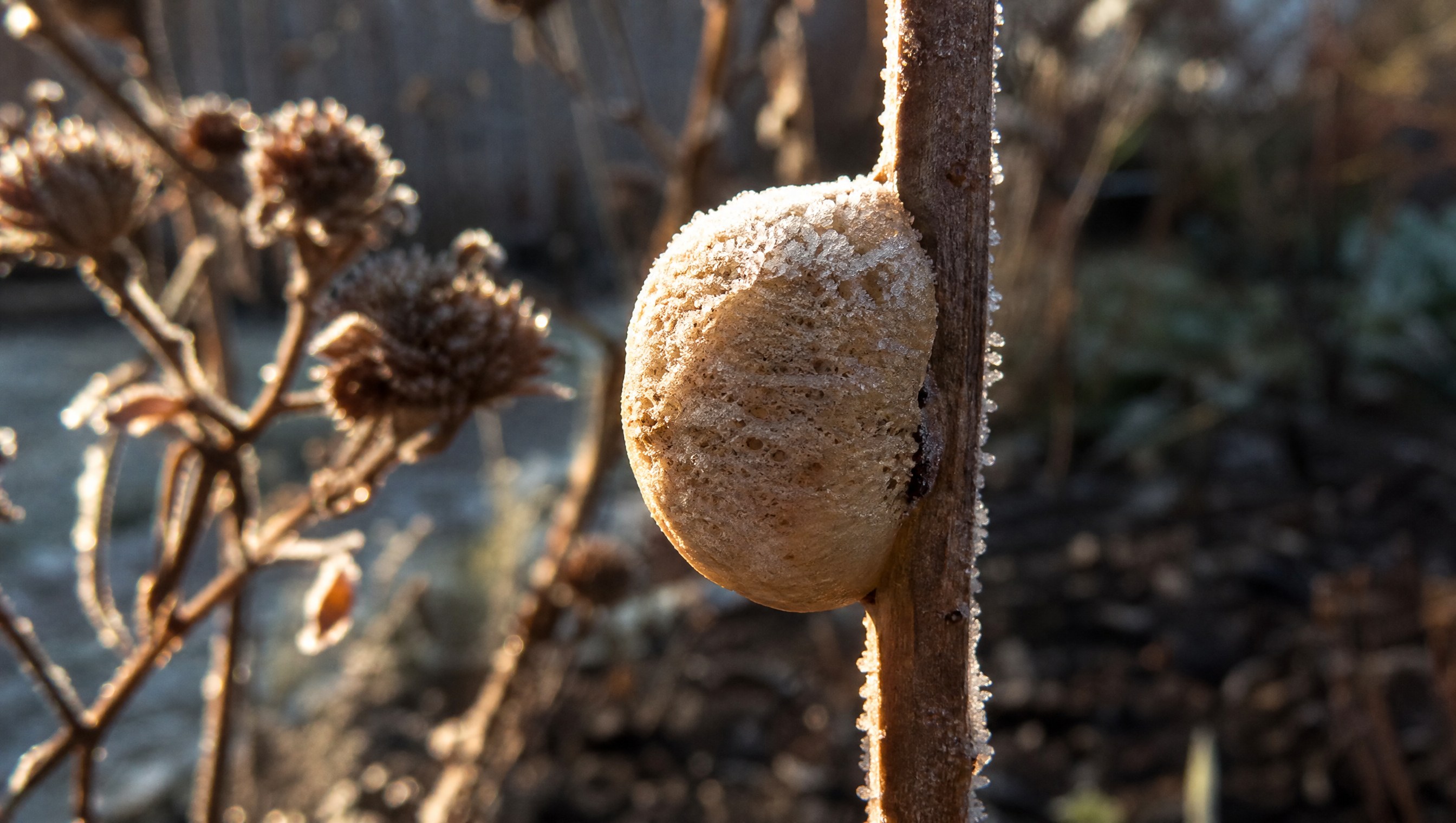

Every praying mantis you have seen this summer is going to be dead by the end of November. That is not a tragedy, it is the schedule. A mantis lives less than a year, and the whole point of the last two months of that year is a tan foam lump the size of a walnut, glued to a stem somewhere in your garden, that will sit through the winter and open on a warm morning in late spring. Here is how to find it, what to do with it, and what not to do.
What the case is
In September and October the female mantis produces a frothy foam from the end of her abdomen and lays her eggs into it as she goes, working the mass onto a stem, a twig, a fence rail, a piece of siding, sometimes the underside of a windowsill. The foam hardens in a few hours into a tan or light brown case, rounded, ridged, with a texture like styrofoam. The proper name is an ootheca. Inside are somewhere between a hundred and two hundred eggs in most cases, occasionally more, each in its own chamber. A female may lay one case or several over the fall, and then she is done. The first hard frost, or simple old age, takes her within a few weeks.
The case does not need her. It survives freezing, rain, and snow on its own, and the eggs inside do not develop until a run of warm days in late spring tells them to. Then, on one morning, the nymphs push out through a slit in the front of the case, dozens of them in an hour, sometimes a hundred or more, each a pale wingless copy of the adult about the size of a mosquito. They hang for a few minutes from silk threads to dry, then scatter. Many of the first meals are each other.
Where to look
The best time to find cases is when you cut the beds down in late fall, and the worst thing you can do is find them by accident after the stems are already in the compost. Look at knee height and lower on anything woody or sturdy: the stems of asters, goldenrod, coneflower, and rudbeckia, raspberry canes, the crossbars of a tomato cage, the lower rails of a fence, the stems of shrubs at the bed edge. A case is easy to miss because it is exactly the color of a dead stem. Run your eye along each stalk for a lump the size of a walnut with a rough surface. Once you have found one you will find three.
What to do with it
Leave it where it is if you can. Cut the rest of the plant down and leave that one stem standing, or cut the stem a foot above and below the case and tie the piece to a shrub or a stake outdoors, at about the same height, where it will get the same weather it would have had. That is the whole job. The case wants cold. A winter outdoors is what tells the eggs when spring has arrived, and a case that skips the winter gets its timing wrong.
Which brings us to the mistake. Every winter, somebody finds a case on a stem, thinks it is interesting, brings it inside, and sets it on a windowsill or in a jar on the counter. The house is warm. To the eggs, warm means spring. Sometime in January or February the case opens and a hundred mantis nymphs come out into the kitchen, and there is nothing to feed them and nowhere to put them, and they die within days. If you want to watch a case hatch, keep it in the unheated garage or a cold shed through the winter and bring it into a mesh cage outdoors in May.
Which mantis you have
The big green or brown mantis on most porches east of the Rockies, three to four inches long, is the Chinese mantis, brought to the United States in the 1890s and sold ever since as garden pest control. Its egg case is the large rounded one described above. The European mantis is also widespread and makes a slightly smaller, more elongated case. The native Carolina mantis is the small mottled one, about two inches, and its case is flatter and narrower, more like a smear along the stem than a lump.
It is worth being honest about the pest-control claim. A mantis eats what it can catch, and it does not sort its prey into pests and friends. That includes bees, butterflies, other mantises, and, for the big Chinese mantis, now and then a hummingbird at a feeder. A garden with a few mantises in it is a healthy garden, but nobody should buy cases to release as a control for anything. Leave the ones you have, and let the numbers sort themselves out.
The short version
Tan lump the size of a walnut on a stem at knee height, found when you cut the beds down. Leave the stem, or tie the piece to a shrub outside. Never the windowsill. In late spring, on a warm morning, a hundred of them will pour out of it, and not one of them will have met their mother.
