
Garden myths · Aug 31, 2026 · By Nell Harding
The Mosquito Trap in Your Basement Corner Has Eight Legs
The little brown spider behind the water heater is the American house spider, and she cannot meaningfully hurt you. What she can do is run a silent, self-repairing insect trap all season for free. Here is her real record, and the case for leaving the corner alone until October.
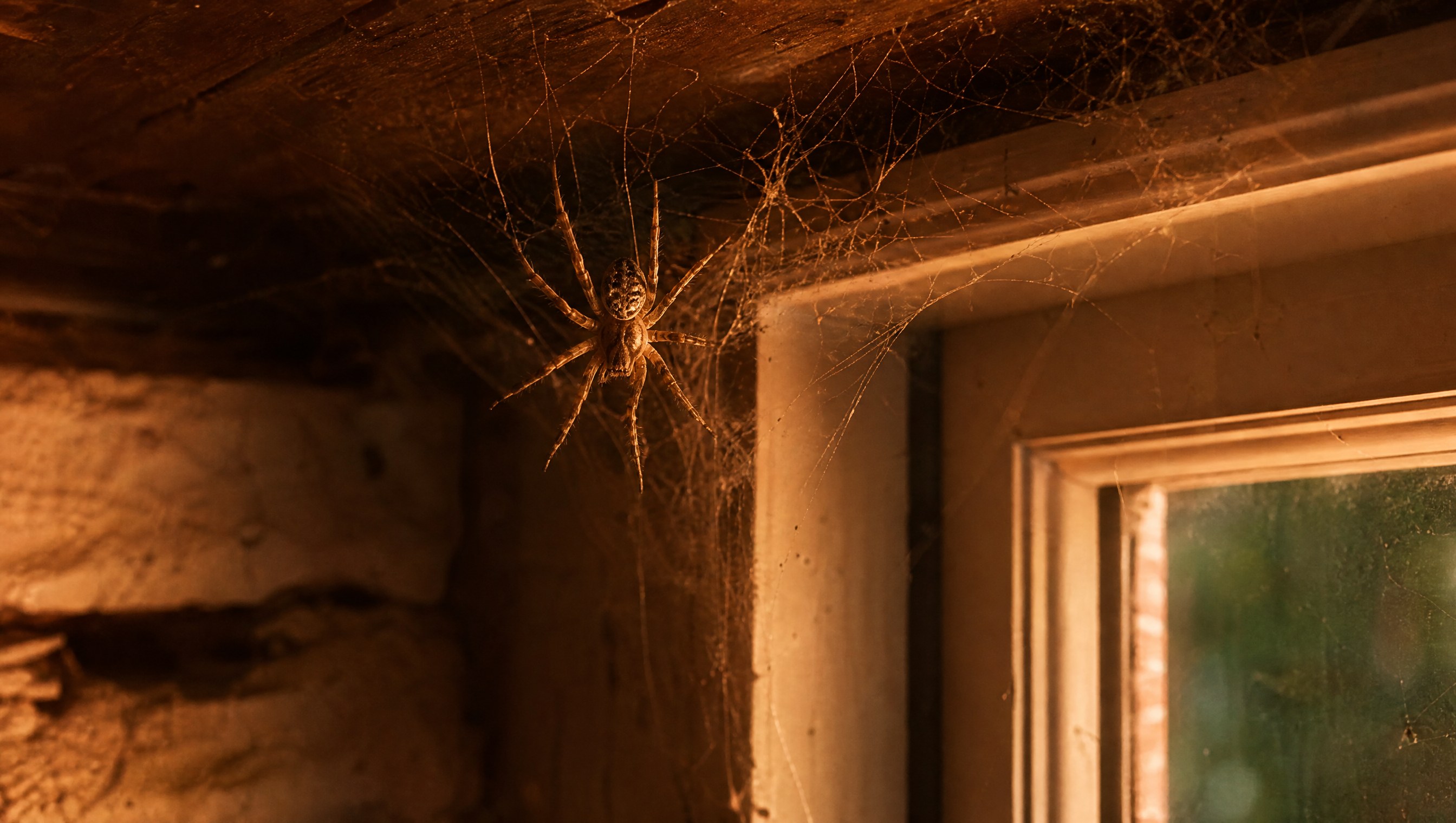

Somewhere in your house right now, most likely low in a basement corner or behind the water heater, a small brown spider is holding a post she has kept since early summer. The family story about her is short and grim. Dark spider, dusty web, probably dangerous, and the broom settles it. We would like to reopen the case, because the story is wrong on every count that matters.
The accusation
The spider in question is almost always Parasteatoda tepidariorum, the American house spider. She is the most common spider found inside North American homes, which is exactly why she has become the default suspect whenever a web appears indoors. The charge is vague but persistent. She looks a little like the dangerous ones, she lives in the shadows, and her web is not even tidy.
Take the name seriously for a moment. The second half of her scientific name, tepidariorum, comes from the Latin for warm rooms. When science formally described her in 1841, she was already so much a fixture of heated human buildings that she was literally named after them. She has been our housemate for as long as we have had houses worth heating.
The verdict
On the danger charge, the case collapses immediately. Her fangs are small enough that they struggle to break adult human skin at all, and she has no interest in trying. Faced with anything large, her first move is to drop from the web on a line of silk and run. Her second move is to play dead. Bites are vanishingly rare and, when they happen at all, are described as milder than a bee sting.
She is also routinely blamed for the sins of spiders she vaguely resembles. She has a rounded abdomen and lives in corners, so she gets mistaken for a widow. The resemblance ends at the silhouette. She is brown and mottled rather than glossy black, carries no red hourglass, and belongs to a different genus with a fraction of the venom.
The resume
Now for what the broom actually costs you. That irregular, unlovely tangle of silk is a working insect trap, and it runs every hour of every night on a budget of nothing. Cobweb spiders hang sticky gumfoot lines from the tangle down to the surface below. A mosquito or a fly blunders into one, the line snaps upward, and the catch is hauled into the web. The engineering is closer to a snare line than a net, which is why the web looks chaotic. Chaos is the design.
The old houses knew this. English and Appalachian folk tradition alike held that sweeping out a resident spider swept out the household's luck, and the rhyme that says to let the spider run alive was practical advice wearing a superstition's clothes. A farmhouse with open rafters and a working population of corner spiders simply had fewer flies over the milk and fewer moths in the flour, and the people who lived there could see the ledger even if they wrote it up as luck.
The timing of the annual broom sweep is especially unfortunate. Late summer into fall is exactly when mosquitoes start following the warmth indoors, when pantry moths ride in with the season's grain, and when every other insect in the yard begins probing the foundation for a winter address. It is the busiest month of her year. Clearing the corner in September is like firing the doorman during the rush.
The menu is a list of everything you do not want in the house. Mosquitoes coming in at dusk. House flies. The pantry moths that find the oatmeal. Fungus gnats drifting up from the potted plants. One study of household spiders found them among the most effective indoor pest control there is, patient, silent, and entirely unpaid.
She maintains the trap herself. Damaged sections are rebuilt overnight, spent lines are recycled, and the whole operation is patrolled from a retreat in the highest corner. A house spider in residence is not a housekeeping failure. She is evidence that the housekeeping is being done at a level below your notice.
Living with her
Our standing recommendation is the one the old farmhouses ran by default. Leave the corner alone until October. She will hold her post, the web will keep working, and you will see fewer of everything else. If the web truly cannot stay where it is, carry her out on a dustpan to a shed or woodpile rather than ending an eight legged employee over a housekeeping preference.
If the web ever looks abandoned, wait a day before clearing it. House spiders relocate a few feet at a time when a spot stops producing, and the new web usually appears one corner over, already fishing.
There are two indoor spiders in parts of North America that do deserve caution, the widows and, in the central states, the brown recluse. Both are reclusive, neither builds the classic dusty corner tangle in the open, and neither looks much like our defendant once you have seen the three of them side by side. Learn those two, and let the rest of the household staff work.
The corner spider has kept the same quiet bargain with us for centuries. She takes the corner nobody was using, she runs the night shift nobody wants, and she asks only not to be swept. We think the bargain still holds.
