
Garden myths · Oct 2, 2026 · By Nell Harding
The Little Nuthatch With the Black Eye Stripe Is a Red-breasted Nuthatch
A small, rusty-bellied nuthatch with a bold black stripe through its eye may be new at your feeder this fall. In some years red-breasted nuthatches pour south from Canada when the northern cone crop fails. Here is how to know one, why it came, and how to keep it around.
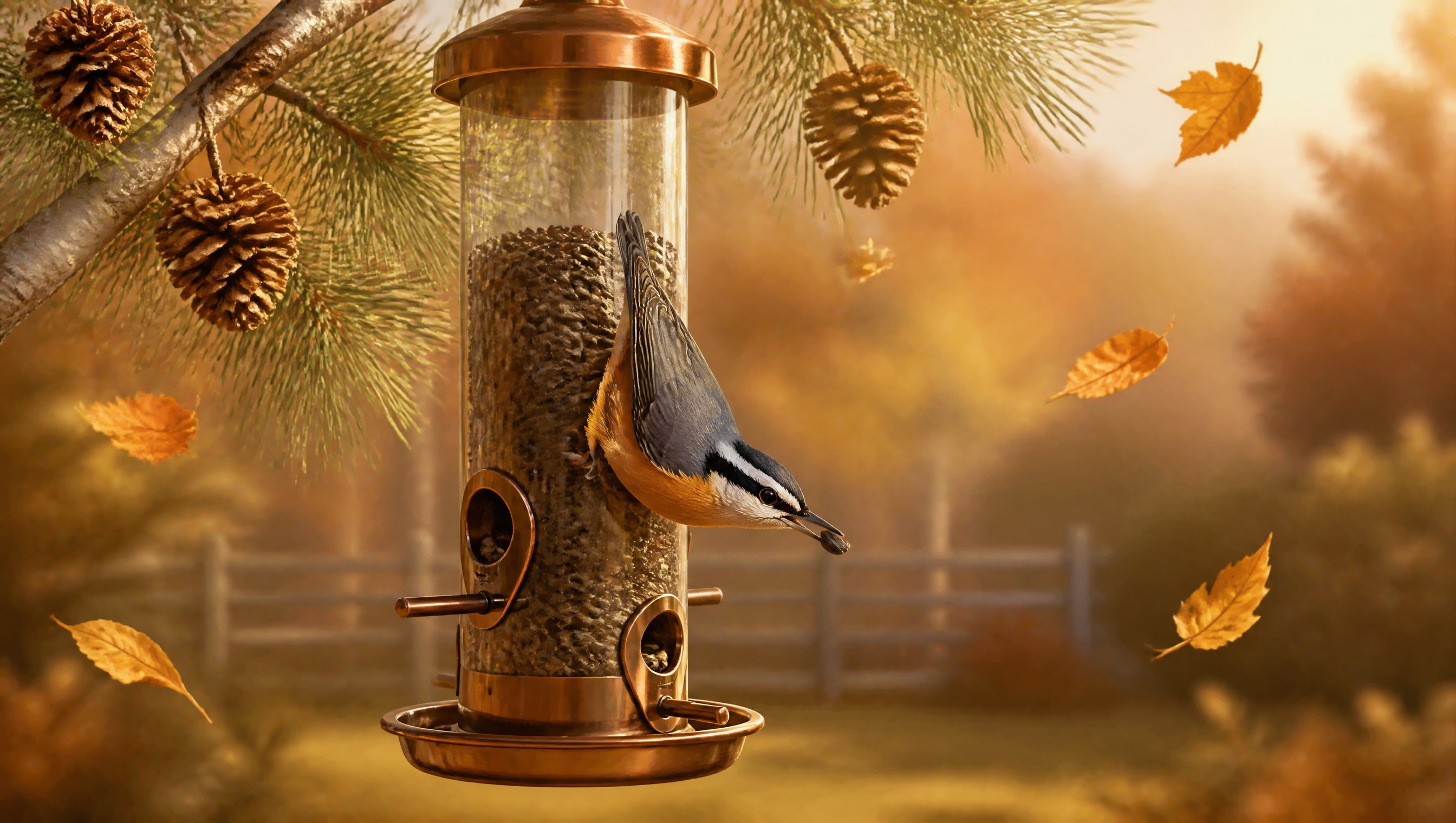

You know the regulars at your feeder by now. Then one fall morning there is a new one: smaller and stubbier than the usual nuthatch, rusty underneath, with a black stripe running straight through its eye and a white stripe just above it. It grabs a seed and is gone, and a moment later you hear it, a little nasal toot from the pines. If that sounds familiar, a red-breasted nuthatch has found your yard.
HOW TO KNOW IT
Audubon describes it as having a black eye stripe and a white eyebrow, with buffy orange underparts and a blue-gray back. The Missouri Department of Conservation adds that the upperparts are dark gray, with a dark cap, and that the cap is black in the male and gray in the female.
The bird it is most often confused with is the white-breasted nuthatch, the one most of us see all year. Missouri notes that the white-breasted is much more common and has white underparts. If the belly is warm orange and there is a stripe through the eye, you are looking at the red-breasted.
Two other birds can cause a second look. Missouri's guide notes that the brown-headed nuthatch of the Southeast has a brown cap, and that the black-and-white warbler, which also creeps along trunks and branches, is distinctly striped with black and white all over. Neither has the rusty belly.
Your ears may find it first. Audubon describes the call as a tinny yank-yank, higher pitched and more nasal than the white-breasted nuthatch's. Missouri writes it as a high, nasal yank, yank-yank or wak, wak, wak, and says it sounds like a small tin horn.
WHY IT CAME SOUTH
This nuthatch is a bird of the conifers, and in winter it lives largely on their seeds. Audubon says it feeds mainly on insects and spiders in summer, and in winter eats many seeds, especially those of conifers. Missouri says its principal winter food is the seeds of pine cones.
That diet is what sends it traveling. Audubon says big southward invasions of red-breasted nuthatches happen in the fall of some years, perhaps mainly when cone crops are very poor in the northern forest. Missouri puts a rough rhythm on it: in years when pine cone production is low, about every two years, large numbers come south from Canada for the winter.
So the bird at your feeder may be a refugee from a thin cone year far to the north. Missouri calls it an uncommon, sporadic winter resident there, very common some winters and absent in others, with numbers climbing in September and falling to almost none by mid-May.
THE SEED HIDER
Watch one for a few minutes and you may see it leave with a seed rather than eat it. Audubon says it may cache food items in bark crevices. Missouri says it visits feeders for sunflower seeds, suet and peanuts, and sometimes wedges large seeds into a crevice of bark.
So when the bird flies off with a seed instead of eating it on the perch, it is often stocking a hiding place nearby. The bark of the trees around your feeder is, in effect, its pantry.
THE STICKY FRONT DOOR
The red-breasted nuthatch has one of the oddest nesting habits of any backyard bird. Audubon says sticky pitch is smeared around the entrance to its nest hole, and that this may prevent other creatures from entering. Missouri says the birds smear a layer of pine or fir sap around the entrance hole, using their bills or bits of bark as tools.
Of course, the bird has to get in and out itself. Audubon says the adults avoid getting stuck in the pitch by flying straight into the hole. You will not see that in October, but it is worth remembering when you watch this tiny visitor dart in and out of the feeder with such precision.
