
Watering & care · Sep 22, 2026 · By Nell Harding
The Wren That Sang From Your Box All Summer Is About to Go Quiet
House wrens sing from the nest box all summer, then clear out for the winter within a few weeks. Here is the honest version of the house wren's year: the fall departure, the stick-filled dummy nests, when to clean the box, and the real cost to bluebirds and chickadees nesting nearby.
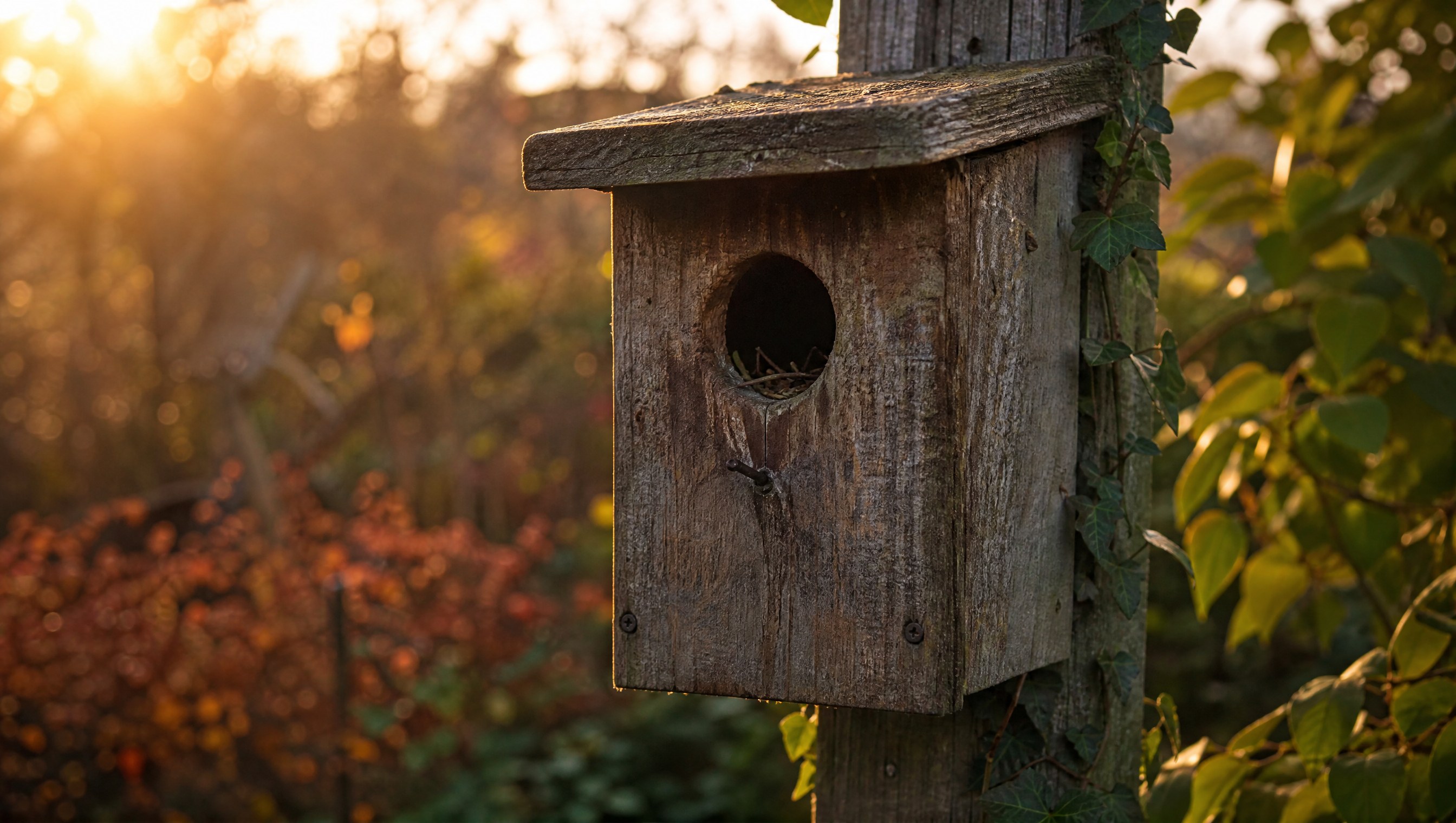

The box by the porch has been noisy all summer, the male house wren pouring out that fast, bubbling, almost mechanical song from sunup on, and sometime in the next few weeks it is going to go quiet and stay quiet. He is not sick and he is not sulking. He is leaving, and the box, the dummy nests packed into every gap he could reach, and the whole loud arrangement he built are about to sit empty until spring.
THE SONG STOPS AND THE BIRDS HEAD SOUTH
House wrens are migratory across most of their range, and the fall departure runs on a calendar, not a cold snap. Across most of the eastern and central United States, house wrens finish singing and clear out by late September into October, with birds in the northern part of that range tending to leave earlier and southern populations lingering later into the fall. Their winter address is the southern United States and down into Mexico, where they spend the cold months in brush and thickets rather than nest boxes, since a wren does not use a cavity except to raise young.
That timing is worth writing on a calendar precisely because it explains everything that happens next: the sudden silence around a box that was never quiet in June, the dummy nests left standing with nobody defending them, and the long stretch between now and the box filling up again. None of it is a problem to fix. It is the bird doing exactly what a house wren does every single year.
THE STICK NESTS WERE NEVER A MISTAKE
If you look inside that box, or any other cavity within his territory, and find it stuffed with twigs, that is not a failed nesting attempt and it is not debris blown in by the wind. NestWatch, the Cornell Lab of Ornithology's nest monitoring program, describes house wren males as defending more than one cavity at a time and filling every box in the territory with twiggy dummy, or mock, nests, sometimes packing several boxes at once with sticks before the female ever chooses one to actually line and use.
Only one of those stick piles becomes a real nest, built into a soft cup and used to raise a brood. The rest just sit there, doing their job as a claim on the territory, for as long as the male is defending the space. Once he leaves for the winter, every dummy nest he built stops mattering to him completely, and there is nothing wrong with any box that is packed with sticks and nothing else.
WHAT TO DO WITH THE BOX NOW
The one rule that matters is timing: clean out a box only after the birds that used it, or defended it, are gone for the season, never while it is in active use. University of Missouri Extension's guide to nest boxes for wildlife puts the general rule plainly, telling landowners to clean out old nesting material after the nesting season ends, whether that means the sticks from a dummy nest or a lined cup that actually raised young.
With the wrens gone for the winter, pull the old sticks and any lining out by hand, so the box is not carrying over parasites or a jammed pile that leaves less usable depth for next year's occupant. A quick scrub with mild soap and water handles a box that smells musty or shows mite activity; a box that just held clean dry sticks does not need much more than emptying. Leave the box up through winter rather than taking it down, since an empty cavity is genuinely useful shelter for wintering birds on hard nights even when no one is nesting in it.
THE HONEST COST OF A GOOD WREN YEAR
A yard with a singing house wren all summer is a lively yard, and that is worth saying plainly before the harder part: house wrens are not gentle neighbors to other cavity nesters. NestWatch is direct about it, noting that both male and female house wrens may destroy the eggs or nestlings of nearby birds nesting in cavities, including bluebirds, chickadees, and other small cavity nesters, while taking over a nest site for themselves.
The standard fix is distance, not exclusion. NestWatch recommends placing boxes meant for other species at least 100 feet away from any box or brushy edge a wren is likely to claim, and setting those other boxes in more open habitat that wrens tend to avoid. In a small yard where 100 feet of separation is not realistic, the honest answer is that you are choosing between hosting house wrens or trying to host bluebirds and chickadees in the same tight space, and a single box close to the house is far more likely to end up a wren box than anything else. That is a real trade, not a failure of setup, and it is worth deciding on purpose rather than discovering it after a bluebird nest fails.
THE WREN YOU WILL STILL HEAR IN DECEMBER
Because the yard goes quiet, it is easy to assume some scolding bird heard in December is the same house wren, just toughing out the cold. In most of the house wren's range it is not; it is a different species entirely. The Carolina wren stays put through winter across the southeastern and much of the central United States, and it is easy to tell apart once you know the mark: a bold white eyebrow stripe running back from the bill, a warmer rust brown body than the plainer house wren, and a loud, ringing, three parted song usually written as teakettle-teakettle-teakettle, delivered at volume even on a cold, gray afternoon.
Hearing that song in the dead of winter is not a house wren that decided to stay behind. It is a resident bird that never left, filling the same acoustic space in the yard that the house wren held all summer, which is exactly why the two get confused with each other so often.
WHEN THE BOX FILLS UP AGAIN
The empty stretch does not last as long as it feels like it will. House wrens return to nest in late April into May across most of the range, which is also the window Missouri Extension lists as typical house wren nesting timing. That is when the first stick shows up in the box again, the song starts back up at first light, and the whole cycle, dummy nests, one chosen cup, a brood raised, and a quiet exit in fall, starts over.
Until then, a clean, empty box hanging on the porch post through the winter is not neglect. It is the box doing exactly what it should be doing between one wren's summer and the next.
