
Watering & care · Sep 22, 2026 · By Nell Harding
The Acorns on Your Driveway This Week Are Next Summer's Mice
A heavy acorn fall feeds a mouse boom next year, and that mouse boom feeds more infected tick nymphs the year after. The Cary Institute has tracked the two-year chain from acorns to Lyme disease risk for decades. Here is what a mast year means and three things to do about it this fall.
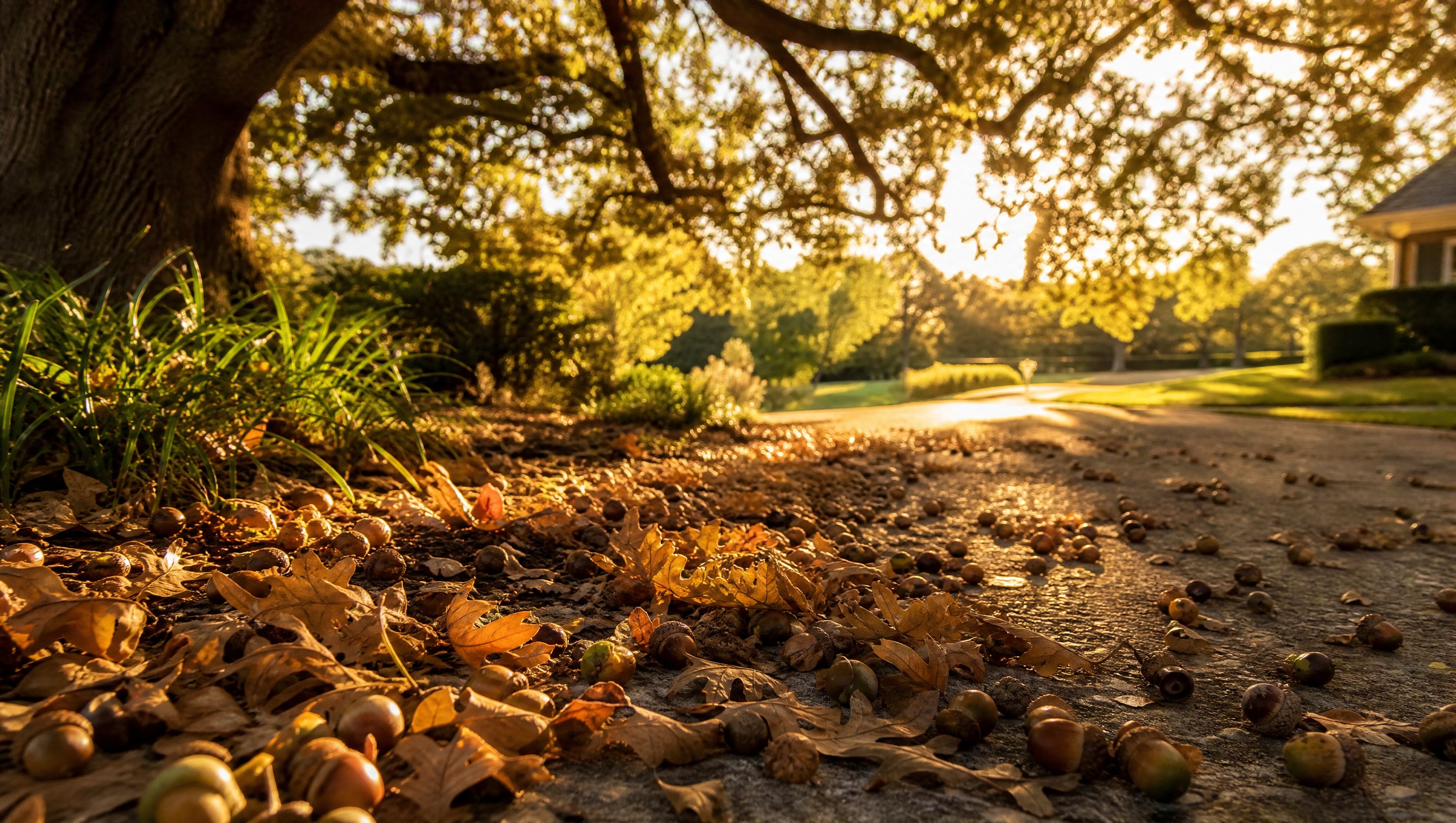

If the driveway has been crunching under a steady rain of acorns this week, and the lawn is dimpled with more caps and shells than you remember raking last fall, you are not imagining a bumper year. You are standing in the first step of a chain that researchers have tracked for decades: a heavy acorn fall this year becomes a mouse boom next year, and a tick problem the year after that.
WHAT A MAST YEAR ACTUALLY LOOKS LIKE
Oaks do not drop the same number of acorns every autumn. In most years the fall is modest; every few years, and not always predictably, the trees synchronize and produce far more acorns at once, a pattern ecologists call a mast year. You do not need a survey to tell one from an ordinary fall. A mast year is the year you cannot walk the driveway or the yard under an oak without acorns underfoot constantly, the year squirrels seem to give up trying to bury them all, and the year the ground under the canopy is genuinely carpeted rather than lightly scattered.
A WELL FED WINTER FOR THE MICE
A heavy acorn crop is a windfall of food for the white footed mouse across most of the acorn producing eastern and central United States, and for its close relative the deer mouse in oak habitat west of the Mississippi. Acorns are calorie dense, and a mouse population that goes into winter with that much food on the ground survives the cold months at a far higher rate than usual, and breeds earlier and more often once spring arrives.
The result shows up the following summer as a genuine population boom, not a small bump. Long term research out of the Cary Institute of Ecosystem Studies in Millbrook, New York, which has tracked the acorn, mouse, and tick relationship for more than 35 years, has quantified the next link in the chain directly: a strong mouse year measurably increases the number of ticks reaching the nymph stage the following year.
HOW THE MICE BECOME A TICK PROBLEM
White footed and deer mice are not just abundant after a mast year, they are also unusually good at a specific, unwelcome job: infecting the ticks that feed on them. Larval blacklegged ticks, the earliest life stage, take a single blood meal before molting, and a mouse is one of their most common hosts. Mice are more efficient than most other small mammals at passing along Borrelia burgdorferi, the bacterium that causes Lyme disease, so a tick larva that feeds on an abundant, infected mouse population has a high chance of picking up the infection in that one meal.
That infected larva molts into a nymph, the pinhead sized stage responsible for most human Lyme infections, the following year. The Cary Institute's long running research states the lag plainly: a large acorn crop reliably predicts higher numbers of infected nymphal ticks two full years later, and a strong mouse year alone was found to boost the following year's nymph numbers by roughly 40 percent. Acorn fall to mouse boom is year one. Mouse boom to elevated nymph numbers is year two, which is the summer when people are actually at higher risk of a bite.
WHO THIS ACTUALLY AFFECTS
The honest regional picture matters here, because the two halves of this chain do not carry the same risk everywhere. A heavy acorn year drives a mouse boom anywhere oaks grow thickly enough to mast, which covers a wide stretch of the country. Elevated Lyme disease risk from the resulting tick nymphs, though, is concentrated mostly in the Northeast, the mid Atlantic, and the upper Midwest, where the blacklegged tick is established and Lyme disease is already common. A big acorn year in a region outside that range can still mean more mice and more of the ordinary nuisance that comes with them, without the same Lyme specific concern.
THREE THINGS TO DO THIS FALL
None of this calls for panic about the driveway. It calls for three concrete, low effort steps, done now while the mouse population is still building rather than next summer when the ticks are already out.
First, mouse proof the house and any outbuildings before the mice start looking for a warmer winter address. Walk the foundation and check every gap a quarter inch or wider, since that is all an adult mouse needs to squeeze through; pack steel wool into gaps around pipes and utility lines, since mice will not chew through it, and add or check door sweeps on exterior doors and the garage.
Second, keep leaf litter, brush piles, and the woodpile away from paths, play areas, and the house itself. Mice shelter in exactly that kind of cover, and ticks in every life stage wait for a host in leaf litter at the yard's edge, so a few feet of open space between the mowed lawn and the wild edge does double duty against both animals at once.
Third, put tick season habits on next year's calendar now, for the specific summer this chain points to. The CDC's tick prevention guidance centers on two habits: treating boots, socks, and outerwear with a permethrin product before you are out in brush or leaf litter, since it stays effective through multiple washings, and doing a full body tick check after time outdoors, with a shower within two hours to help find and remove any tick that has not yet attached. An optional fourth step for anyone who wants to go further is tick tubes, permethrin treated cotton that mice collect for nesting material, which treats the mice themselves rather than the yard.
MORE THAN JUST MICE ARE EATING WELL
A heavy acorn fall is not only a mouse story. Deer move through a mast year noticeably fatter heading into winter, turkeys and jays work the same ground the mice are working, and a wide range of wildlife gets a genuine calorie boost from a crop this size. The mouse and tick chain is simply the part of that same abundance that ends up affecting people directly, two full years after the acorns hit the driveway.
