
Watering & care · Sep 21, 2026 · By Nell Harding
The Bags on Your Arborvitae Are Sealed for Winter, and Full of Next Year's Eggs
Evergreen bagworms on arborvitae, juniper, spruce, and cedar seal their bags shut by late summer and spend the winter as eggs, not caterpillars. Sprays do nothing for them now. A careful winter pick does.
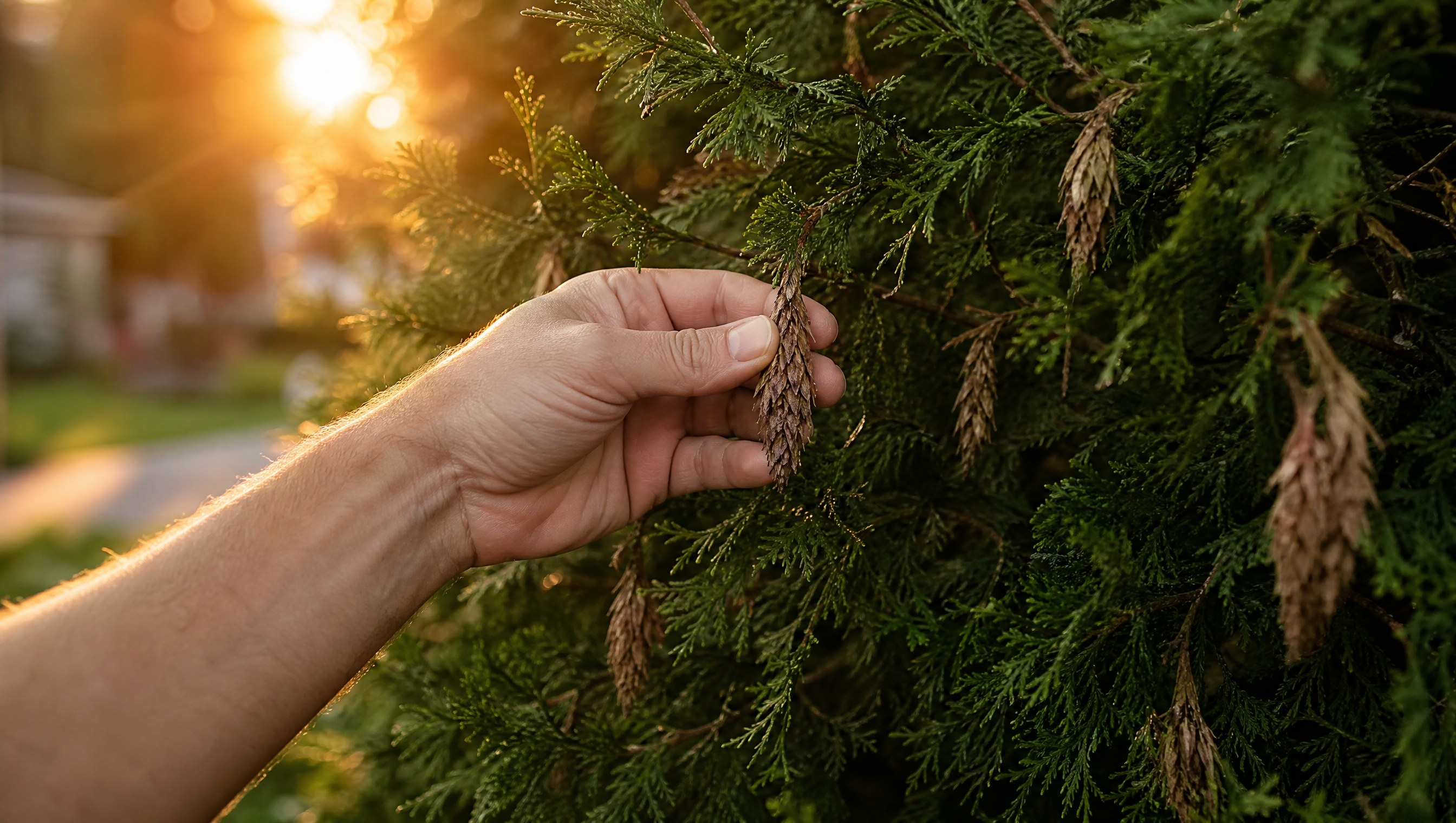

Pull one of the brown, spindle shaped bags off your arborvitae, juniper, spruce, or cedar this week, split it open, and you will not find silk or an empty case. You will find eggs, sometimes close to a thousand of them, already packed inside and ready for spring. That bag is not a leftover from summer. It is next year's infestation, sealed and waiting on your shrub right now.
WHAT THE BAGS ACTUALLY ARE
The bags belong to the evergreen bagworm, a caterpillar that builds its own portable case out of silk woven together with bits of the very foliage it is eating. Early in the season the case is barely a quarter inch long, easy to miss among the needles. By late summer it has grown to nearly two inches and thickened into the shape most gardeners actually notice: a papery, tapered cone hanging point down from a twig, looking for all the world like a tiny pinecone or a scrap of debris the wind blew in. Purdue Extension, in its county bulletin "Check Evergreens for Bagworms," describes the late season bag plainly as resembling an upside down pine cone hanging like a Christmas ornament, and that is exactly the camouflage that lets an infestation build for a full season before anyone notices the shrub is thinning out.
THE FEEDING STOPPED WEEKS AGO
By late summer the caterpillars inside those bags are done growing. They seal the open end shut, lash the whole case to a twig with a band of tough silk, and settle in to pupate. Nothing inside a sealed bag this time of year is chewing foliage anymore, which is the first reason the pest looks worse on the shrub than it actually is doing right now. The damage for this season is finished. What happens next inside the bag is the part almost nobody sees, and it is the part that decides how bad next June will be.
THE FEMALE THAT NEVER LEAVES
Male bagworms transform into small, dark, clear winged moths, leave their bags, and fly off to find mates. Females never get the chance. The University of Missouri Extension publication "The Bagworm in Missouri" (G7250) describes the adult female as wingless, legless in any functional sense, and entirely dependent on staying put: she remains inside the bag she built as a larva, releases a scent that draws a male to her, mates without ever leaving the case, and then lays her eggs, between roughly 500 and 1,000 of them according to the Missouri publication, inside the same bag that has been her home since spring. Her job finished, she dies inside the bag as well. Nothing about her life cycle carries the eggs anywhere else. They stay exactly where she left them.
WHY THE SPRAY BOTTLE STAYS ON THE SHELF
This is the detail that trips up a lot of well meaning fall garden care: there is nothing left to spray. Insecticide, even a strong one, kills bagworms by being eaten or contacted while the caterpillar is actively feeding on foliage. Once the bags are sealed, the caterpillars inside are pupating or, later, the eggs are simply dormant, protected by a tough silk case that most sprays cannot penetrate and that no feeding caterpillar is around to ingest anything from. Purdue's bulletin puts the seasonal question directly: once you confirm the caterpillars are no longer feeding, pesticide applications have no effect on this pest. The window that actually works is next year, in late May or June, in the short stretch right after the eggs hatch when the new larvae are tiny, exposed, and still feeding on open foliage before they have built a case worth protecting.
THE THREE THINGS THAT MAKE THE WINTER PICK WORK
Hand removal, done correctly between now and the spring hatch, is the one control method that genuinely works on a dormant bag, and both extension sources treat it as the preferred method at this point in the season. Three details separate a pass that actually cuts next year's population from one that barely dents it.
First, pick every bag you can reach, not most of them. A shrub with ten bags overlooked out of a hundred still hatches a full new generation from those ten; the eggs inside do not know the rest of the population is gone. Second, get the whole bag off the twig, including the silk band the caterpillar used to lash it in place. A bag that is pulled loose but leaves its silk anchor wrapped around the stem can still shed eggs into the canopy below it if it is crushed in place instead of removed; where a bag will not pull free cleanly, snip the twig tip it is tied to rather than tearing the bark. Third, the bags do not go in the compost pile and they do not go on the ground under the shrub. Eggs inside a bag left at the base of the plant, or shredded into compost that never gets hot enough to kill them, can still hatch and simply walk back up the trunk in spring. Drop every bag straight into a sealed bag or a bucket of soapy water, which both sources note as an effective way to make sure nothing survives, and put it out with the trash.
WHAT A STRIPPED ARBORVITAE WILL AND WON'T DO
A heavy bagworm year can leave an arborvitae, juniper, or spruce looking scorched, with whole branches gone brown and bare. Evergreens are not like deciduous shrubs that push a full new flush from bare wood every spring; most conifers only produce new growth from buds at the tips of branches that still have living green tissue. A branch that was stripped completely and has gone fully brown down to old wood typically will not leaf back out, and pruning that branch out is usually the better move than waiting on it. A shrub that lost needles but still has some green interior growth generally will recover over a season or two once the population feeding on it is brought down, which is exactly what a thorough winter pick is aimed at doing.
WHEN TO CHECK AGAIN
One pass now is not the end of it. Go back over the same shrubs again in late winter or very early spring, before the hatch, since a bag or two is easy to miss on a dense plant the first time through, and every bag missed is several hundred more eggs back in play. After that, the next real checkpoint is late May into June, watching for the first tiny new bags on open foliage, which is the one short window all season when a spray is worth using at all.
