
Watering & care · Sep 21, 2026 · By Nell Harding
The Bluebirds Are Not Leaving. They Are Moving Into the Box Together
Eastern bluebirds switch from insects to berries, many stay through winter while many move south, and on the coldest nights a small flock piles into one box for warmth. The bluebird year from fall through the March pairing off.
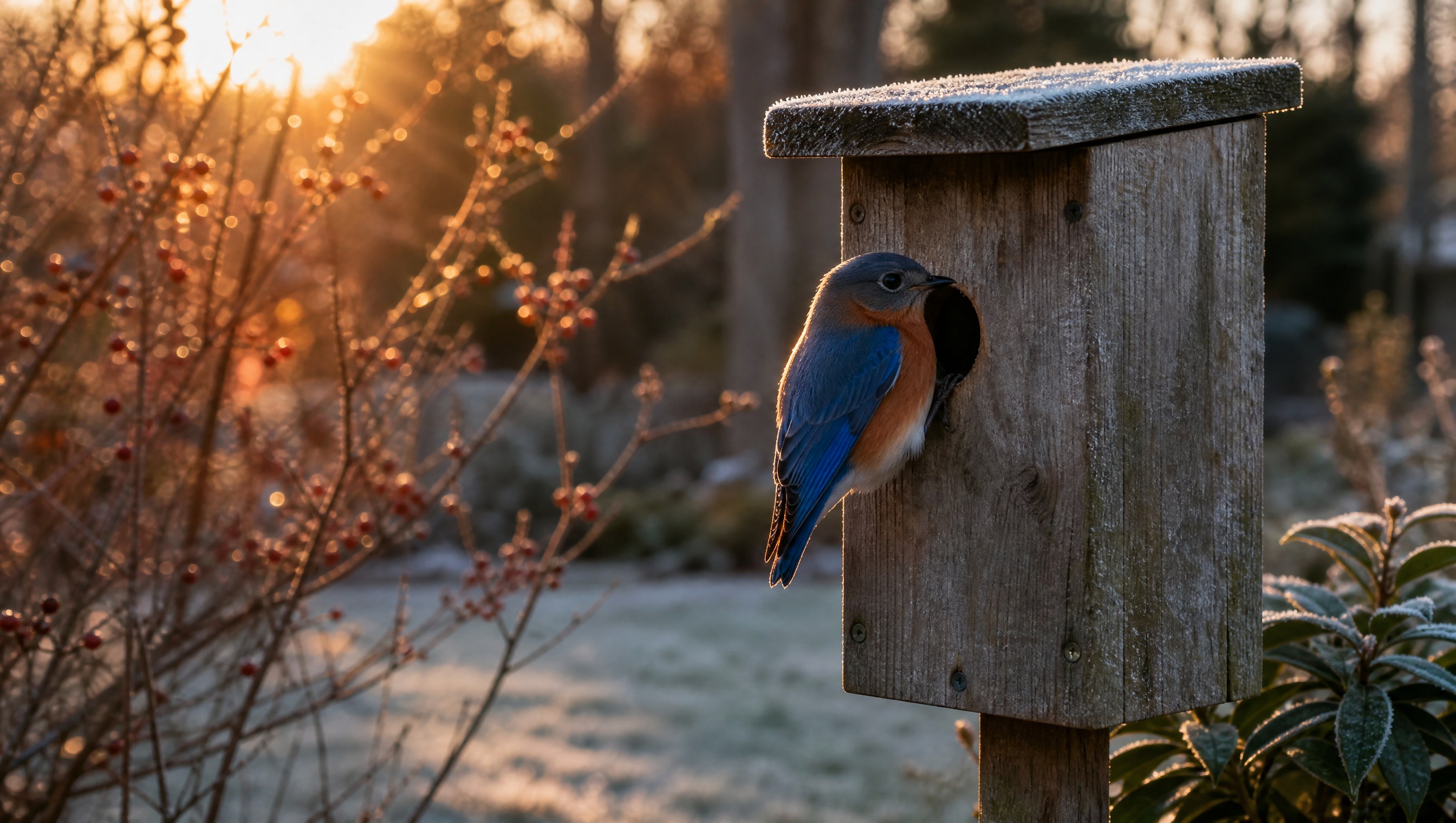

The bluebirds at your feeder in October are not on their way out. Many of them are about to move into the box in your yard together, and by the coldest nights of January a single box can hold close to a dozen birds stacked in there for warmth.
THE SUMMER FAMILIES BREAK INTO FALL FLOCKS
Through spring and summer, eastern bluebirds hold nesting territories in pairs, often with grown young from an earlier brood still helping out. That structure dissolves in fall. Parents, young of the year, and unrelated bluebirds start moving and feeding together in loose flocks, sometimes a handful of birds, sometimes several dozen, drifting across open ground, field edges, and yards with fruiting shrubs. It is a quieter, more social bluebird than the territorial pair defending a box in June, and it is the shape the species stays in for most of the fall and winter.
THE DIET SWITCHES FROM INSECTS TO BERRIES
Eastern bluebirds hunt insects from a low perch for most of the growing season, but that food source collapses once cold weather sets in. From fall through winter, the flock survives almost entirely on fruit.
Sumac, dogwood, eastern red cedar, and holly are the shrubs doing the real work, and that is the practical reason to leave them standing through winter instead of cutting them back in a fall cleanup. A yard with sumac or holly left alone is doing more for the local bluebirds than a fall-cleaned yard with a feeder alone.
MANY MOVE, MANY STAY
Eastern bluebirds are partial migrants, and that word many matters more than a clean north-south rule does. Many bluebirds from the northern edge of the range do move south for the winter. At the same time, many bluebirds across the mid latitudes and the southern part of the range simply stay put all winter, especially where berry-bearing shrubs and open feeding ground hold up.
Milder winters in recent decades have made winter bluebird sightings more common across a wider stretch of the country than they once were. The honest version is not that bluebirds leave or that they stay; it is that a given flock's winter address depends on where it started and what food is nearby, and mixed flocks of stayers and late arrivals from farther north are common in the same yard.
THE WINTER ROOST
The most surprising part of a bluebird's winter is what it does after dark. On the coldest nights, small groups of bluebirds pile into a single cavity, whether an old nest box, a tree hollow, or a dedicated roost box, and share body heat until morning.
The Virginia Bluebird Society's guidance on preparing boxes for the season describes exactly this: on cold nights, a small group of birds may cluster together for warmth, all in the same box. It is not a nesting behavior at all. It is a shared survival strategy, and it is the reason a box that sat empty all summer can suddenly be worth checking again come November.
WHAT TO DO BY MONTH
Right now, in fall, clean the old nesting material out of any box that raised a brood this year; a box left packed with old nest and mites is a worse winter shelter, not a better one. Once the box is clean, prepare it for roosting rather than nesting: a dedicated roost box with the entrance hole low and few vents works best, but an ordinary nest box can be adapted by plugging or taping over the upper ventilation gaps so body heat stays inside, while leaving the entrance and any floor drainage holes open.
Through the coldest stretch of winter, mealworms and suet dough at a platform feeder, along with a heated or regularly refreshed water source, help a flock get through the hardest nights without ever needing to touch the box itself.
By March, the communal winter arrangement breaks up fast: a single pair claims the box as its own again, and any leftover winter insulation needs to come back out before nesting starts.
THE HOUSE SPARROW PROBLEM
House sparrows are not a minor nuisance to bluebirds; they are a direct threat, and they will kill adult bluebirds and destroy eggs and nestlings inside a box they want for themselves.
NestWatch, the Cornell Lab of Ornithology's nest monitoring program, recommends a specific structural fix on its eastern bluebird page: where house sparrows are a problem, drilling a second entrance hole gives the bluebird a way to escape a box a sparrow has cornered it in. Beyond that, a genuinely sparrow-resistant box design and regular monitoring through the nesting season, removing sparrow nesting material promptly, are the standard tools. Poison is never the answer; it is illegal to use on birds and it is not selective enough to spare the bluebirds you are trying to protect.
WESTERN AND MOUNTAIN COUSINS DO THE SAME THING
Western bluebirds and mountain bluebirds, filling the equivalent role farther west, run the same basic fall-to-spring pattern in their own ranges: family flocks in fall, a shift toward fruit and berries in winter, partial migration out of the coldest high-elevation and northern sites, and communal cavity roosting on hard nights. The box care and the house sparrow precautions apply the same way wherever any of the three species nests.
WHAT THE LAW ACTUALLY SAYS
Bluebirds of all three species are protected under federal migratory bird law, and that protection covers the birds, their eggs, and their active nests. Putting up boxes, cleaning them out between broods, and preparing them for winter roosting are all standard, encouraged practices and none of it runs afoul of that protection. Handling the birds themselves, or removing an active nest with eggs or young still in it, is a different matter and is not something a homeowner should do. If a bluebird ever needs to be moved, that is a job for a licensed wildlife rehabilitator, not a well meaning hand.
