
Watering & care · Sep 25, 2026 · By Nell Harding
The Finch With Crusty Eyes at Your Feeder Is Sick, and Your Feeder Can Pass It On
A house finch with a swollen, crusted eye is a sign of a disease first noticed at backyard feeders in 1994. Here is what it looks like, which birds catch it, why the feeder matters, and the simple cleaning routine that helps.
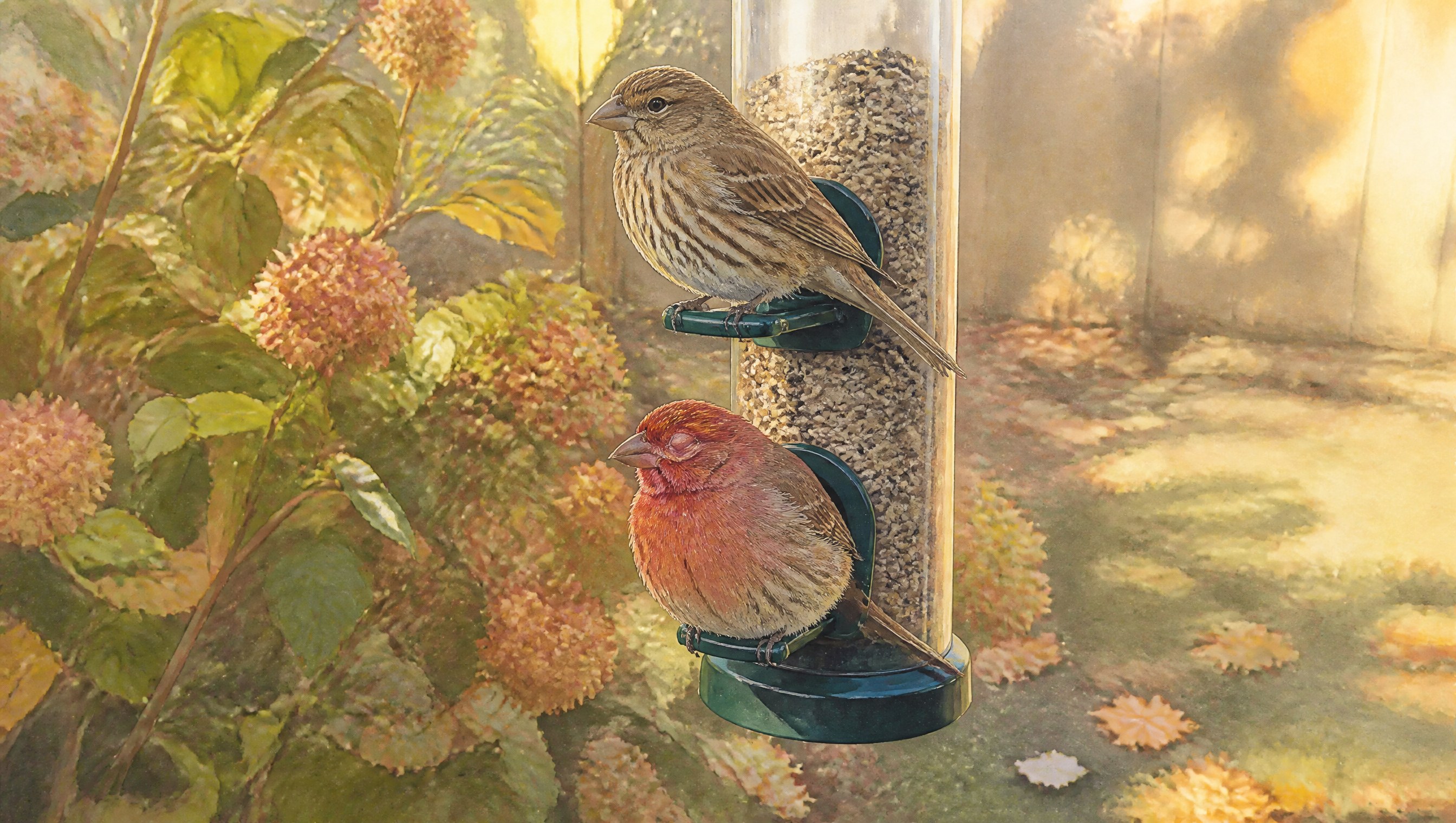

Sooner or later this fall, someone at the kitchen window says it: that finch looks wrong. It sits on the feeder rail longer than the others, puffed up and slow, and when it turns its head you can see the eye, swollen and pink, crusted nearly shut. It is a hard thing to watch, and the natural first thought is that nothing can be done. Something can. The disease has a name, it has a history at backyard feeders, and the main tool against it is probably already under your kitchen sink.
WHAT YOU ARE LOOKING AT
The illness is house finch eye disease, also called mycoplasmal conjunctivitis. Project FeederWatch, the long-running citizen science program at the Cornell Lab of Ornithology, describes the signs simply: infected birds have red, swollen, runny or crusty eyes. Penn State Extension adds a few more to watch for, including scabby, cloudy-looking or glassy eyes, mucus oozing from the nostrils and an upper respiratory infection.
Behavior is often what catches your attention first. Maryland's Department of Natural Resources notes that some sick birds sit in the yard and scratch at their eyes, while others appear completely listless. A finch that stays put on the perch while the rest of the flock flushes, or that lets you walk closer than usual, deserves a second look at its face.
It is worth being precise about what you see. The signs FeederWatch lists are specific: redness, swelling, a runny eye or a crust. A bird that simply squints in bright sun, or has one ruffled feather near its eye, is a different matter. When the swelling and the crust are there, the feeder is the place to act.
A DISEASE WITH A BIRTHDAY
Unlike most bird illnesses, this one has a known beginning at feeders. FeederWatch dates it to January 1994, when house finches with red, swollen eyes were first observed at feeders in the Washington, D.C. area, including parts of Maryland and Virginia. Penn State Extension describes it as first discovered during the winter of 1993 to 1994 and then spreading through the eastern United States. Maryland's natural resources department tells the same story from the ground: it was a group of Project FeederWatchers in Washington who first noticed finches arriving with red, swollen, crusty eyes.
The ordinary backyard watcher, in other words, is how this disease was found. That is still true. The people who keep feeders are the ones who see it first, and they are the ones in the best position to slow it down.
House finches are not the only birds at risk. FeederWatch says the disease has affected several other wild species, including the American goldfinch, the evening grosbeak and the purple finch, and Maryland's natural resources department names the same three. If goldfinches share your feeders with house finches, as they do in many yards, they share the risk as well.
WHY THE FEEDER MATTERS
The feeder is not the cause of the disease, but it changes the odds. FeederWatch puts it plainly: whenever birds are concentrated in a small area, the risk of a disease spreading within that population increases. A busy tube feeder in fall is exactly that, a small area where dozens of birds touch the same perches and the same ports every day.
Penn State Extension points to one very specific habit. The infection apparently causes some discomfort, it says, since diseased birds frequently wipe their eyes on branches and bird feeders, possibly contributing to the spread of the disease. Picture that happening on a single perch used by a whole flock, and the reason for cleaning becomes obvious.
THE CLEANING ROUTINE
The recipe is the same from every source. FeederWatch says to clean feeders with a 10 percent bleach solution, which it spells out as 1 part bleach to 9 parts water. Penn State Extension gives the same 10 percent solution and adds bird baths to the job, to be cleaned on a regular basis. Neither calls for anything special beyond a bucket, a stiff brush and a little patience.
A simple routine looks like this. Empty the feeder and knock out the old seed. Scrub it in the bleach solution, paying the most attention to the perches and the feeding ports, where birds rub their faces. Rinse it well and let it dry completely before you refill it. Do the bird bath at the same time. Penn State also recommends raking or shoveling under the feeders so old seed does not pile up on the ground, where birds gather too.
How often is the question everyone asks. Penn State's answer is on a regular basis, which in practice means making it a habit through the feeding season rather than a once-a-year chore, and doing it at once, not next weekend, on the day a sick bird appears.
IF A SICK BIRD SHOWS UP
FeederWatch's advice for the moment you spot a sick finch is direct: if you see one or two diseased birds, take your feeder down and clean it with a 10 percent bleach solution. Maryland's Department of Natural Resources agrees and adds that sometimes it is best to keep the feeder down until the sick bird moves on. Taking the feeder away for a while breaks the chain at the one place where birds crowd together face to face.
It is natural to want to help the sick bird itself. Maryland's natural resources department notes that if you can capture the sick bird, it often can be taken to a licensed wildlife rehabilitator. Penn State Extension covers the hardest case too: dispose of dead birds by burying them or wrapping them in plastic bags and placing them in the trash, then clean and disinfect the feeder, move it to another part of the yard and refill it with fresh seed.
None of this is a reason to stop feeding birds. It is a reason to feed them the way a good host would, at a clean table. The finches will keep crowding onto that feeder on cold mornings all season, and a bucket of weak bleach every so often is a small price for keeping the crowd healthy.
