
Planting & timing · Sep 24, 2026 · By Nell Harding
The Deer in Your Yard Are About to Stop Looking Both Ways
The deer that browse the garden have been careful on the road all summer. That changes in late October, when the shortening days start the rut. Here is why the short days matter, when the risk peaks, where deer cross most, and the two habits that matter most behind the wheel.
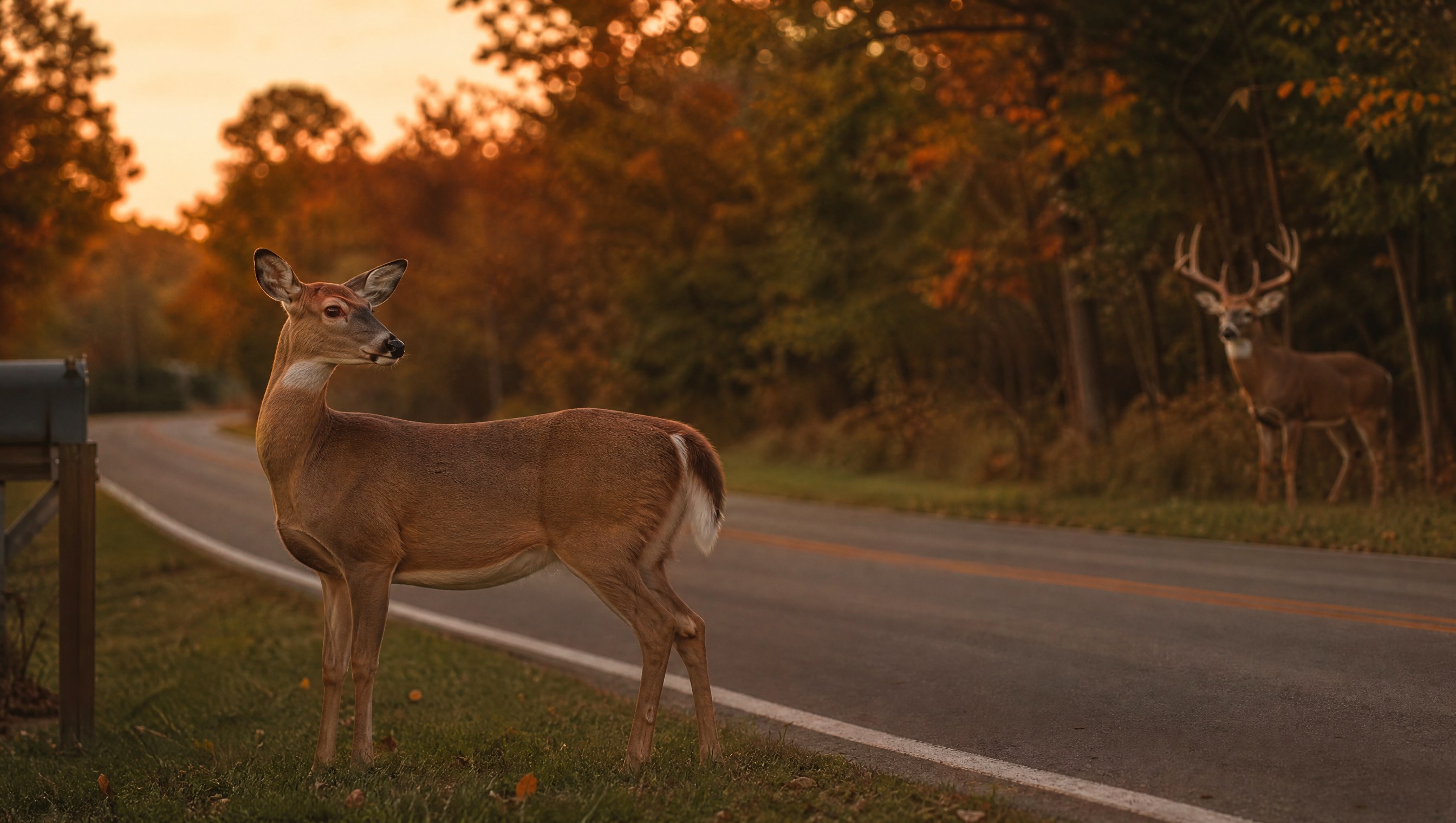

If deer visit your garden, you know their summer manners. A doe steps out of the tree line at dawn, eats the hostas, and when she reaches the road she stops, looks, and waits. She has been doing it all year. Within a few weeks, that careful animal will start doing something very different, and the reason is written in the length of the day.
THE SHORT DAYS START IT
White-tailed deer breed in the fall, and the signal is the light. The Oklahoma Department of Wildlife Conservation explains that fewer daylight hours and cooler weather signal white-tailed deer to enter the breeding season, commonly called the rut. It is the same shortening of the days that we watch in the garden as the evenings come in earlier, and it arrives on a schedule the deer have followed long before we built roads through their woods.
The rut is not one night. Oklahoma's wildlife department describes it as running over several weeks, from late October into December, with deer activity peaking in November. That puts the most dangerous weeks squarely in the stretch when most of us are raking leaves and putting the garden to bed.
WHAT CHANGES IN THE DEER
During the rut, the bucks are chasing does with one thing on their minds, as the Oklahoma department puts it. Deer may be moving at any hour of the day or night, and they move more around dawn and dusk. One of the department's biologists described the shift plainly: as the rut starts to pick up, they put caution to the wind, and collisions go up.
The single most useful thing to know is that deer rarely travel alone this time of year. Oklahoma's advice is that when you see a doe cross the road, at least one buck, and maybe more, will likely be following. The doe you watched cross safely is not the end of the danger. It is often the start of it.
WHY NOVEMBER IS THE WORST MONTH
The Wildlife Center of Virginia calls November the peak month for deer collisions in that state and points to three things arriving together: the mating season, fewer daylight hours that make deer harder to spot, and cooler weather that gets them moving. Virginia ranks ninth in the nation for deer related crashes, the Center notes, with one in every 94 drivers likely to have a collision.
The clock matters as much as the calendar. According to the Wildlife Center of Virginia, the majority of deer collisions happen at dawn and dusk, typically between 5 and 8 in the morning and 5 and 8 in the evening. Those are exactly the hours most of us drive to work and home. In summer, those drives happen in daylight. Once the days shorten, the morning commute and the drive home both fall into the dim hours when deer are moving most, and a deer at the road edge is much harder to see.
It is worth remembering that dawn and dusk are the peak, not the only danger. Oklahoma's wildlife department stresses that during the rut deer may be moving at any time of the day or night. A buck chasing a doe across a field at two in the afternoon is not following anyone's schedule. The rule of thumb for these weeks is simple: expect deer anywhere near woods, at any hour, and expect them to behave in ways they would not in July. The animal that froze politely at the road edge in summer may now bolt straight across without a glance.
WHERE DEER CROSS MOST
The Wildlife Center advises extra alertness near wooded areas and anywhere you see deer crossing signs, and Oklahoma's wildlife department gives the same advice about the signs. They are not decoration. They mark places where deer have been crossing, and hitting, for years. For many of us the most dangerous stretch is not a highway at all but the quiet road past our own gardens and woodlots, the one we drive so often we stop watching it.
If the deer come through your yard, you already know their route. The gap in the hedge where they step out, the corner of the field where they cross, the spot at the bottom of the hill where you have seen them at dusk: those are the places to slow down, especially in the early morning and at dusk from late October on.
THE TWO HABITS THAT MATTER
The first habit: when one deer crosses, slow down and wait. Oklahoma's point about the buck behind the doe is the reason. Give it a few seconds before you speed back up, and watch both sides of the road, not just the side the first deer came from.
The second habit: if a collision cannot be avoided, brake and stay in your lane. Oklahoma's wildlife department says plainly not to swerve to avoid the deer, and the Wildlife Center of Virginia notes that swerving causes worse accidents than staying in your lane. Swerving is the instinct, and it is the move that sends cars into trees and oncoming traffic. The Center also advises using your high beams when it is safe to do so, to improve how far ahead you can see.
If the worst happens, the Wildlife Center of Virginia's advice is clear: never approach an injured deer. Call 911, stay in your vehicle, and let the responding officers handle the animal humanely.
The deer in the garden will be back to their careful selves by the new year. For the next ten weeks or so, it is our turn to be careful for them.
