
Watering & care · Sep 23, 2026 · By Nell Harding
The Bird Mewing Like a Cat in Your Hedge Is Fattening Up to Leave
The gray catbird has spent the summer in your shrubs, and right now it is eating berries as fast as it can find them. Here is what the catbird is doing this fall, when it goes, and the three things that help it most before it does.
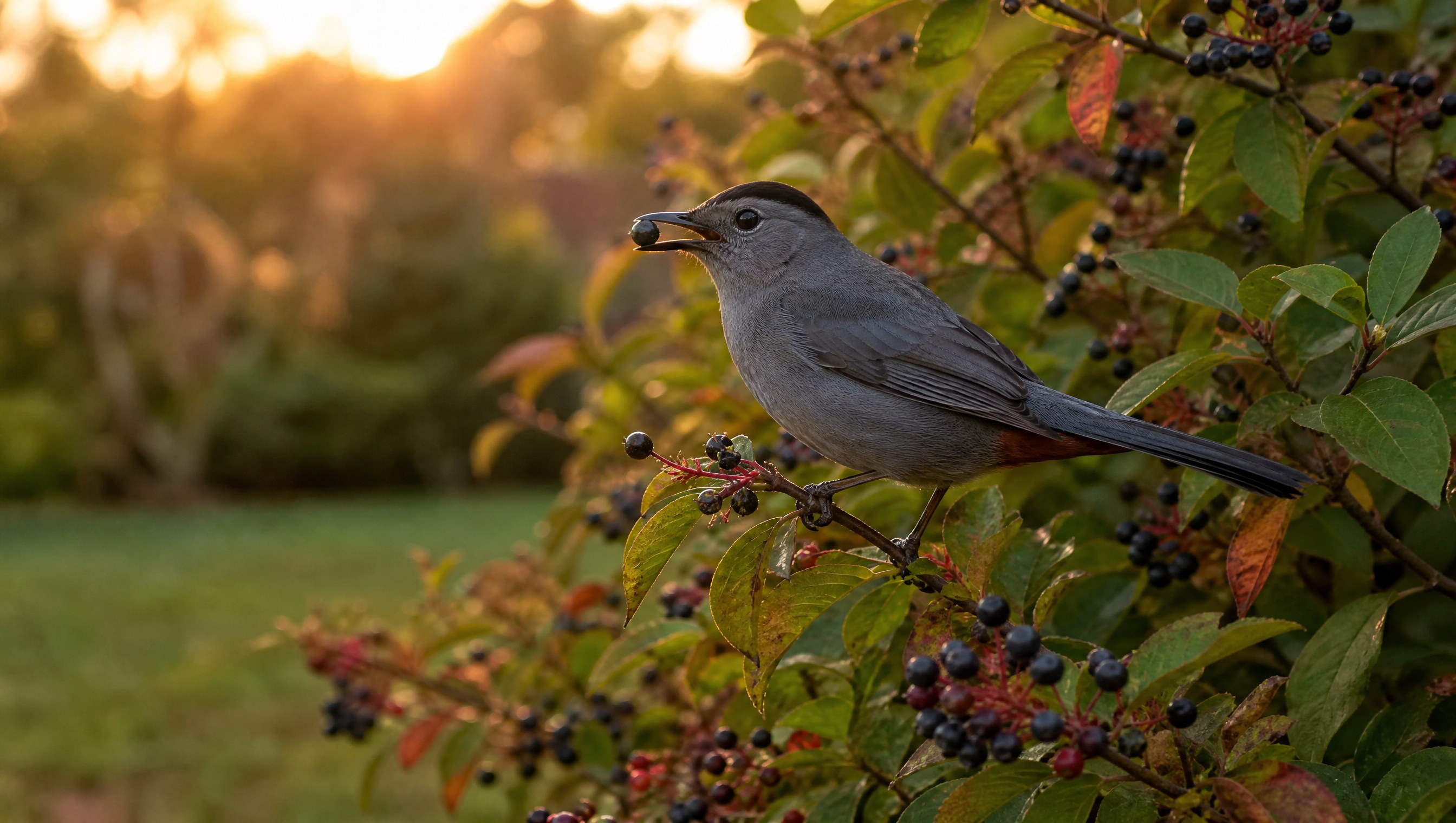

All summer there has been a slate-gray bird working the hedge, a bird that sounds more like a cat asking to come in than anything with feathers. It scolds you when you walk past, flicks its long tail, and disappears into the leaves. This month it has changed its habits. It is eating berries, lots of them, and it is doing it for a reason: it is getting ready to leave.
WHO IS MAKING THAT SOUND
The bird is a gray catbird. It is easy to know once you have seen it well: an entirely slate-gray body, a neat black cap, and a small rusty patch under the long tail that shows when it tips forward. The National Audubon Society's field guide describes its voice as a long, irregular run of musical and mechanical notes with a cat-like mewing mixed in, and says it sometimes seems to mimic other birds. That mewing is the call most gardeners hear first and never forget.
Catbirds like thick cover. Audubon notes that the bird often hides in the shrubbery but also moves about boldly in the open, jerking that long tail as it goes. A dense hedge, a tangle of shrubs along the property line, or a berry bush by the porch is exactly the kind of place a catbird spends its summer.
WHY IT IS EATING BERRIES NOW
In early summer the catbird is mostly an insect eater. Audubon's field guide lists beetles, ants, caterpillars, grasshoppers, crickets and other insects, along with spiders and millipedes, as the bulk of its diet in that season. That is the part of its year most gardeners never notice, because it happens down in the leaves.
Fall is different. Audubon says more than half of an adult catbird's yearly diet may be plant matter, especially in fall and winter, when it eats many kinds of wild berries and some cultivated fruit. The berries on your shrubs right now are the fuel for a long night flight south, and the bird is loading up.
Yes, that includes your raspberries and grapes. If you lost fruit to a gray bird in July, Audubon's list of some cultivated fruit in the diet means the catbird is a fair suspect. It is also the bird that spent June picking caterpillars off the same plants, which is worth remembering when the netting goes up next year.
WHEN IT GOES
Audubon's field guide says the catbird apparently migrates mostly at night. You will not see it leave. One week the hedge is full of mewing, and the next it is quiet. The Illinois Department of Natural Resources says spring migrants arrive in that state in May and that fall migration starts in mid-October. Birds breeding farther north tend to leave sooner, and those farther south later.
Not every catbird goes. Audubon notes that some northern birds stay through the winter where they have a reliable food source, so a catbird in your yard in December is not impossible, especially near a well-stocked shrub border. Most, though, head for the southeastern states and the tropics, and the hedge stays quiet until spring.
THE THREE THINGS THAT HELP IT MOST
The first is simple: leave the berries on the shrubs. Fall cleanup and hedge trimming can wait until the catbirds have gone. Every cluster of fruit you leave hanging through October is food for a bird that needs to fatten up before flying hundreds of miles at night.
The second is that native berries matter more than berries in general. Audubon reported on a study led by ecologist Amanda Gallinat of Utah State University, published in Biological Conservation in 2020, that looked at migrating songbirds at Manomet in Massachusetts. Native blueberry seeds were commonplace in the catbirds' samples, even late in autumn when that fruit was scarce or past ripe, while the birds largely passed over invasive fruit like Japanese barberry and multiflora rose. The study also found that native plants bore the most fruit in late summer and early autumn, while the invasive fruit peaked about 20 days later.
The third is to plant for next fall. Audubon's recommendation from that research is to plant locally native fruiting plants in parks and backyards so that migrating birds have the food they actually choose. If your hedge is mostly an invasive shrub, adding a few native berry producers over the next planting season gives next year's catbirds something better to fuel up on.
None of this asks much of you. It mostly means not doing something: not shearing the hedge in September, not stripping the last fruit, and choosing a native shrub the next time you add one. The reward is a gray bird that comes back in May and starts mewing from the same hedge again.
