
Garden myths · Sep 23, 2026 · By Nell Harding
The Ball on Your Goldenrod Stem Has a Grub Inside Making Its Own Antifreeze
That round swelling halfway up a goldenrod stem is a home, and there is a small grub inside getting ready for winter. Here is the goldenrod gall's whole year, from the exit tunnel it chews in fall to the birds that break in for it in January.
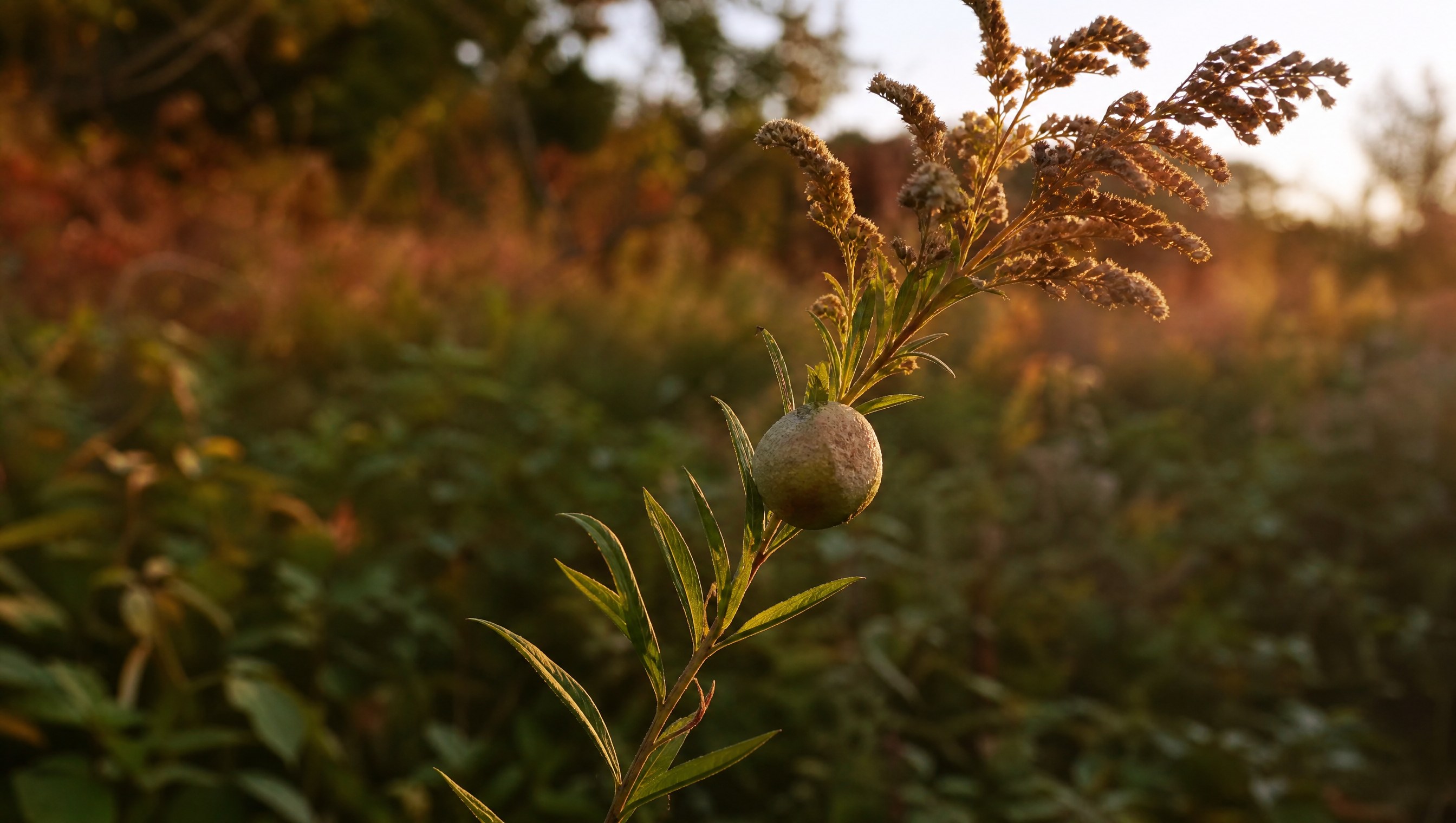

Walk past a stand of goldenrod this week and look halfway up the stems. On some of them there is a ball, nearly round, green going brown, as if the plant had swallowed a marble and it stuck. Most people assume it is a disease or a seed pod. It is neither. It is a house, and something is living in it.
WHAT THE BALL IS
The swelling is a gall, made by the goldenrod gall fly. The University of Wisconsin Extension describes these as ball-shaped swellings on some of the stems that grow to nearly the size of a golf ball, often with a reddish tinge or a mottled purple look. The fly's grub lives inside, and the plant grows the gall around it.
The Huron-Clinton Metroparks naturalists in Michigan put it simply: the gall that forms is the home of the larva, giving it shelter and food for the summer. The grub feeds on the gall's inner tissue all season, safe inside a wall of plant.
THE EXIT TUNNEL IT CHEWS NOW
Here is the clever part, and it happens right about now. Metroparks says the larva digs a tunnel, usually in early fall, to prepare for spring, when it will need to leave the gall. Wisconsin describes the mature larva chewing a tunnel out to the surface of the gall and stopping just short, leaving only a thin layer over the opening.
That matters because the grub will become a fly with no chewing mouthparts to speak of. The work of breaking out has to be done now, while it is still a grub. From outside, Wisconsin says, the finished tunnel shows as a pinhead-sized dark spot on the gall. Look closely at a few galls this month and you may find one.
HOW IT SURVIVES THE COLD
Wisconsin says the larva enters diapause, a kind of suspended development, to spend the winter inside the gall. As temperatures drop, the cold triggers the grub to convert glycogen into glycerol and sorbitol, which work as antifreeze by reducing the water in its body so that ice crystals do not form where they would do damage.
In plain terms, the grub makes its own antifreeze out of stored sugar and sits through the winter in a gall on a dead stem, exposed to everything January can throw at it. Metroparks adds that the larvae can melt ice that forms in the gall and turn it into usable sugars and proteins.
THE BIRDS THAT BREAK IN
Not every grub makes it to spring. Wisconsin names downy woodpeckers and black-capped chickadees among the birds that eat the larvae, along with two tiny chalcid wasps and small Mordellistena beetles. Metroparks describes woodpeckers landing on the plant and pecking right at the tunnel, then using their tongues to pull the larva out, while chickadees peck furiously at the galls to open them up.
That is why a winter walk past standing goldenrod can tell you who has been feeding. A gall with a neat hole drilled into its side had a bird visit. A gall with no hole may still have a grub inside, waiting.
SPRING, AND WHY TO LEAVE THE STEMS
The flies that survive come out in mid-spring, Wisconsin says, after the new goldenrod stems have started to emerge, so the next generation has fresh stems to use. The galls themselves do not seem to do the goldenrod much harm; Wisconsin notes the plants still bloom despite the gall.
So here is the case for leaving a patch of goldenrod standing through the winter instead of cutting it all down in fall. Every gall on those stems is either a grub making it to spring or a winter meal for a chickadee or a downy woodpecker. Cut the stems and both are gone. Leave a patch, and in February you can go out and count the holes.
The easiest time to find them is right now, while the goldenrod is still standing tall and the galls are green going brown. Check a road edge, a meadow strip or the back of a sunny border. Once you have spotted one, you will start seeing them everywhere, a whole small winter story hanging on stems most of us walk past without a second look.
