
Garden myths · Oct 2, 2026 · By Nell Harding
The Brown Silk Pod on Your Shrub Is a Cecropia Moth
Once the leaves come down, you may find a baggy brown pod of silk fastened along a twig of your maple, cherry or lilac. Inside is one of the biggest moths you will ever see, waiting for spring. Here is what it is, how it lives, and why you should leave it be.
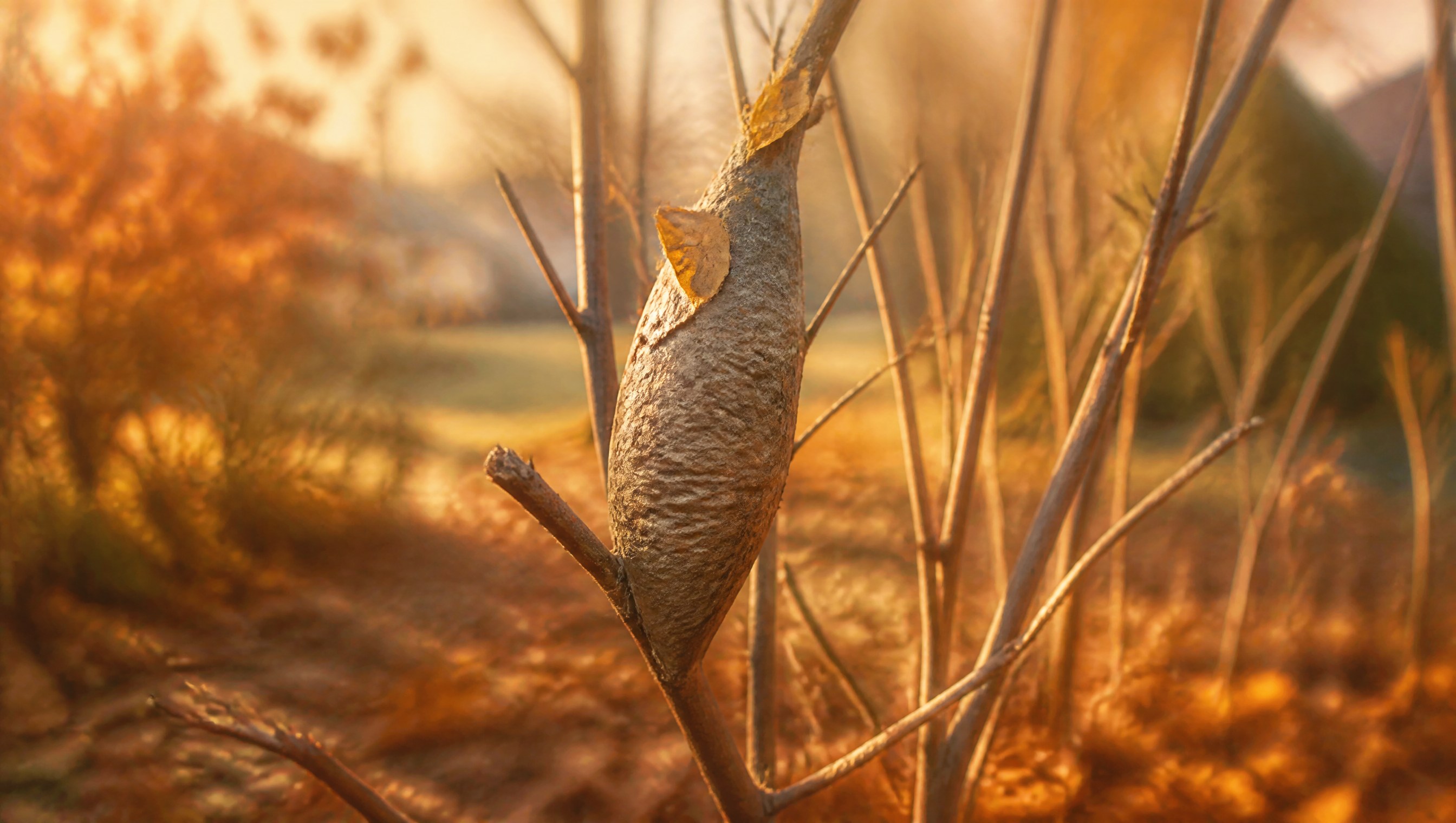

The leaves come down, and suddenly you can see the inside of your shrubs again. Along one bare twig of the lilac or the cherry there is something that was not there in July, or that you simply never noticed: a wrinkled brown pod, about the length of your hand, fastened tight along the branch. It looks like a dead leaf that refused to fall. It is not. It is a cradle, and something large is asleep inside it.
WHAT YOU ARE LOOKING AT
That pod is the cocoon of a cecropia moth. Iowa State University Extension describes it as a dirty gray or brown cocoon resembling a pod, attached to plant twigs or hung between branches, about four to five inches long and an inch or two wide. NC State Extension calls them tough, brown cocoons of silk.
The Missouri Department of Conservation says the cocoons are brownish gray and attached by silk along their whole length to a twig, in some sheltered, inconspicuous place. That is why you rarely see one in summer. The leaves hide it until fall takes them away.
The caterpillar spun it in late summer, Iowa State says. Before that, it spent the season eating its way through the leaves of the very shrub it is now tied to.
THE CATERPILLAR THAT MADE IT
If you had looked closely in August, you might have found the maker. Iowa State says the caterpillar is about four inches long and nearly three quarters of an inch thick, light green with a fluorescent blue tinge, with several pairs of large knobs behind its head that look like red, orange or yellow balls covered with black spikes.
It is not picky. The Missouri Department of Conservation says the larvae feed on more than 20 species of Missouri trees and shrubs, notably maples including box elder, willows, cherries, plums, apples, dogwoods and lilacs. NC State says they feed mainly on birch, cherry and maple.
That sounds like a lot of chewing, but the damage is small. Iowa State says cecropia caterpillars cause very little harm to ornamental plants, and that serious defoliation is very unlikely except on very small, newly transplanted plants.
A WINTER INSIDE THE POD
Inside the silk, the caterpillar has already become a pupa. NC State says cecropias overwinter as pupae in cocoons attached to the twigs of the trees they feed on, and Iowa State says the insect stays inside all winter. The cold is part of the plan. University of Illinois Extension notes that moth and butterfly pupae need to experience winter cold in order to make the change into adults.
In spring the moth climbs out. Iowa State says the adult emerges the following May, and Missouri says adults fly from early April through June. It is a spectacular animal: Missouri gives a wingspan of three and three quarters to six inches, and NC State says up to six inches wide.
Iowa State describes the wings as dark reddish brown, with black spots near the tips of the forewings and a crescent-shaped spot in the center of each wing, on a very plump body covered with long, rust-red hair.
TWO WEEKS, NO MEALS
Here is the strange part. The giant moth that emerges never eats. NC State says cecropia moths lack functioning mouthparts and live for about two weeks. Missouri explains that, as with other giant silk moths, the adult mouthparts are small or absent, and the adults live without feeding, relying on food consumed and stored when they were caterpillars.
So everything the moth will ever do as an adult runs on the leaves it ate the summer before. In those two weeks it finds a mate, and NC State says the female lays about 100 white and brown mottled eggs in small groups on the stems and leaves of hardwood trees. Then the summer of chewing starts again.
