
Watering & care · Sep 10, 2026 · The 2026 edition
The Black Spots on Your Maple Leaves, and the Two Other Marks Worth Knowing
Every September the maples on the street come out in black spots and somebody calls a tree company. Tar spot, anthracnose, and scorch are the three marks a maple leaf carries this month, and only one of them is a message. Here is how to read them from the sidewalk.
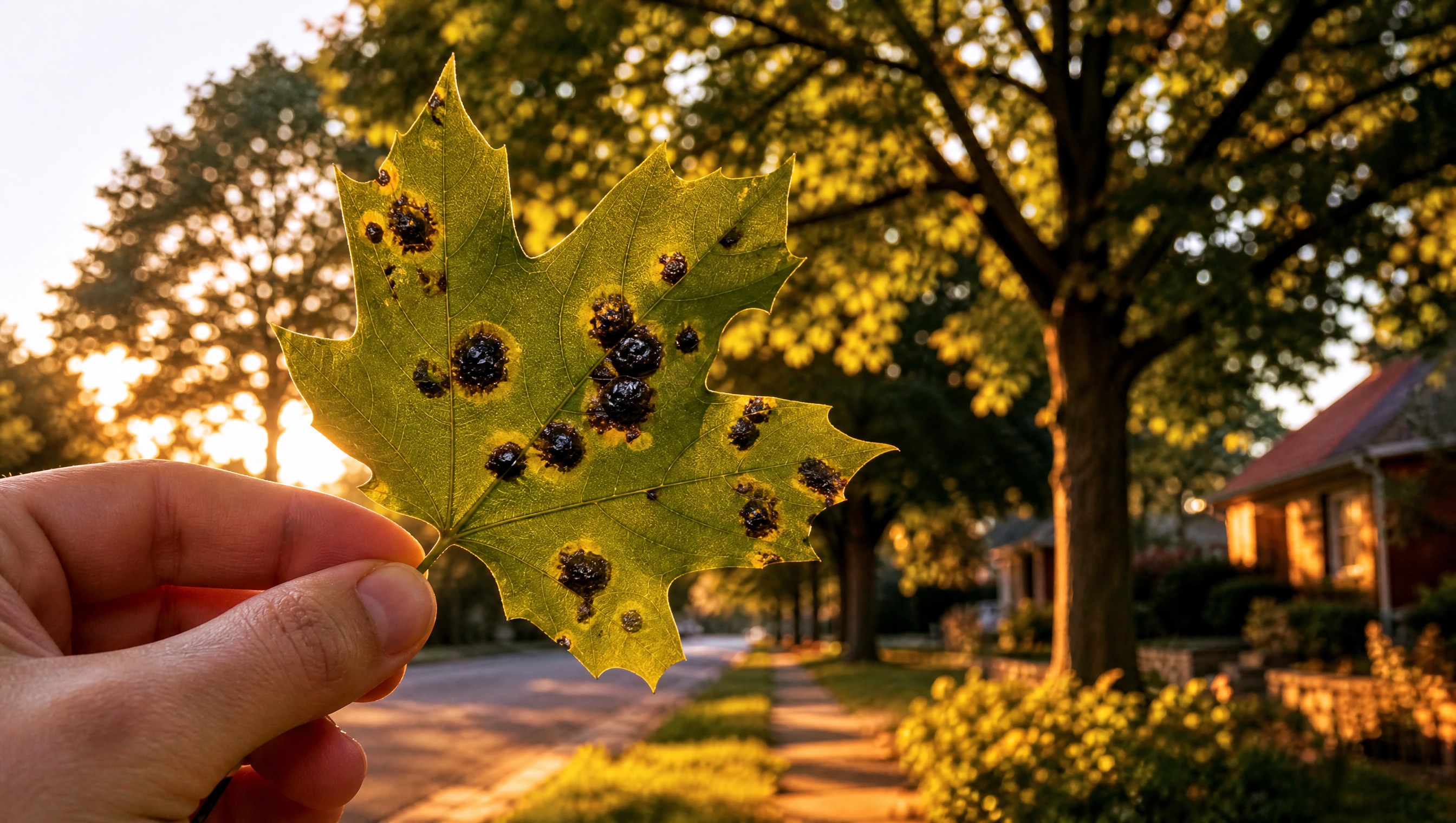

The maple was fine in August. Then one week in September the leaves come out in black spots, raised and shiny as if somebody had flicked a paintbrush of tar at the tree, and the phone calls start. Is it dying. Should it be sprayed. Should it come down before it falls on the garage. The answers are no, no, and please do not. A maple leaf this month carries three common marks, and the leaf in your hand tells you which one you have and which one, if any, needs anything from you.
Tar spot: the ugly one
Tar spot is exactly what it looks like. Round black blotches, a quarter to three quarters of an inch across, raised above the surface of the leaf and glossy, sometimes with a thin yellow halo around each one. They appear in late summer and thicken through September, and on a Norway maple or a silver maple in a bad year the whole crown can look freckled from the street. The spots are the fruiting bodies of a fungus called Rhytisma, and the fungus is a passenger, not a predator.
It does the tree no lasting harm. The leaf still works around the spots, and by the time the spots are big enough to notice the tree is a few weeks from dropping the leaf anyway. In a heavy year the leaves may fall a little early, which alarms people, and the tree loses nothing it needed. The next spring it leafs out clean, and whether the spots come back depends on the weather, not on anything you did.
That is because of how the fungus travels. It winters on the fallen leaves, and in a wet spring it fires spores up into the new foliage at bud break. A cool, damp April and May means a spotted September. A dry spring means a clean one. Raking and binning the leaves in the fall lowers the dose under your own tree, and it is worth doing, but it cannot stop the spores blowing in from the maple next door or the one across the road. Tar spot is a street problem, and no single yard fixes it.
Spraying is not worth it. The extension offices are close to unanimous on this. A fungicide would have to go on in spring, three times, over the whole crown of a mature tree, to prevent a cosmetic problem that arrives in September. Nobody with a ladder and a tank sprayer covers a forty-foot maple, and nobody should. Rake, bin, and let the tree be ugly for six weeks.
Anthracnose: the wet spring's other mark
The second mark is quieter. Irregular tan-to-brown patches that follow the veins of the leaf, running out from the midrib and along the big veins, sometimes taking the edge of the leaf with them. It is anthracnose, a group of fungi that also love a cool wet spring, and on a maple it is a cosmetic problem in the same class as tar spot. It shows up earlier, often by early summer, and by September the marked leaves are simply the ones that were infected in May.
On an established maple, anthracnose does not need treating. It rarely reaches the twigs, and when it does the dieback is a few inches at the tips. The same raking helps. The important caution is that anthracnose on a dogwood or a sycamore is a different disease with a different temper, and those trees can be badly hurt by it. A maple with brown veins is fine. A dogwood with brown veins is a call to the extension office.
Scorch: the one that is a message
The third mark is not a fungus at all, and it is the one to read carefully. Leaf scorch is a brown, dry, papery margin all the way around the leaf, working inward between the veins, with the middle of the leaf still green. The leaf looks as if it had been held near a candle. What it means is simple. The leaf ran out of water. The roots could not send up enough to replace what the leaf lost to the sun and wind, and the edges, farthest from the veins, died first.
The easy cause is drought, and a September of scorched maples after a dry August is normal. The fix is a deep soak, a slow hose at the base of the tree for an hour or two once a week until the rain comes, and a ring of mulch to hold it. Do not fertilize a scorched tree. It has a water problem, and fertilizer asks it to grow.
The harder causes are the ones scorch is trying to tell you about. Road salt from last winter, still in the soil along the curb. A root cut by a trench for a new water line. A driveway or a patio poured over half the root zone, so that half the tree's plumbing is gone. A tree planted too deep, or with a wire basket left on the roots, ten years ago. If a maple scorches every summer, wet year or dry, one of those is usually underneath it, and the water helps but does not cure. That is the moment for an arborist, not a spray.
The pattern that is not on the list
There is one thing a maple can do that none of the three marks explain, and it is the one to act on. If one side of the tree, or one big limb, wilts and browns while the rest of the crown looks normal, the problem is inside the tree. It may be verticillium wilt, a soil fungus that plugs the water vessels one branch at a time, or a girdling root, one of the tree's own roots wrapped around the base of the trunk and slowly strangling it. Both show up as a lopsided tree, and both are worth a visit from someone who can look at the trunk flare and take a twig for testing. Spots are never that. Spots are all over, and all over is almost always fine.
So this month, pick up a leaf from the gutter and look. Black raised drops are tar spot, and the rake is the only tool. Brown blotches along the veins are anthracnose, and the rake again. Brown crisp edges with a green heart are scorch, and the hose is the tool, along with a walk around the base of the tree to see what changed. One side dying is the only one worth a phone call. The maple has been doing this every September for longer than the street has existed, and it will be green again in May.
