
Watering & care · Sep 9, 2026 · By Nell Harding
What Killed That Patch of Lawn? Grubs, Drought, or the Dog
Every September lawn has a brown patch and a worried owner. Three tests you can run on your knees in two minutes tell grubs from a dry spell from the dog, and two of the three need no bag of anything at all.
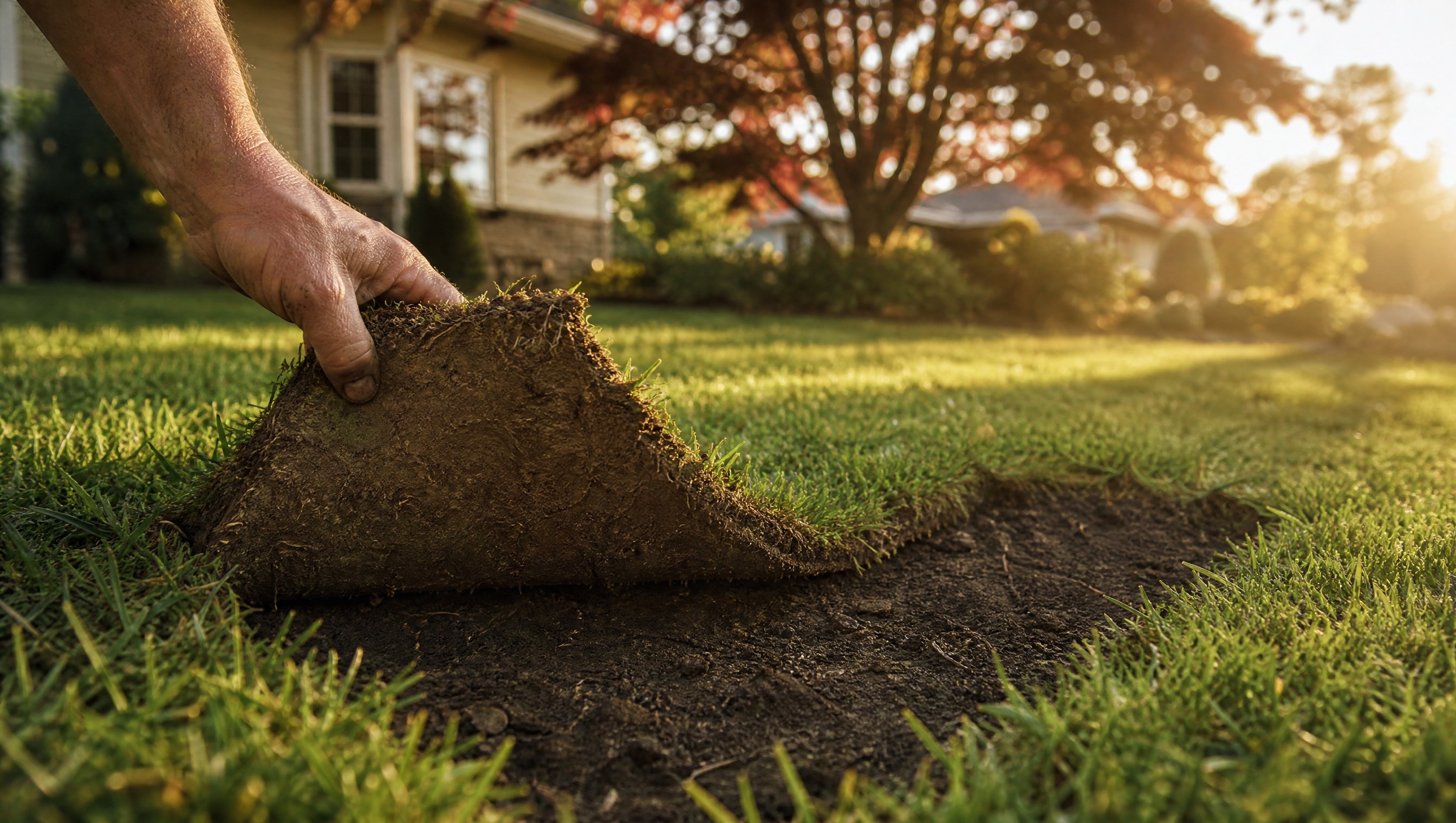

The brown patch shows up in the first cool week of September, right where the lawn used to be its greenest, and the owner does what owners do. They go to the store and buy the bag with the grub on it. Half the time the bag was never needed, because the patch was not grubs at all. The lawn can tell you what happened. It takes three tests, all done kneeling, and none of them costs a cent.
The flap test: grubs
Grab a handful of the dead grass at the edge of the patch and pull. Healthy turf, even dormant turf, fights you. Grub-damaged turf comes up in your hand like a corner of loose carpet, roots and all, because there are no roots left. The white C-shaped grubs under it, the larvae of Japanese beetles, June beetles, and chafers, have spent late summer eating them. Fold the flap back and you will usually see a few lying in the top inch of soil, curled like commas.
There is a second witness. Something has usually been digging. Skunks, raccoons, and flocks of crows and starlings all know exactly where the grubs are and tear the turf up at night or at dawn to get them. A patch that lifts and shows dig marks is grubs, no lab required.
Now the part the bag does not tell you. Cut three sides of a square foot with a spade, lift it, and count. Most extension services put the treatment line somewhere around eight to ten grubs per square foot, and the exact number depends on the species and on how well watered the lawn is. Fewer than that and a healthy lawn outgrows the damage on its own by the time the ground freezes. A handful of grubs is not an infestation. It is a lawn.
If the count is well above the line, September is the last honest window for the curative products, and the label is the law on rates and timing. Below the line, rake out the dead flap, drop grass seed in the bare soil, keep it damp, and let the cooling weather do the rest. The grubs go deeper as the soil cools and stop feeding for the year.
The tug test: drought dormancy
Pull on the brown grass and it holds. The blades are straw-coloured and crisp, but the plant is anchored and will not give. Now part the blades and look at the very base, right at the soil. Green there, even a hint, means the crown is alive. The lawn is not dead. It has gone dormant, which is what a cool-season grass does when it goes a few weeks without water in the heat.
Drought browning has a shape of its own. It comes on evenly across a whole area rather than in blotches, it starts in the sunniest spots and on the thinnest soil over rock or hardpan, and it stops at the shade line of a tree. It also arrives in a dry stretch, which the grub patch does not need.
The fix is the sky, or the hose. One real soaking, an inch of water, and a dormant lawn shows green again inside two weeks. What you should not do is fertilize it or reseed it while it is still brown. It is asleep, not hungry. The one caution worth knowing is time. A cool-season lawn can hold dormancy for a month or so without harm, but past six weeks without any water at all the crowns begin to die, and then the brown really is dead. In a long dry fall, give it a soak once a month to keep it alive, even if you never plan to make it green.
Readers in the South with warm-season grasses, Bermuda, zoysia, centipede, see the reverse. Those lawns brown on purpose after the first frosts and stay brown until spring. That is not damage and it is not a patch. It is the whole lawn going to bed.
The ring test: the dog
A dead spot the size of a dinner plate, roughly round, with a ring of darker, thicker green grass around it, is a dog. The centre burned because urine is salt and concentrated nitrogen, and too much nitrogen in one spot kills grass the same way a spilled handful of fertilizer does. The ring is the tell. Around the edge the urine was diluted enough to feed the grass instead of burning it, so it grew greener than the lawn around it. Nothing else leaves that halo.
The spots run along the dog's usual route, near the door and the fence and the favourite tree, and they show up worst in a dry spell when there is no rain to dilute them. The prevention is a bucket of water poured on the spot within an hour or two, or a hose left running there for a minute. The repair is to rake out the dead centre, scratch the soil, and seed it. Do not bother with the additives sold to change the dog. Change the water.
The two that look like these and are not
A round dead spot with no green ring is usually a spill. A fertilizer spreader that sat too long in one place, a splash of gas from the mower can, a bag of ice melt left on the grass last winter. Same burn, no halo. It seeds over like the dog spot.
Fungal disease is the other look-alike, and it is the one that fools people into treating for grubs. Brown patch comes in humid weather as irregular blotches a foot or more across, sometimes with a darker smoky ring at the edge in the morning dew. Dollar spot is a scatter of bleached spots the size of a silver dollar. Neither one lifts like a rug, neither one has the dog's dark green halo, and both come with damp nights and heavy nitrogen. Water in the morning instead of the evening, ease off the fertilizer, and most fungal patches recover on their own when the weather breaks.
So kneel before you shop. Pull, and see whether it lifts or holds. Look at the base for green. Look at the edge for a ring. Two minutes on your knees in September, and the bag with the grub on it stays on the shelf where, most years, it belongs.
