
Watering & care · Sep 20, 2026 · By Nell Harding
The Raccoon on Your Deck Rail Is About to Move Into Your Chimney
Fall fattening gives way to November den hunting, and an uncapped chimney or a soffit gap are the two entry points a raccoon actually uses. Here is the month-by-month window to cap it first.
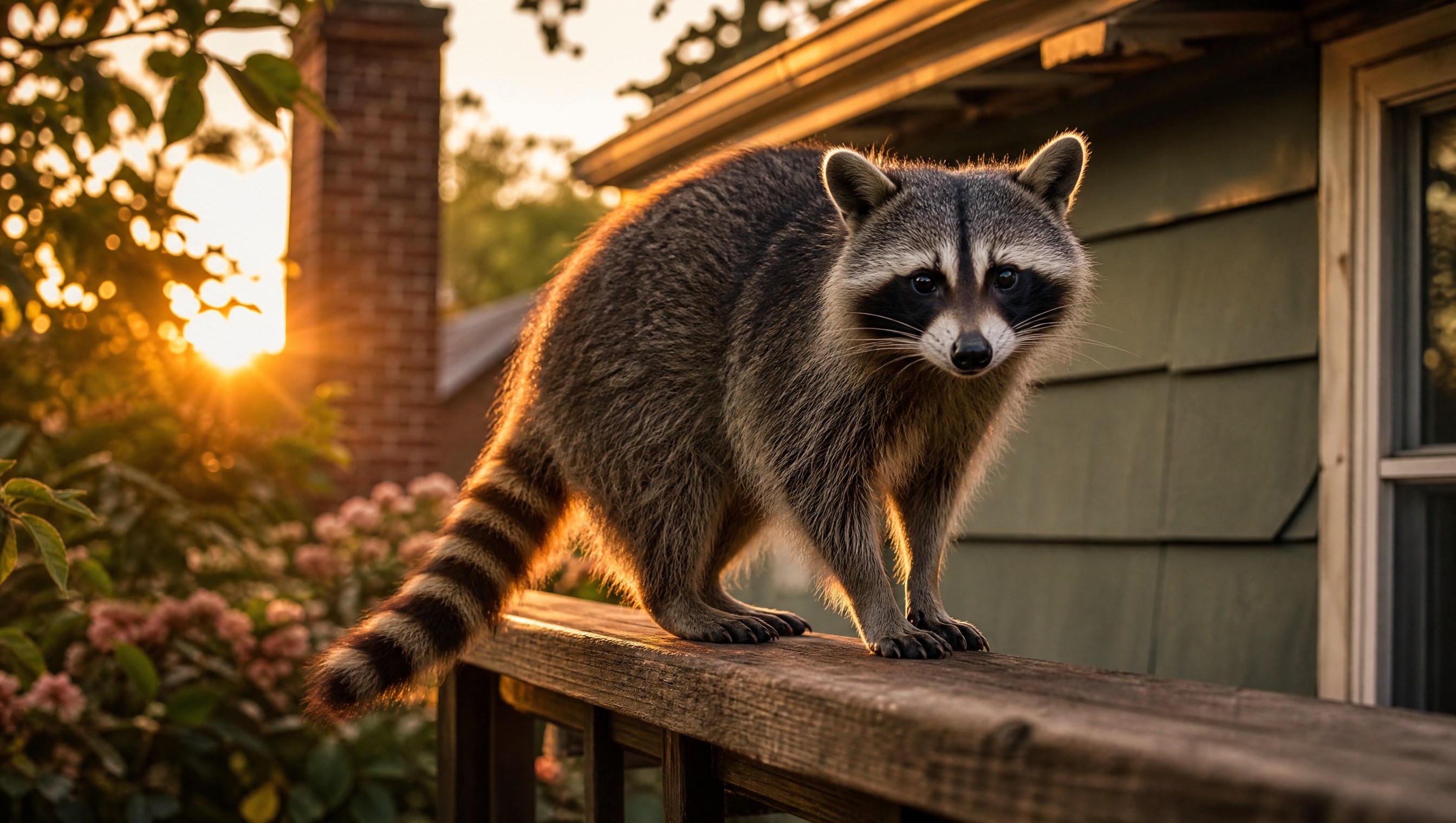

The raccoon working the deck rail at dusk for spilled birdseed is not passing through. By the time the leaves are down it will be house hunting, and an uncapped chimney is one of the two doors it is most likely to find open.
Right now a raccoon's whole job is putting on weight. Fall is the fattening season, and a raccoon that spent summer foraging opportunistically spends September and October eating anything dense with calories: windfall fruit under the trees, spilled birdseed under the feeder, pet food left out overnight, and whatever it can pull from an unsecured bin. The deck rail or roof edge it keeps returning to is doing double duty as a dining spot and a latrine, and that combination is worth naming honestly rather than glossing over.
Raccoons use the same few surfaces to defecate over and over, and the CDC's page on raccoon roundworm, Baylisascaris procyonis, explains why that matters. The eggs in raccoon droppings take two to four weeks to become infectious once shed, so a latrine cleaned up promptly is far less of a hazard than one left to accumulate. Infection in people is rare, the CDC notes, and mostly affects children or others more likely to put contaminated dirt or waste in their mouths by accident, but it can be serious when it happens, so the practical response is simple and not alarming: find the latrine, remove the droppings promptly with a shovel rather than a broom that raises dust, and wash your hands afterward. That is the whole precaution, stated once.
The move to denning
Fattening season gives way to den hunting in November, and this is the part of the year that actually determines whether a raccoon ends up in your house. Washington Department of Fish and Wildlife's raccoon profile lists the structures raccoons use for shelter, and alongside hollow logs and abandoned burrows it names attics, crawl spaces, chimneys, and abandoned vehicles without any hesitation. An entrance as small as four inches high and six inches wide is enough, which is smaller than most people assume. In a yard, that means exactly two weak points: an uncapped chimney flue and a gap where a soffit or fascia board has pulled loose from the roofline. Everything else on a typical house is reasonably raccoon proof; those two usually are not.
Once a raccoon picks a den, it does not truly hibernate the way a groundhog does. Raccoons in cold climates go through torpor, extended sleep with a lowered body temperature and heart rate, but they wake during mild spells to forage and can be active on and off all winter. A chimney flue is an appealing torpor site precisely because it is warmer than the surrounding attic and dry.
The three signs you already have one
Most homeowners do not see the raccoon move in. They hear it. The clearest sign is scratching, shuffling, or low chattering from inside the flue or the chimney wall, usually most active right at dusk and again around dawn as the animal settles in or heads out to forage. The second sign is the latrine itself, a buildup of dark, tubular droppings in one repeated spot on the roof, at the base of the chimney, or on a deck or porch roof directly below a den entrance. The third is physical damage at the entry point: a pulled-back section of soffit, a bent or missing piece of fascia, or a flue cap that has been worked loose or pried up, often with claw marks in the surrounding paint or wood. Any one of the three on its own is worth investigating. Two together are close to a confirmation.
What to do, by month
Now, before den hunting starts, is the month to cap the chimney. WDFW's guidance on exclusion is specific about the standard: seal entry points with quarter-inch mesh hardware cloth, boards, or metal flashing, not the lighter mesh sold as a spark arrestor. A proper chimney cap, sheet metal frame with heavy welded screen, keeps a raccoon out permanently; a flimsy cap gets pried off in one night. Screen every soffit and fascia gap the same week, using the same heavy hardware cloth, and bring in anything that reads as food: pet bowls at night, unsecured birdseed, and trash or recycling bins without a locking or clamped lid.
November is the last easy window. Once a raccoon has denned somewhere, capping the chimney with it inside just traps it in your house, so the order matters: secure attractants and cap entry points before den season, not during it. Watch for the three signs through the winter months regardless; a mild spell can send a raccoon looking for a better den even in December or January.
February is mating season, which raises the stakes on any den decision made in late winter, and April is when a pregnant female that did find her way in delivers kits, typically two to three of them, inside whatever chimney, attic, or wall cavity she chose. This is the one month of the year with a hard rule attached: never trap, seal, or exclude a raccoon between roughly March and June without confirming no kits are present first. A cap installed over an active den, or a female excluded while her kits are still inside, orphans them in the wall, where they die slowly and often leave an odor problem worse than the original one. If you suspect a spring den, wait. Raccoon families move on within a matter of weeks once kits are mobile, and capping the chimney after they leave is a far simpler job than an emergency removal with young inside.
The legal and practical edges
Trapping and relocating a raccoon is regulated, and the rules vary meaningfully by state; some states permit relocation only by a licensed nuisance wildlife control operator, others restrict it further, and moving an animal across county or state lines is commonly restricted outright. This article is not legal advice for your specific address; check your state wildlife agency's current rules, the same kind of page WDFW publishes for Washington, before assuming you can trap and relocate on your own.
Raccoons are a primary rabies vector species across much of the country, so the standing precautions are worth repeating plainly: keep pets current on rabies vaccination, never hand feed a raccoon or let a pet approach one, and treat any raccoon that is active in full daylight, appears disoriented, or shows no fear of people as a reason to call animal control rather than approach it yourself. A raccoon fattening on your bird seed at dusk is behaving completely normally and is not, by itself, a rabies concern.
The short version
The deck rail visitor this month is a preview, not the problem. Cap the chimney with a real screened cap, screen the soffit gaps, and lock down the food sources before November, and the raccoon that fattened on your property all fall dens somewhere else instead of in your flue.
