
Watering & care · Sep 19, 2026 · By Nell Harding
The Rabbit Under the Shed Will Girdle Your Young Trees This Winter
An eastern cottontail that has spent all summer on clover and lawn edges switches to bark and twigs the moment the greens die back, and a young fruit tree or cane fruit planting is the easiest meal in the yard. The guards go on now, not after the first gnaw ring appears.
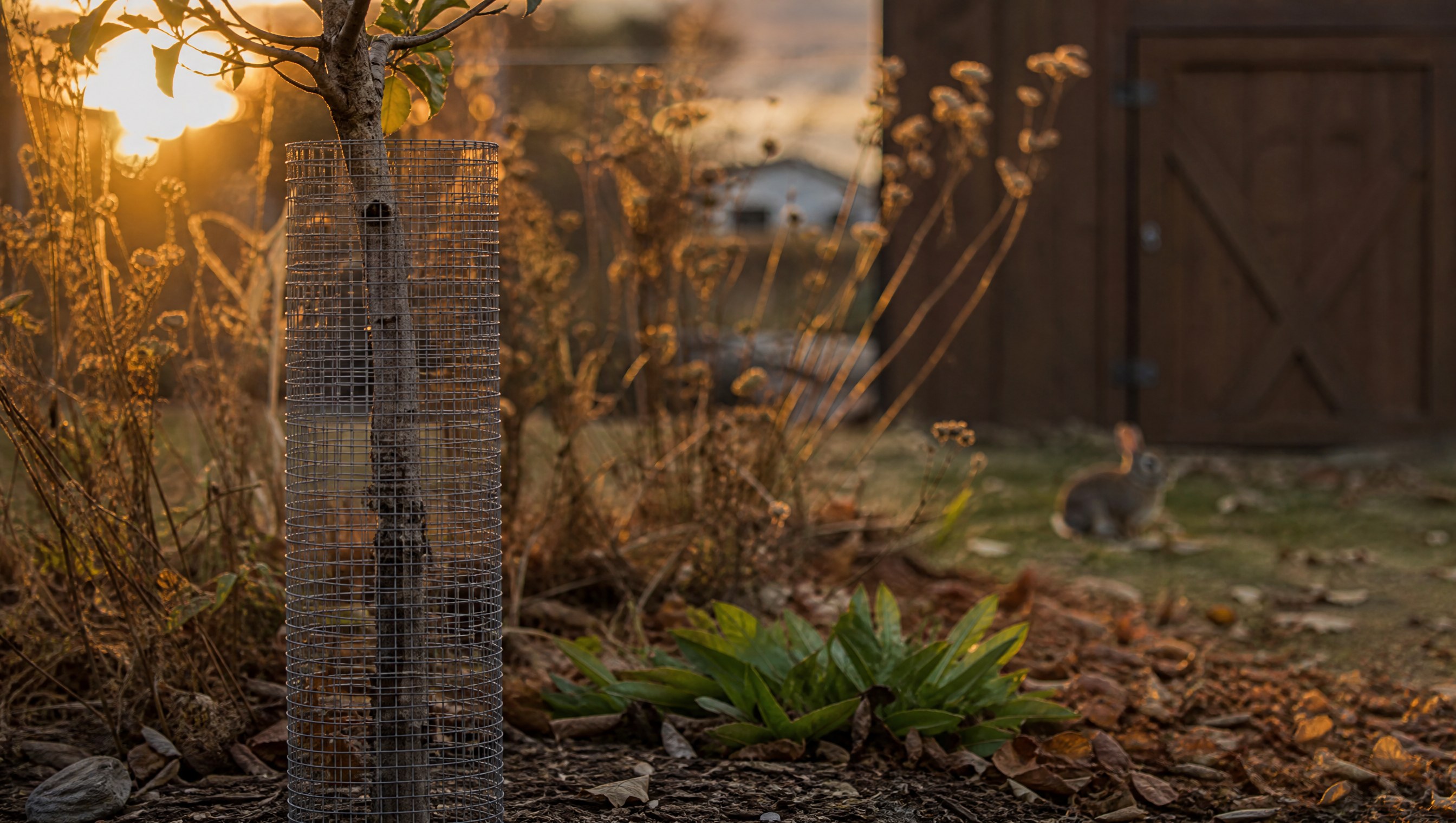

The eastern cottontail under the shed has been an easy neighbor all summer, nosing through clover and the shaggy edge of the lawn and mostly leaving the vegetable beds alone. That changes the moment the garden dies back. A cottontail does not hibernate and does not store food, so when the soft green forage disappears it switches, almost overnight, to bark, buds, and twigs, and a young fruit tree, a row of raspberry canes, or a newly planted shrub is the easiest, most concentrated meal within reach.
The Cottontail's Year, Compressed
Penn State Extension's cottontail life history notes that eastern cottontails can produce up to six litters a year, roughly five young per litter, with the first litters born as early as late March; the last late-season litters typically arrive in early fall, often in a shallow grass-lined divot scratched into open lawn rather than a burrow. Those late litters are weaned into a garden that is already thinning out, which is part of why fall pressure on woody plants climbs even as the population itself is not yet at its peak. Penn State Extension is direct about the seasonal diet swing too: cottontails eat flowers and vegetables in spring and summer, then shift to woody plants in fall and winter as those softer foods disappear.
That forage switch is not a preference so much as an availability problem. Bark and cambium are lower in nutrition than green leaves, and a rabbit would rather have clover if clover is on offer. Once frost and mowing remove it, the calculation changes, and it changes for every rabbit in the neighborhood at roughly the same time, which is why damage tends to appear over a short window in late fall rather than trickling in all season.
What the Damage Actually Looks Like
A rabbit feeds with a single pair of upper incisors working against a pair below, and the result is a clean, angled cut, close to 45 degrees, on any twig or small branch it clips. On a trunk, a rabbit gnaws bark from the ground up to roughly the height it can reach standing on packed or drifted snow, often twelve to eighteen inches on bare ground and considerably higher once there is a snowpack to stand on. Worked all the way around the circumference, that gnawing removes the bark and the cambium layer beneath it in a full ring, which is what girdling means. Iowa State University Extension describes it directly: rabbits feed on the tissue between the bark and the wood, and once they completely encircle a trunk the girdling destroys the tree by disrupting the downward flow of food from the foliage to the root system. Everything above that ring, sometimes the whole tree, dies back or dies outright the following spring even though the roots underground are perfectly healthy.
The tell is the height and the cleanness of the cut. A rabbit's gnaw ring sits up off the soil line, at snow height, with a fairly crisp upper edge where the animal was standing at its reach limit. That single detail does most of the diagnostic work.
Rabbit, Vole, or Deer
Voles do their damage at the opposite end of the trunk. A vole tunnels under mulch, snow, or grass right at the soil surface and gnaws bark down at ground level, often leaving irregular tooth marks and shallow grooves rather than a clean ring, and the girdling (when it happens) sits at or just below the soil line, not up at rabbit height. If you clear the mulch back from a trunk in late winter and find chewed bark hugging the ground, that is a vole problem, and it calls for keeping mulch pulled a few inches back from the trunk and, in bad years, a below-ground hardware cloth collar, not a taller rabbit guard.
Deer browse is a different signature again: it happens well above a rabbit's reach, typically starting around two feet and running up to five or six feet on a mature deer, and because deer lack upper incisors and instead tear browse against a hard palate, the twig ends are ragged and torn rather than cut cleanly at an angle. Ragged, high, torn: deer. Clean, low, angled: rabbit. Irregular and hugging the soil: vole. Checking a damaged tree against those three signatures before buying a fix saves money, because a deer fence solves nothing for a vole and a taller trunk guard solves nothing for deer.
Guards That Actually Work
The reliable fix is physical, not chemical: a cylinder of quarter-inch hardware cloth, or a commercial spiral plastic tree guard, wrapped loosely around the trunk with an inch or two of clearance so the tree can grow without the guard biting into new bark. Cage it a few inches into the ground where voles are also a concern, and set the top height above whatever snow depth the site typically sees plus the rabbit's standing reach. Iowa State University Extension's guidance is to make fencing high enough that rabbits will not be able to reach over it after a heavy snow, generally twenty-four to thirty-six inches tall, and to check protected plants after a snowfall and clear snow away if a rabbit could still reach over. A guard sized to this fall's snowless soil line is a guard that fails the first time there is a foot of snow on the ground and a rabbit gets a two-foot head start.
Cane fruit and young shrubs get the same treatment at a smaller scale: a wrapped collar of hardware cloth around the base of the canes, or, for a whole row, a temporary fence of chicken wire staked around the planting through the dormant season. The guard comes off in spring once new growth resumes and the tender bark that a rabbit prefers is gone, both to let the trunk breathe and to stop the guard from girdling the tree itself as it thickens.
Repellents, and Why They Are a Backup, Not a Plan
Taste and scent repellents, capsaicin or predator-urine based sprays reapplied after rain or snow, will reduce browsing pressure on a given night, but they wear off, wash off, and lose effectiveness once a hungry rabbit has few other options left in a hard winter. They are a reasonable supplement on trees you cannot physically guard right away, never the primary defense on a tree worth keeping. A repellent bought in November for a tree already showing bare wood is a week too late; a hardware cloth cylinder installed in September is not.
What Not to Do
Do not wrap a trunk in plastic tree tape or a solid, non-breathable wrap for the whole winter; trapped moisture against the bark invites rot and disease, which is a slower version of the same dead tree. Do not assume a short guard is enough because there is no snow on the ground yet in September; guards go up to the expected peak snow height for the site, sized before the snow arrives, not adjusted after. And do not wait for a gnaw ring to appear before acting: by the time bark is visibly missing in a full ring, the damage is often already done, and a tree girdled all the way around rarely recovers no matter what happens next.
Sources
This article draws on Iowa State University Extension's Yard and Garden guidance, How to Protect Trees and Shrubs from Animal Damage Over Winter, and Penn State Extension's Cottontail Rabbits fact sheet on eastern cottontail life history and feeding habits.
