
Watering & care · Sep 13, 2026 · By Nell Harding
Pull the Mulch Off the Trunk
A field note from a walk down my own street. Every young tree had a cone of mulch piled against its bark, and it took me one evening on my knees to undo what the crew did in May.
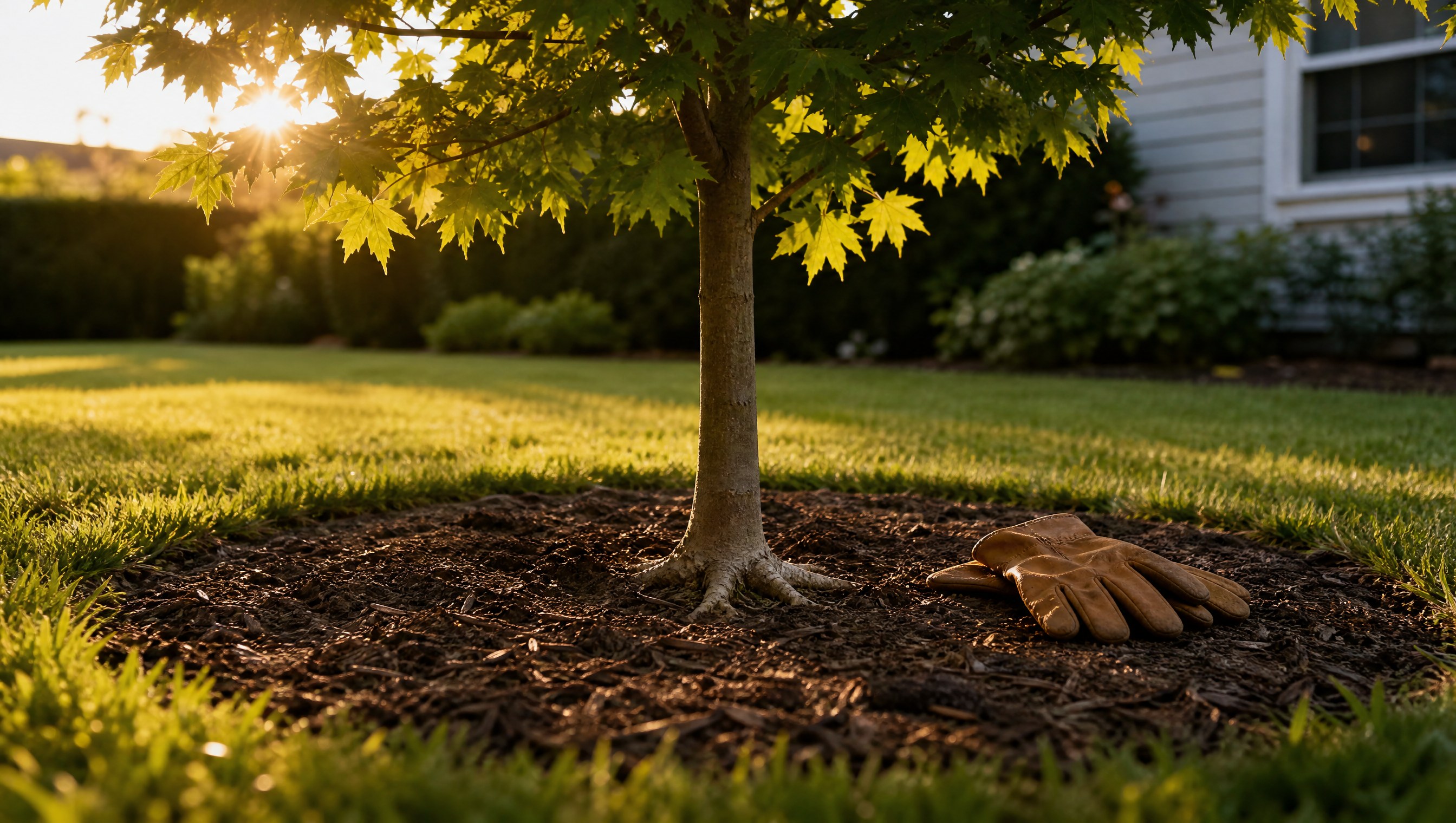

I walked the length of my street one evening this week and counted. Fourteen young trees planted by the town in the last five years, and twelve of them had a cone of shredded bark piled a foot high against the trunk, neat as a hat. The crew comes in May, spreads the mulch, and rakes it up into a volcano because that is what a finished job looks like. It is the most common thing done to a tree in this country, and it is slowly killing all twelve.
Bark is not root. It is the tree's skin, and like skin it is built to be in the air and to dry out between rains. Pile mulch against it and it stays wet from April to November. Wet bark softens, and rot and cankers get in where the trunk meets the pile, and you never see it because the pile is covering it. That is the first way a mulch volcano works on a tree, and it is the slow one.
The second way is worse. Roots grow toward moisture, and a damp cone of mulch against the trunk is the moistest thing in the yard. Fine roots grow up out of the ground into the pile, and because the pile is a cone, they grow around the trunk instead of away from it. Ten years on, those roots have thickened into a collar that wraps the base of the tree and squeezes it a little harder every season. The arborists call them stem-girdling roots. The homeowner calls it a maple that leaned over one summer and died for no reason.
What I found when I pulled it back
I went out with gloves and did my own two trees first, then the neighbor's with permission. On the older maple, planted maybe eight years ago, the bark under the cone was dark and soft for a hand's width above the soil, and there were two pale roots the thickness of a pencil already circling the trunk under the mulch. I cut those with the pruners. On the young serviceberry, planted the spring before last, the bark was still sound. That one I caught in time.
The fix is the easiest job in the garden. Kneel down and rake the mulch back with your hands until you see the flare, the place where the trunk widens out into the roots. That flare belongs in the open air. Leave three inches of bare ground all the way around it. Then spread what you pulled back out into a flat ring, two or three inches deep, out toward the drip line of the branches. A doughnut, with the tree in the hole. Not a volcano.
A big old oak gets away with a volcano for years, because its bark is thick and its roots were established long before the mulch arrived. The trees that cannot afford it are the young ones, the thin-barked ones like maple, birch, cherry and linden, and anything planted in the last five years, which is exactly the list the town plants. If you have one of those, the pile comes off this week, while the ground is still warm enough for the bark to dry.
It took me twenty minutes for three trees, and the only cost was the knees of my trousers. The crew will be back in May with the same rake. So will I. Look at the base of your own tree tonight. If you can see it widen into the ground, it is fine. If it disappears into a brown cone, you know what to do.
