
Kitchen garden · Sep 12, 2026 · By Nell Harding
Never Put a Tomato in the Fridge
A ripe tomato keeps making its own flavor until you eat it, and cold switches that off. Here is what the study measured, which notes go first, the one exception, and what to do with a September counter full of them.
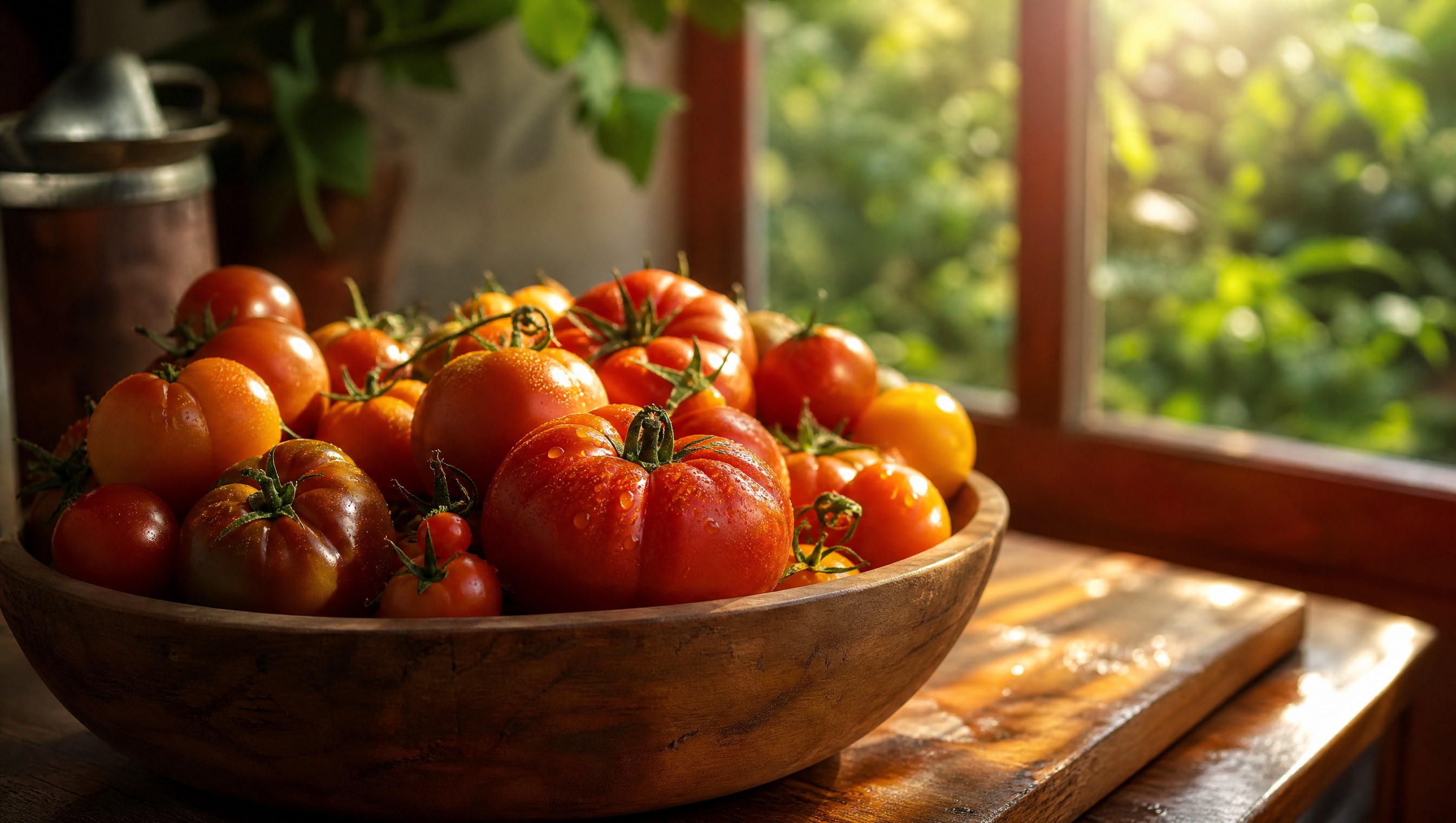

Every September the same argument starts over the same bowl. The tomatoes are coming in faster than anyone can eat them, the counter is full, and somebody puts a dozen in the fridge to keep them. They do keep. They stay red and firm for a week or more, and when they come out and get sliced they taste of almost nothing. The person who put them there says they were never that good. The person who grew them knows better. The grower is right, and since 2016 there has been a study that explains exactly why.
A tomato makes its own smell, fresh, until you eat it
What you taste when you bite a good tomato is mostly what you smell. Sugar and acid are on the tongue, but the thing that makes a garden tomato different from a January one is a set of aroma compounds, a few dozen of them, that the fruit makes out of its own fatty acids, amino acids and carotenoids. They are volatile, which means they evaporate, and a ripe tomato is producing them continuously, right up until it is cut. It is not a store of flavor that slowly runs down. It is a small factory that is still running.
That factory is run by genes, and the genes are sensitive to temperature. Below about twelve degrees Celsius, which is fifty-four Fahrenheit, they start to switch off. A kitchen refrigerator runs somewhere between thirty-five and forty. Put a ripe tomato in there and within a day the production of those compounds has dropped, and the longer it stays the further it falls.
What the Florida study actually did
In 2016 a group led by Harry Klee at the University of Florida published the mechanism in the Proceedings of the National Academy of Sciences. They took ripe tomatoes, held some at five degrees Celsius for a week, then brought them back to room temperature for a few days, and measured the aroma compounds and the activity of the genes that make them against fruit that had never been chilled.
The chilled fruit lost a large share of its volatiles. The genes for the enzymes that make them, with names like lipoxygenase and alcohol dehydrogenase, were turned down. So were the master ripening regulators that sit above them, the genes a tomato uses to decide it is ripe at all. And the cold left a mark on the DNA itself, a chemical tag called methylation on the switches that control those genes, which is part of why they stayed off. A trained taste panel could tell the difference between the chilled and unchilled fruit without being told which was which.
The part of the study that matters for your kitchen is what happened after the fruit warmed up. Some of the genes came back on. Some did not. A short chill was mostly reversible. A week was not.
Which notes go first
The compounds that fall fastest in the cold are the green, grassy ones, the ones that come from fatty acids and smell like a tomato leaf when you brush it. Those are the notes that say fresh. The sweeter, fruitier compounds hold on longer, which is why a fridge tomato is not exactly bad, just flat. It has lost the top of its range.
This is also the whole story of the winter supermarket tomato. It was picked green so it would travel, held cold, and gassed with ethylene to turn it red. The color came back because color is a different pathway. The smell was never made in the first place, because the fruit was never ripe and warm at the same time.
What to do with a September counter full of them
Keep them on the counter, out of direct sun, stem side up. The stem scar is where a tomato loses moisture and where mold gets in, and setting it on that scar seals it. Do not crowd them in a bowl three deep, because the bottom ones bruise and the bruises are where rot starts. A tray or a wide platter in a single layer is better than a bowl, for all that a bowl looks nicer.
Eat them in the order they ripen, not the order they were picked. Sort the counter every morning. A tomato that has gone fully soft and dark is at its peak today and will not be tomorrow.
Green ones and half-ripe ones ripen on the counter too, and faster in a paper bag with a banana, which leaks ethylene. They will not get the full flavor of a vine-ripened fruit, but they will get most of it, because the fruit is still warm while it finishes.
The one exception
A tomato that is dead ripe today and will not be eaten until the day after tomorrow is going to lose something either way. Left on the counter it will go over and start to rot. In the fridge it will go quiet. For a day or two, the fridge loses you less than the compost bucket does, and the study found a short chill is mostly recoverable. Put that one in, and take it out an hour before you slice it, so the compounds that can restart have warmed up enough to do so.
That is the whole rule. A ripe tomato lives on the counter. A dead-ripe one you cannot eat today can visit the fridge for a day, and comes out early. A week in the cold is a tomato you will not get back.
The test you can run tonight
Take one tomato from the fridge and one from the counter, both ripe, and smell the stem end of each. The counter one smells like the plant. The cold one smells like the fridge. Now leave the cold one out for an hour and smell it again. Some of the plant will have come back. That gap between the two, and the part that returns, is the study in one sentence.
