Garden myths · Jul 17, 2026 · The 2026 edition
Watering in the midday sun does not burn leaves
The lens-effect warning has been repeated for a century. Physicists finally tested it.
Every gardener has heard the warning, usually delivered with complete confidence: never water at midday, because the droplets act as tiny magnifying glasses and scorch the leaves. It is one of gardening's most repeated rules. It is also, for practical purposes, wrong, and the story of how we know is a good lesson in how garden folklore survives.
The claim sounds plausible, which is exactly why it spread. A curved water droplet really is a lens, and a magnifying glass really can start a fire. But plausibility is not physics. In 2010, researchers at Eotvos University in Budapest did what a century of garden columns never had: they put droplets on leaves in full sun, measured, modeled the optics, and photographed the results.
The finding: on a smooth leaf, a sitting water droplet cannot focus sunlight tightly enough, for long enough, to damage the leaf beneath it. The focal point of a droplet lying flat against a leaf lands below the leaf surface, not on it, and the droplet is meanwhile evaporating and cooling the very spot it sits on. The scorch marks gardeners blame on droplets are, on inspection, disease spots, ozone damage, nutrient deficiency, or plain heat stress.
The researchers did find one genuine exception: leaves covered in fine hairs, like some ferns, can hold a droplet up above the surface at just the right height for its focal point to land on the hairs. So if your garden is mostly floating fern, the old rule stands. For tomatoes, squash, beans, roses, and essentially everything else in an ordinary bed, it does not.
So why does this almanac still tell you to water in the morning? Because the real reasons are better than the fake one. Midday watering is not dangerous; it is wasteful. In the heat of the day a sprinkler can lose a third or more of its water to evaporation before it ever reaches a root. The same gallons delivered at 7 a.m. nearly all arrive.
Morning watering also gives leaves the full day to dry. Evening watering, the other tempting slot, leaves foliage wet through the cool night, which is a standing invitation to powdery mildew, blight, and the rest of the fungal crowd. Morning remains the champion not because midday burns, but because morning wastes least and dries fastest.
Here is the part of the myth that does real damage: gardeners who believe it will watch a bed wilt at 1 p.m. on a 95 degree day and refuse to water until evening, out of fear of scorching. That afternoon of drought stress is far more harmful than midday water could ever be. Wilt at midday from dry soil is an emergency now, not at sunset.
The practical rule set, cleaned of folklore, is short. Default to early morning. If a plant is wilting from dry soil at noon, water it at noon, at the base, without guilt. If you must choose between evening water and a dry night for a drought-stressed bed, water and accept damp leaves for one night. And put the myth to rest at the garden fence when it comes up, gently, with the Budapest study in your back pocket.
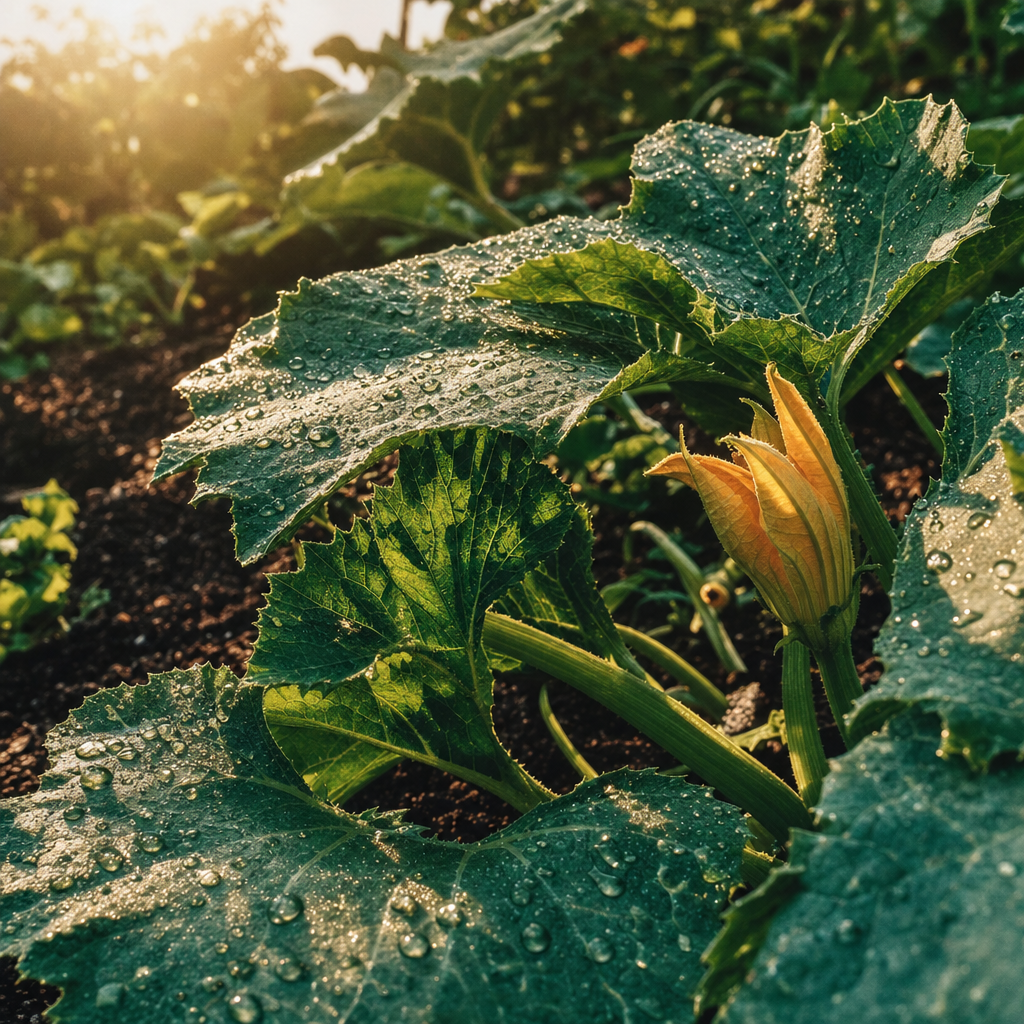
One more midday sighting worth reclassifying while we are here. The dramatic droop of squash and pumpkin leaves at high noon is often not thirst at all: big soft leaves fold on purpose in peak sun to reduce their exposed area, then recover by late afternoon. Check the soil before reaching for the hose; if it is moist two knuckles down and the leaves perk up by five, that was posture, not drought.
Garden myths survive because the advice they give is half right. Morning really is the best time to water. But knowing the true reasons, evaporation and drying time rather than tiny magnifying glasses, means you also know when the rule is safe to break. The plants were never in danger from the sun and a sprinkle. They were in danger from a gardener waiting for permission.
New entries land here through the season.
Follow the garden day to day on Facebook