
Watering & care · Oct 5, 2026 · By Nell Harding
Leave the Pokeweed Berries for the Birds
The tall weed with magenta stems along the back fence is loaded with dark purple berries right now. They are poison to people and a feast for catbirds, mockingbirds and waxwings. Here is who eats them, which parts are the most toxic, and how to remove the plant if it has to go.
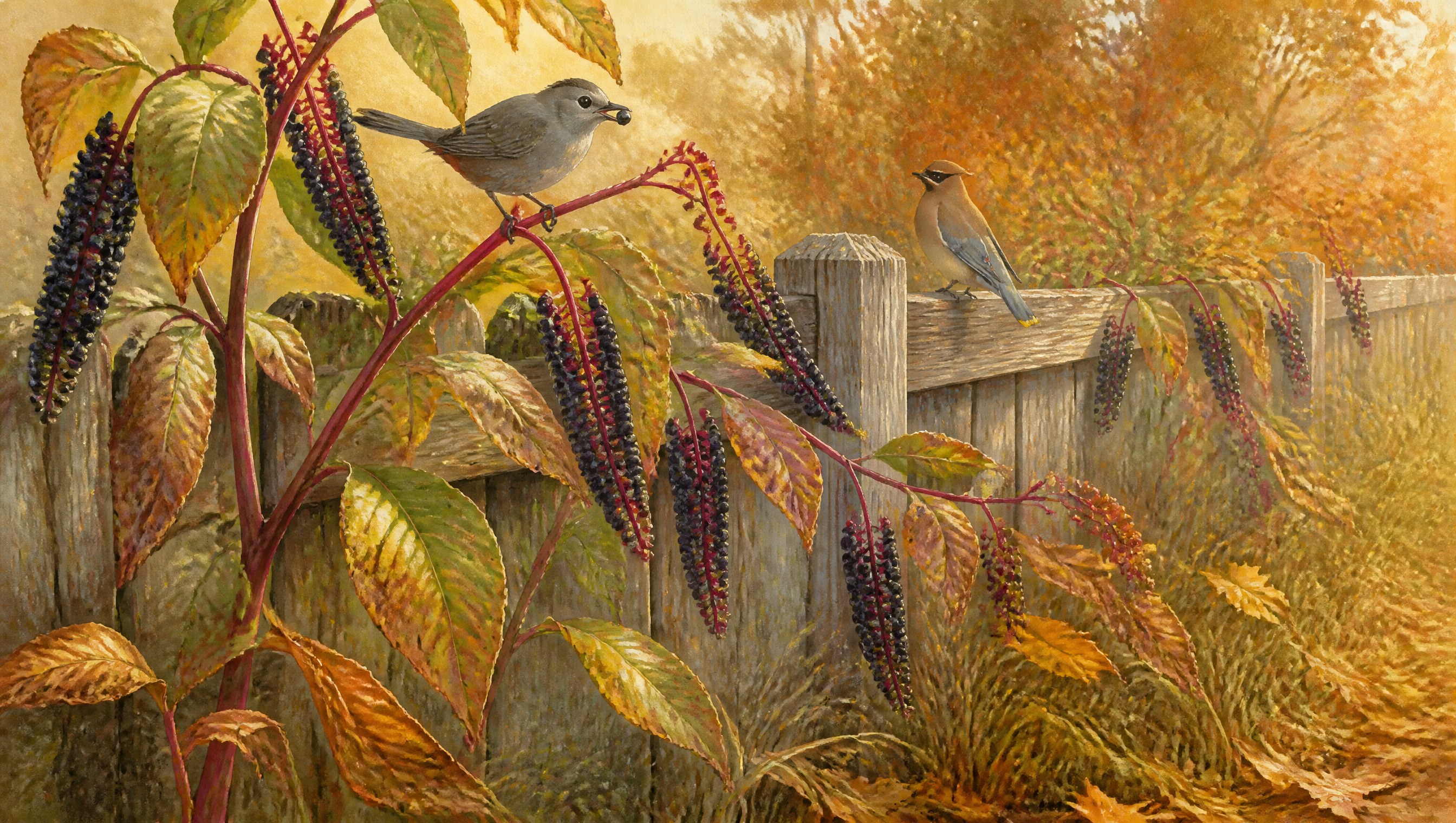

By October the tall weed along the back fence is hard to miss: thick magenta stems, big leaves going yellow, and long drooping clusters of dark purple berries. Most gardeners know pokeweed is poisonous. Fewer know how many birds are counting on it right now.
WHO EATS THE BERRIES
The Missouri Department of Conservation lists the northern mockingbird, gray catbird, brown thrasher, northern cardinal and cedar waxwing among the birds that commonly eat poke berries. It says the birds seem to be immune to the toxins in the fruit and eat the berries with gusto.
Mammals take their share too. MDC names mice, raccoons, opossums, foxes and even black bears among the animals that eat poke berries.
Ohio State University's weed guide agrees that birds commonly eat pokeweed berries without adverse reactions, and adds that birds are probably an important way the plant spreads.
MDC also notes that the bright red, late-season stems are thought to be how the plant signals to birds that the berries are ripe. Those magenta stalks you see this month are an advertisement.
WHY YOU SHOULD NEVER EAT THEM
What is safe for a catbird is not safe for you. MDC says all parts of pokeweed are toxic, and that the berries are toxic to humans if eaten.
Ohio State's guide says all parts of common pokeweed are toxic to humans, pets and livestock. It ranks the roots as the most poisonous, the leaves and stems in the middle, with toxicity rising as the plant matures, and the berries as the least toxic. Least toxic is still toxic.
Some people also react through the skin. MDC notes that some people develop a rash after handling the plants.
You may know someone who cooks poke salat. MDC says young shoots and leaves are eaten by many after thorough cooking in at least two changes of water. That is the young greens only. The berries are never part of it.
LEAVE IT OR PULL IT
If the plant stands in a back corner where no one plays, leaving it through the fall is an easy gift to the birds. Let the berries hang until the catbirds and waxwings strip them.
If small children or a dog spend time in that corner, the safer choice is to take it out. Wear gloves, given MDC's note about rashes.
Ohio State says that for a few scattered plants, cutting below the root crown is effective, because digging up the large taproot is very difficult. It describes that taproot as large, fleshy and white, four to six inches across.
Expect new ones to turn up. Ohio State says pokeweed seeds can remain viable in the soil for up to 40 years, and the birds that eat the berries carry the seeds wherever they go.
