
Garden myths · Aug 24, 2026 · By Nell Harding
The Scarecrow Never Worked, but the Crow Does
A century of stomach records says the black bird in the corn is mostly eating your pests, billing you a few ears for the service, and memorizing your face while she works.
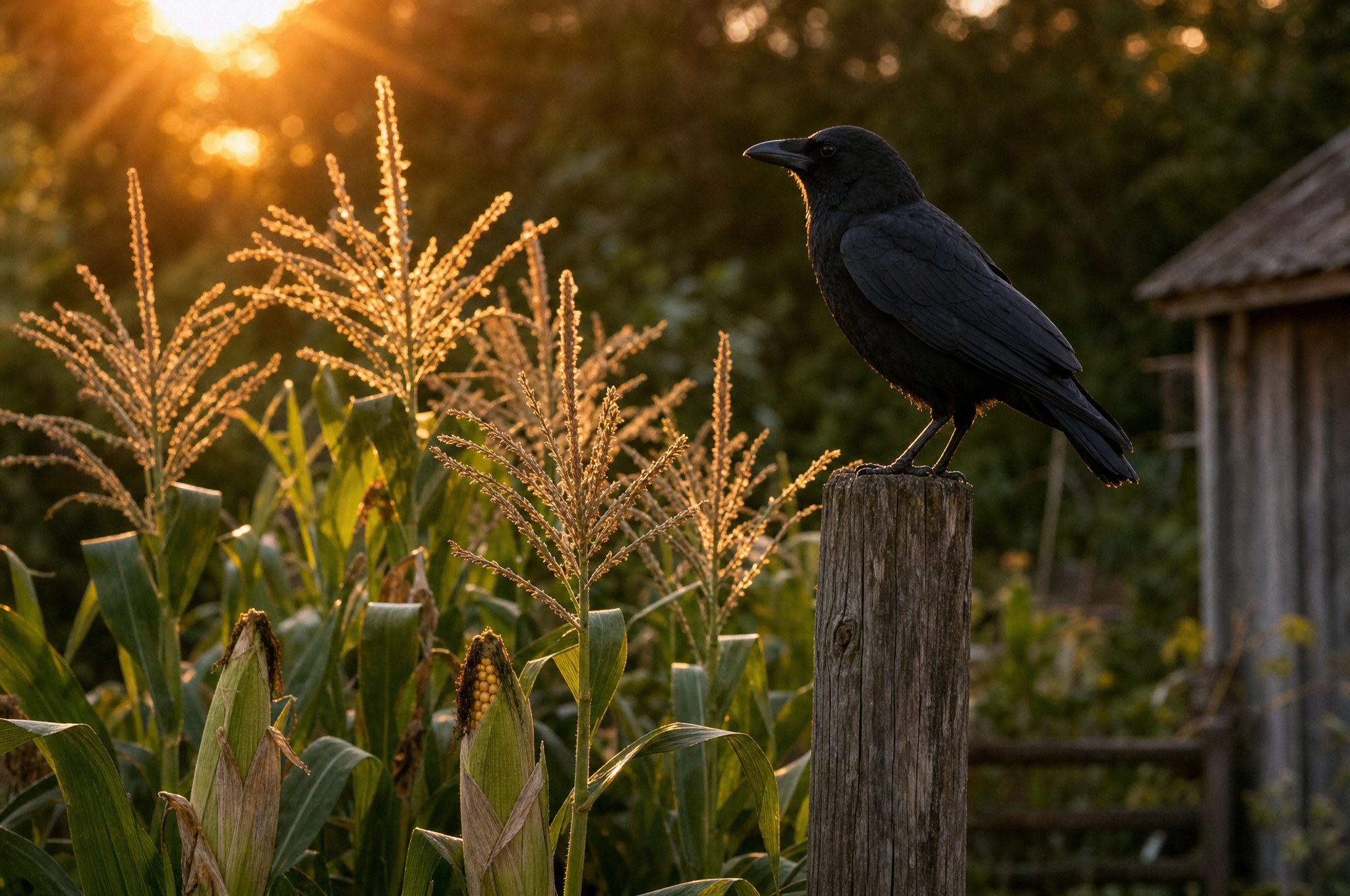

Every garden with a corn patch has staged the same play. A shirt stuffed with straw, a hat nailed to a pole, arms spread against the sky. The whole production exists to frighten one black bird, and the bird stopped attending the show sometime in its first week. Before you rebuild the scarecrow this year, it is worth reading the crow's actual file, because the file has been public for a century and almost nobody has looked.
The charge is old and specific: crows steal corn. Colonial townships put bounties on them, and whole counties once organized shoots on the strength of it. The bird was tried in the court of the farmyard and convicted on the evidence of a few shredded ears in August.
Then somebody finally checked. In the early 1900s, government biologists began opening the stomachs of birds shot on farms, thousands of them, and writing down exactly what was inside. It was grim work and it produced the most honest record we have of what a crow actually does all day.
The summer ledger reads like a pest-control invoice. Grubs, cutworms, armyworms, grasshoppers, and beetle larvae, taken by the hundred, day after day. A crow family raising nestlings works its territory like a route, and nestlings eat almost nothing but insects. Through the weeks when your garden is most vulnerable, the black bird on the fence line is running a protein operation, and the protein is your pest list.
The corn is real. Nobody disputes the corn. A family of crows will find sweet corn in the milk stage a few days before you were planning to pick it, and they will open the tips of more ears than they finish. Call it what the stomach records suggest it is: a service fee. A few ears, billed once a season, against months of daily patrol that no hardware-store deterrent will sell you.
It helps to understand who is billing you. Crows run a family business. Young birds often stay a year or more to help feed the next brood, so the group working your block may be three generations deep, and they hold the same territory season after season. The big one on the wire has likely known your garden longer than you have known some of your neighbors.
She also knows you. In a famous series of experiments in Seattle, researchers wore a rubber mask while trapping and banding crows, then walked campus in the same mask for years afterward. Crows scolded the mask on sight, years later, including birds that had never been trapped. The grudge was taught, parent to fledgling, like a family story. A crow does not remember that a human bothered it. It remembers which one.
This has a practical edge. Harass the family, and you are not a passing nuisance, you are entered in the ledger, and the ledger is long. Leave them alone, or better, and the same memory works for you. Crows that decide a yard is safe treat it as infrastructure and defend the routine that includes it.
Which brings us back to the straw man. Crows habituate to any stationary object within days. They test it, note that it never moves, and file it as furniture. The classic sight of a crow perched on the scarecrow's shoulder is not insolence. It is an accurate risk assessment. Deterrents only work while they are new, which is why the old farm manuals said to move the scarecrow every few days, and why nobody ever did.
If the corn matters to you, protect the corn, not the whole garden. Paper bags slipped over the ripening ears for the last two weeks defeat the crow completely, and the squirrels as a bonus. Plant a few extra feet of row as the fee. Everything else in the garden, the crows are already guarding.
There is also the cleanup division. Crows clear carrion, patrol for the eggs and young of rodents, and run a neighborhood alarm system that every squirrel and songbird understands. When the hawk crosses your yard, the crows announce it first and loudest. You have a security desk on the wire and never once paid it.
So the account balances like this. On one side, some corn, honestly stolen. On the other, a season of insect control, a cleanup crew, an alarm network, and a neighbor that recognizes your face and holds no grudge you did not earn. The scarecrow stands in the middle of it all, arms out, guarding nothing, a monument to a myth. The bird it was built against has been on the payroll the whole time.
